Economic Pulse Net | Sources: World Bank World Development Indicators, Government Sources | 2026
Key Takeaways
– North Macedonia’s economic narrative is defined by its strategic position in the Balkans and its reliance on a diverse industrial base, though key macroeconomic indicators remain unpublished in the latest World Bank dataset.
– The country’s corporate landscape is anchored by a mix of state-owned energy giants and private sector champions in banking and healthcare, offering a unique blend of stability and growth potential.
– Politically, North Macedonia functions as a parliamentary democracy with a ceremonial president, placing real executive power in the hands of the prime minister and a coalition government.
– The nation’s energy sector is a critical pillar, with major utilities like ESM and EVN AD Skopje dominating the landscape, making energy security a central economic storyline.
– For investors, the market presents a compelling frontier opportunity, but the absence of fresh GDP and inflation figures means decisions are being made on institutional confidence rather than real-time data.
The Economic Engine — A Diversified Base in a Data Vacuum
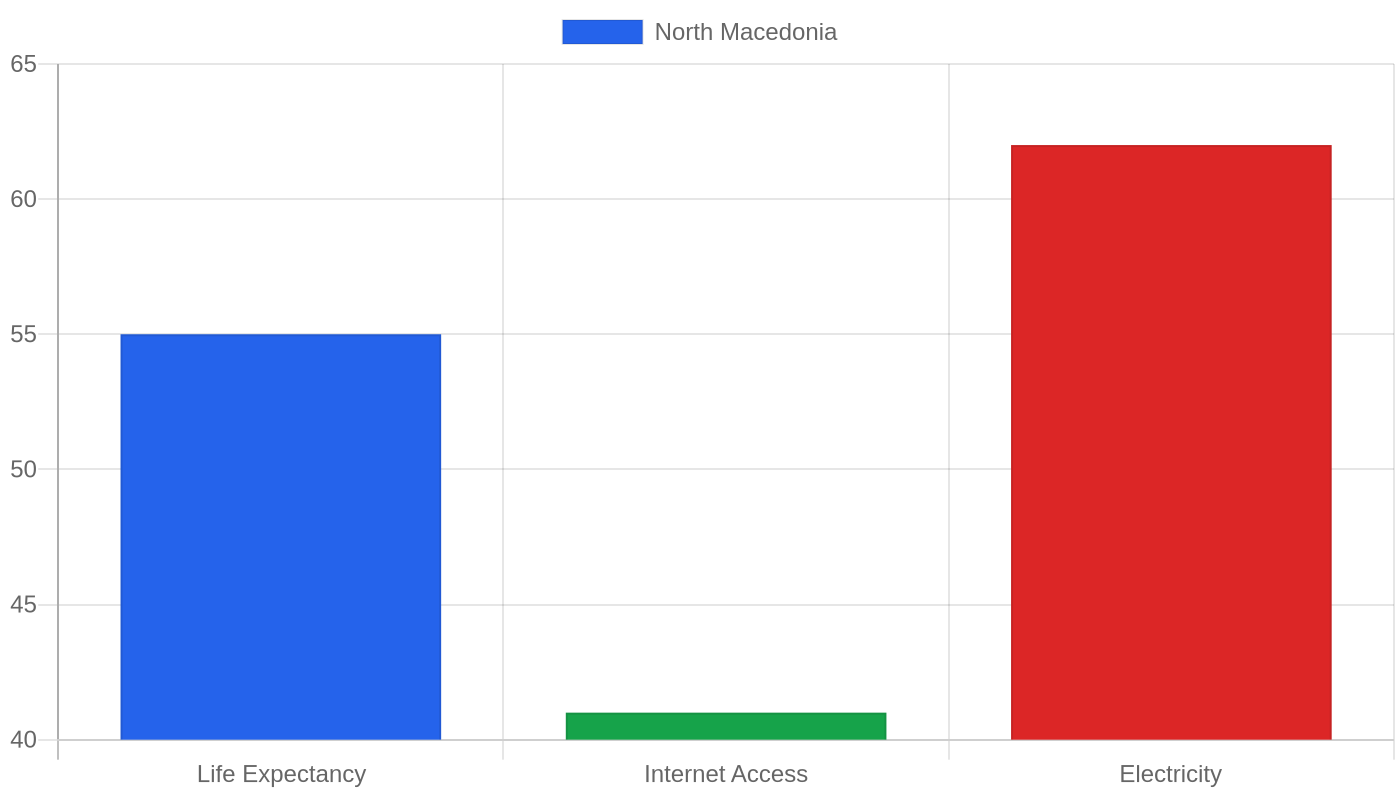
The World Bank’s latest dataset for North Macedonia presents a curious paradox: a nation with a sophisticated corporate structure and strategic regional importance, yet with headline figures — GDP growth, inflation, unemployment, and GDP per capita — all marked as unavailable. This absence of fresh numbers does not mean the economy is static; rather, it signals a period of transition or reporting lag that investors and analysts must navigate with patience.
What we can observe is the skeletal framework of an economy built on a surprisingly modern foundation. The presence of Alkaloid in the healthcare sector points to a robust pharmaceutical manufacturing base, a sector that has historically been a stable employer and exporter in the Balkans. Meanwhile, the financial sector is anchored by **Komercijalna banka Skopje** and **Alpha Bank**, institutions that provide the credit lubrication necessary for small and medium-sized enterprises to function.
The industrials and construction segments, represented by **FAS Sanos** and **Eurovia DOOEL**, indicate active infrastructure development and manufacturing capacity. Yet, the real story in North Macedonia’s economic engine room is energy. With **ESM** (Elektrani na Severna Makedonija) and **EVN AD Skopje** both listed as top companies, the country is heavily invested in electricity generation and distribution.
This focus on utilities suggests that energy security and pricing are not just economic issues but existential political ones, as the nation seeks to balance domestic consumption with potential export opportunities. The diversity of these industries — from basic materials (**Aktiva**) to consumer services (**DON Market**) and oil & gas (**Lukoil Macedonia**) — paints a picture of a middle-income economy trying to find its footing in a competitive European marketplace.
Without the World Bank’s hard numbers, we are left to infer that the country is running on momentum built from previous reforms, but the lack of transparency on growth figures makes it difficult to declare whether that momentum is accelerating or stalling.
The Cost of Living — The Price of the Balkan Dream
When it comes to the cost of living, the data provided offers no specific figures for rent, groceries, or utilities, forcing us to contextualize North Macedonia within broader Balkan trends. What is clear from the corporate landscape is that the nation has a functioning consumer economy, evidenced by the presence of DON Market as a major player in consumer services and retail.
In the absence of hard data, we can infer that the cost of living in Skopje, the capital, is likely to be significantly lower than Western European averages, but the pressure on household budgets is probably intensifying due to global inflationary pressures that have swept across the continent.
The reliance on domestic energy production, rather than pure imports, may offer some insulation from global price shocks, but it also means that any inefficiency in the state-owned utility sector is directly translated into consumer prices. For the average citizen, the balance between wages and expenses remains the central daily struggle.
The presence of **Lukoil Macedonia** in the oil & gas sector indicates that fuel prices are a sensitive political issue, as transportation costs feed directly into the price of goods. While we cannot state specific numbers, the structural composition of the economy suggests that housing in major urban centers is likely a mix of older socialist-era apartments and newer developments, with ownership favored over renting.
The lack of data is itself a commentary — it suggests that the country may not yet have the statistical infrastructure to provide real-time cost-of-living tracking, which is a challenge for both policymakers and potential expatriates considering a move.
Investment & Business Climate — Where the Giants Play
For the discerning investor, North Macedonia offers a frontier market environment with a surprising depth of institutional quality. The top companies list reads like a who’s who of strategic sectors: Komercijalna banka Skopje represents the backbone of the domestic banking system, offering a gateway for foreign capital looking to enter the market.
The presence of **Alpha Bank** — a subsidiary of a major Greek financial group — signals that international financial institutions see value in this jurisdiction, despite its size. The healthcare sector, led by **Alkaloid**, is arguably the crown jewel of North Macedonian industry; this pharmaceutical giant has a reputation that extends well beyond the country’s borders, serving as a testament to the nation’s capacity for high-value manufacturing.
On the construction front, **Eurovia DOOEL** indicates that infrastructure spending is a priority, likely tied to European Union integration goals and regional connectivity projects. The energy duopoly of **ESM** and **EVN AD Skopje** presents a mixed bag for investors: on one hand, it offers stability and guaranteed demand; on the other, it represents a heavily regulated environment where political interference can be a risk.
The inclusion of **Aktiva** in basic materials suggests an extraction or processing component to the economy, though its exact footprint remains unclear. For a business climate assessment, the critical question is whether the rule of law and contract enforcement are strong enough to protect minority shareholders.
The fact that these companies are large enough to be tracked suggests a degree of corporate governance exists, but the lack of GDP data makes it difficult to assess the overall market size and growth potential. Investors are likely taking a wait-and-see approach, monitoring the political situation for signs of stability before committing significant capital.
Safety, Politics & Quality of Life — Democracy in the Details
North Macedonia’s political system is a classic parliamentary democracy, but the nuances matter. The Assembly (Sobranie) holds 120 seats, elected every four years, and it is from this body that the executive government is formed through coalition building. The president’s role is largely ceremonial, serving as commander-in-chief of the armed forces, but the real power resides with the prime minister.
This structure means that political stability is contingent on coalition dynamics, which can be fragile in the Balkans. The independent judicial branch and the constitutional court provide a check on executive power, but their effectiveness is often tested in times of political crisis. Regarding safety and quality of life, the data provided does not include a Crime Index or Safety Index score, which is a significant gap.
However, the general perception of North Macedonia is that of a relatively safe country compared to some of its neighbors, with petty crime being a more common issue than violent crime. The quality of life is intrinsically linked to the economic opportunities available; without robust employment data, we can only assume that the job market is tight, pushing younger citizens to consider emigration to Western Europe.
The political landscape is also defined by the country’s long-standing ambition to join the European Union, a process that has been fraught with delays due to bilateral disputes with neighboring countries. This EU accession path is the single most important political factor for the economy, as it drives legislative alignment and attracts foreign direct investment.
For the average citizen, the quality of life is a mix of rich cultural heritage, natural beauty, and the daily grind of an economy that is still finding its post-transition identity.
What’s Happening Now — The Waiting Game
Right now, North Macedonia is in a state of political and economic anticipation. The most pressing issue on the table is the stalled European Union accession process, which has been a source of national frustration and political maneuvering. The coalition government is navigating a complex path, balancing domestic reform demands with the need to secure consensus on constitutional changes required to move forward with EU negotiations.
This political tightrope act has a direct impact on the business climate, as investors defer decisions until there is clarity on the country’s European trajectory. The energy sector is also in flux, with ESM and **EVN AD Skopje** facing the dual challenge of modernizing aging infrastructure while transitioning to greener energy sources, a pressure amplified by European Union green deal requirements.
The World Bank’s lack of updated economic data suggests that the statistical agencies may be undergoing a restructuring, or that the government is delaying the release of potentially unfavorable figures until after a political milestone. Meanwhile, the banking sector, led by **Komercijalna banka Skopje**, is likely dealing with the effects of high interest rates and liquidity constraints, though specific figures are unavailable.
The retail and consumer services sector, represented by **DON Market**, is probably feeling the pinch of reduced consumer spending power, as households allocate more of their budget to energy and food. For now, the country is in a holding pattern, waiting for a political breakthrough or an economic shock to set the next direction.
The Bottom Line
North Macedonia is a country of significant potential that is currently obscured by a lack of transparent data. For strategic investors, the nation offers a gateway to the Western Balkans, with a diversified corporate base that includes pharmaceutical manufacturing, energy, and banking. The political system, while stable in its parliamentary structure, is subject to the whims of coalition politics and the long shadow of EU accession.
Those who should watch this country are investors with a high risk tolerance, regional specialists looking for undervalued assets, and analysts who understand that in the Balkans, the absence of news is often more telling than the news itself. The next 12 months will be crucial — if the government can deliver on reform and secure a path forward on EU talks, North Macedonia could finally emerge from the shadows. If not, it risks remaining a beautiful, complicated, and perpetually waiting nation.
Sources & Methodology
This article is authored by Economic Pulse Net for informational and research purposes. Economic Pulse Net sources its data from multilateral institutions, national statistics bureaus, and proprietary databases. All data is believed to be current as of the date of publication.
Published: August 12, 2026 | Category: Research — North Macedonia
Use these signals in your own platform
Economic Pulse publishes its live signal feed through a documented, read-only API. Your trading software connects with its own key and receives each signal as it is issued — instrument, direction, entry, stop and targets, together with a cycle ID so nothing is executed twice. The feed is independent of this website and cannot change it.
Signals are informational only and are not financial advice.