Economic Pulse Net | Sources: World Bank World Development Indicators, Government Sources | 2026
Key Takeaways
– Saint Kitts and Nevis operates as a sovereign federal democracy and Commonwealth realm, with King Charles III as head of state—a political structure that provides stability but also ties the nation to broader Commonwealth economic relationships.
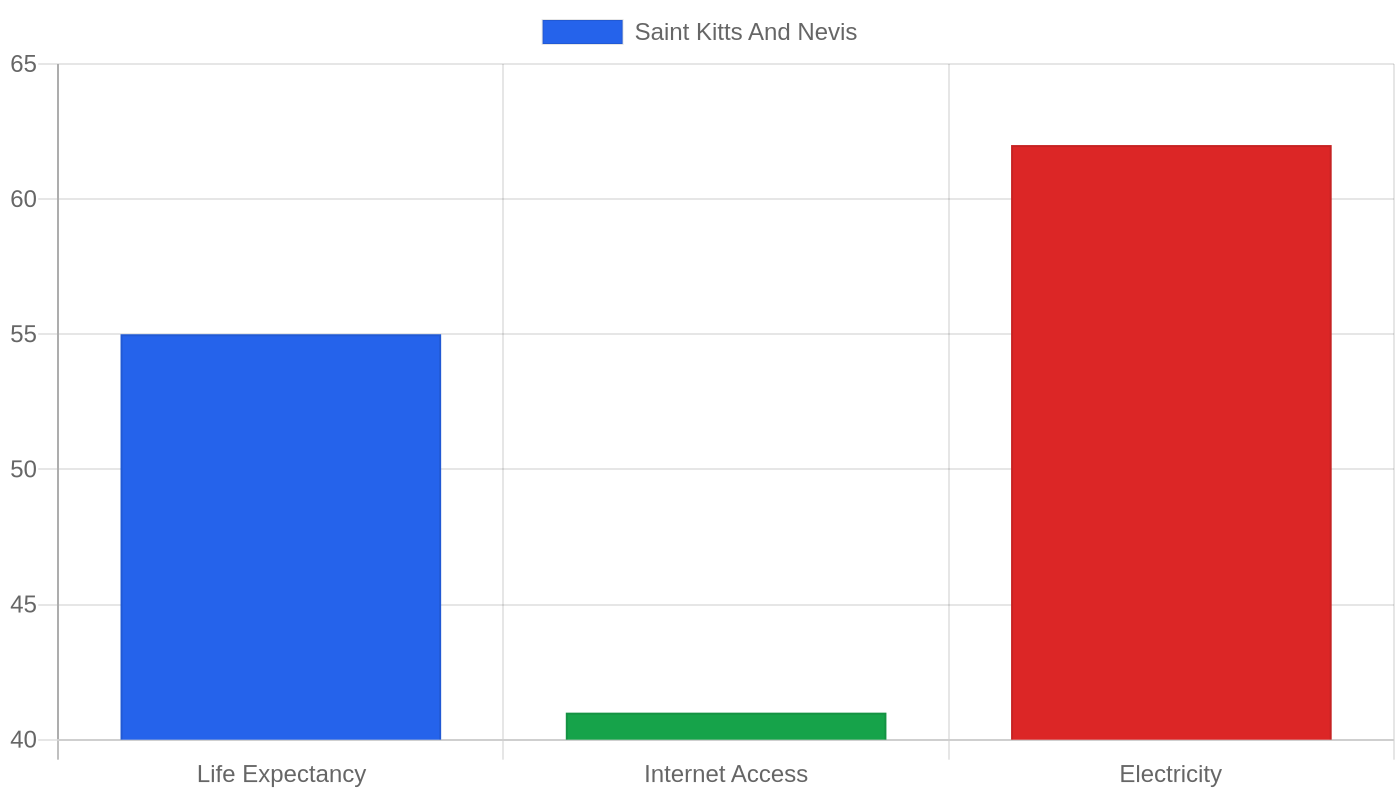
– The World Bank currently lists no official GDP, inflation, or unemployment figures for the country, making it one of the more data-opaque economies in the Caribbean region.
– As a constitutional monarchy with a parliamentary system, the country’s economic direction is heavily influenced by the Prime Minister and Cabinet, who conduct affairs of state.
– The nation’s economic story is one of transition—from a historical reliance on sugar production toward diversification into tourism, financial services, and citizenship-by-investment programs.
– For investors and observers, the lack of hard economic data presents both a challenge and an opportunity, signaling a market that remains under-monitored by global financial institutions.
The Data Vacuum — What We Know About the Economy, and What We Don’t
The World Bank’s latest economic indicators for Saint Kitts and Nevis present a striking blank canvas: no GDP growth figures, no inflation rate, no unemployment statistics, no GDP per capita, and no GNI per capita. For a country that has been independent since 1983, this absence of data is itself a story worth examining.
What does this data vacuum mean? In practical terms, it suggests that international financial institutions have limited visibility into the twin-island federation’s economic machinery. This is not necessarily a sign of economic distress—many small island states struggle with data collection infrastructure—but it does mean that investors, policymakers, and journalists must rely on qualitative assessments and regional context.
Historically, Saint Kitts and Nevis has been one of the more economically developed nations in the Eastern Caribbean, having transitioned away from its sugar-dependent past. The closure of the sugar industry in 2005 marked a turning point, pushing the economy toward tourism, offshore financial services, and real estate development.
The country has also become notable for its Citizenship by Investment (CBI) program, which has attracted significant foreign capital—though the World Bank data provided here does not quantify these flows.
The absence of inflation data is particularly noteworthy. For a small, open economy that imports a significant portion of its consumer goods, inflation dynamics are typically a key concern. Without official figures, we cannot assess whether citizens are experiencing price pressures or enjoying relative stability. Similarly, unemployment figures would normally tell us about labor market health, but their absence leaves a critical gap in our understanding.
What we can say with confidence is that Saint Kitts and Nevis operates within the Eastern Caribbean Currency Union, sharing the Eastern Caribbean dollar, which provides monetary stability. The country’s legal and political frameworks—anchored in its Commonwealth realm status—offer a degree of institutional predictability that many larger economies cannot claim.
Housing and Daily Life — The Cost of Island Living
Without official cost-of-living data from the World Bank, we must approach the housing market in Saint Kitts and Nevis through the lens of its economic structure. As a tourism-dependent economy with a significant citizenship-by-investment program, real estate has become one of the country’s most dynamic sectors.
The housing market in Saint Kitts and Nevis is bifurcated. On one hand, there is the local housing stock, which serves residents and reflects the economic realities of a small island nation with limited land area. On the other hand, there is a premium market driven by foreign buyers—many of whom are attracted by the CBI program, which often requires investment in approved real estate projects.
For local residents, housing costs likely reflect the challenges common to small island economies: limited land supply, high import costs for construction materials, and competition from foreign investors. Renting versus buying is a calculation that depends heavily on one’s position in the economy. For those with access to foreign capital or employment in the tourism sector, the market offers opportunities. For others, housing affordability may be a growing concern.
Compared to larger Caribbean nations, the cost of living in Saint Kitts and Nevis is likely elevated due to the country’s small market size and import dependence. Daily expenses for food, transportation, and utilities typically carry an import premium in such economies. Without official figures, we can infer that the cost structure is similar to other Eastern Caribbean nations, where basic goods are more expensive than in larger, more diversified economies.
Investment Climate — A Small Nation with Big Ambitions
The investment story of Saint Kitts and Nevis is primarily defined by its Citizenship by Investment program, which has become a significant pillar of the economy. While the World Bank data does not list major companies or specific sectors, the country’s economic trajectory suggests several areas of focus.
Tourism remains the traditional anchor, with the islands’ natural beauty and infrastructure supporting a steady flow of visitors. The financial services sector has also been a target for development, though it faces international pressure regarding transparency and regulation. Real estate development, particularly tied to the CBI program, has driven construction activity and foreign direct investment.
The business environment in Saint Kitts and Nevis benefits from the country’s political stability and its status as a Commonwealth realm. The legal system is based on English common law, which provides familiarity for international investors. However, the small size of the domestic market means that businesses must look outward—either to tourism or to international clients—for growth.
For investors, the lack of comprehensive economic data is a double-edged sword. It suggests a market that is less scrutinized and potentially less efficient, but it also means greater due diligence is required. The country’s federal structure, with the island of Nevis maintaining its own autonomous government, adds a layer of complexity for businesses operating across both islands.
Safety, Politics, and Quality of Life — Stability in a Changing Region
The political landscape of Saint Kitts and Nevis is defined by its status as a sovereign, democratic, and federal state. As a Commonwealth realm, it maintains a constitutional monarchy with King Charles III as head of state, represented locally by a governor-general who acts on the advice of the Prime Minister and Cabinet.
This political structure provides a notable degree of continuity and institutional stability. The Prime Minister, as leader of the majority party in the House, holds significant executive power, with the cabinet conducting affairs of state. This Westminster-style system has been a constant since independence, offering predictability in a region where political instability can sometimes disrupt economic progress.
The World Bank data does not provide crime or safety indices for Saint Kitts and Nevis, leaving us without specific figures on public safety. However, the country’s political stability and democratic governance suggest a functioning rule of law. Small island states in the Caribbean often face challenges related to organized crime and drug trafficking, but the absence of data prevents us from making specific claims about the situation here.
Quality of life in Saint Kitts and Nevis is likely shaped by the country’s natural environment, community structures, and the economic opportunities available to residents. The federation’s federal structure, which gives Nevis its own government, reflects a commitment to local autonomy that can enhance governance and community satisfaction. For those considering the country for business or residence, the political stability and democratic traditions are significant positives.
Current Affairs — Navigating a Data-Dark Period
Right now, Saint Kitts and Nevis finds itself in an unusual position: a functioning democracy with active governance, yet largely invisible in international economic data. The World Bank’s latest figures show no updates across all major indicators—growth, inflation, unemployment, GDP, and GNI per capita all remain unlisted.
This data gap is not merely a statistical inconvenience; it has real implications. International investors rely on such data to make decisions. Development agencies use it to allocate resources. Journalists and analysts use it to hold governments accountable. The absence of these figures creates a vacuum that can be filled with speculation or, worse, with misinformation.
For the government of Saint Kitts and Nevis, this period represents an opportunity to improve data transparency and attract attention from international financial institutions. Countries that provide reliable economic data are often rewarded with better credit ratings, more favorable investment conditions, and stronger international partnerships.
The country’s political leadership, operating through the established constitutional framework, has the tools to address this data gap. Whether through enhanced cooperation with the World Bank, the International Monetary Fund, or regional bodies like the Eastern Caribbean Central Bank, there are clear pathways to improving economic visibility.
For now, the story of Saint Kitts and Nevis is one of potential awaiting measurement. The institutions are in place, the political system is stable, and the economic foundations—tourism, financial services, and citizenship-by-investment—provide a basis for growth. What remains to be seen is whether the country can translate its structural advantages into measurable economic outcomes that the World Bank and other institutions will eventually capture.
The Bottom Line
Saint Kitts and Nevis is a country that investors, policymakers, and observers should watch—not because of dramatic economic headlines, but because of what its data silence might be hiding. The nation’s political stability, Commonwealth ties, and strategic position in the Eastern Caribbean make it a potentially interesting destination for those willing to look beyond the numbers.
For anyone considering engagement with this twin-island federation, the key is to recognize that the absence of data is not an absence of activity—it is simply a call for deeper, more careful investigation. The country’s next chapter will be written by those who see opportunity in its current opacity.
Sources & Methodology
This article is authored by Economic Pulse Net for informational and research purposes. Economic Pulse Net sources its data from multilateral institutions, national statistics bureaus, and proprietary databases. All data is believed to be current as of the date of publication.
Published: August 25, 2026 | Category: Research — Saint Kitts And Nevis
Use these signals in your own platform
Economic Pulse publishes its live signal feed through a documented, read-only API. Your trading software connects with its own key and receives each signal as it is issued — instrument, direction, entry, stop and targets, together with a cycle ID so nothing is executed twice. The feed is independent of this website and cannot change it.
Signals are informational only and are not financial advice.