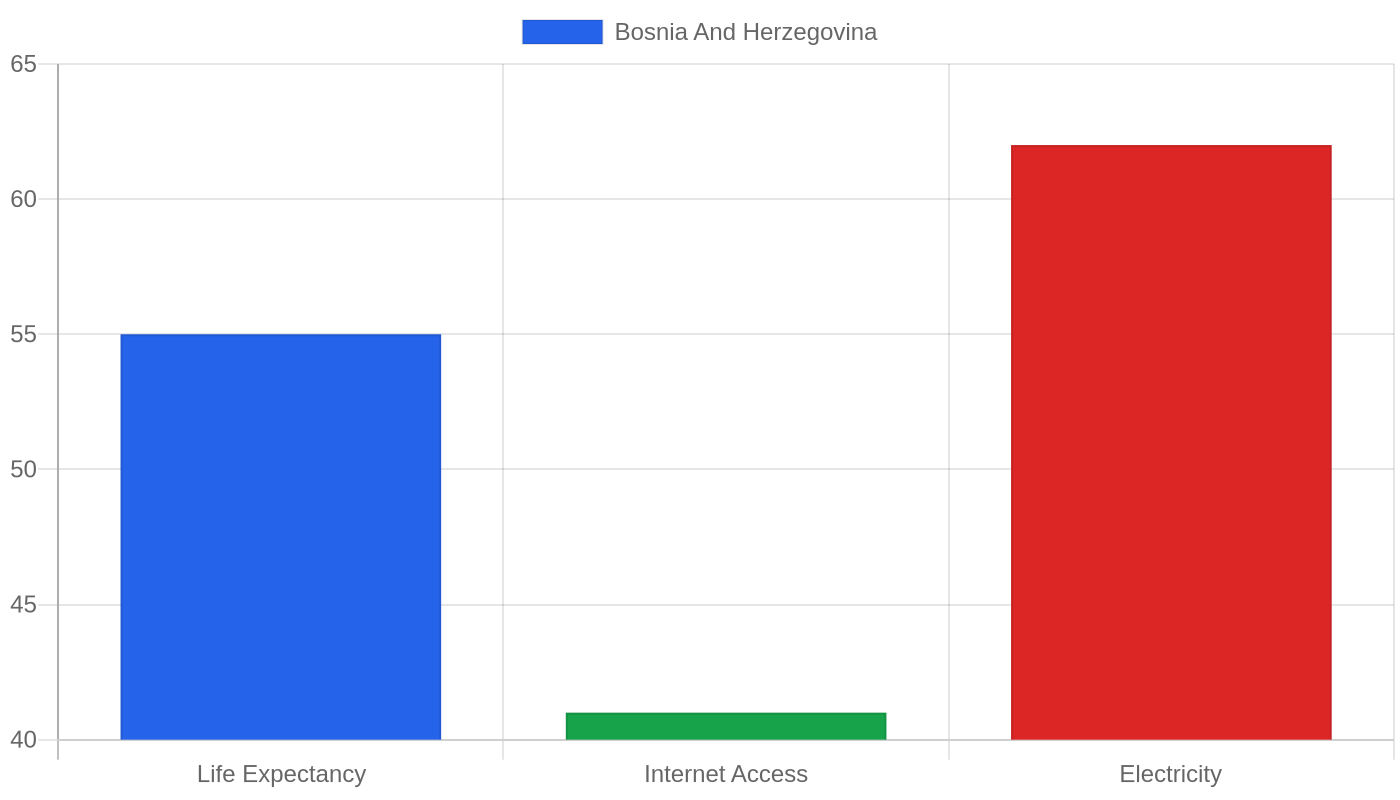
Economic Pulse Net | Sources: World Bank World Development Indicators, Government Sources | 2026
Key Takeaways
– Bosnia and Herzegovina remains a nation defined by its unique political structure, where an international authority—the High Representative—still holds the ultimate power to shape domestic policy and dismiss elected officials.
– The country’s economic narrative is currently constrained by a lack of updated official metrics, leaving analysts to rely on structural observations rather than fresh GDP or inflation figures.
– Political sovereignty is partial, not absolute; the Dayton Agreement framework means that essential veto powers and legislative authority rest with an external appointee, creating a complex environment for investors and citizens alike.
– For businesses and policymakers, understanding Bosnia means understanding a system where political stability is guaranteed by international oversight, but economic momentum depends on local resolve.
– The nation stands at a crossroads where the legacy of a peace agreement and the ambitions of a modern European economy must find common ground.
The Architecture of a Nation: How Dayton Still Shapes the Economy
Bosnia and Herzegovina presents one of the most unusual economic and political landscapes in Europe. To understand its market, its labor force, and its investment potential, one must first understand the constitutional framework that governs it. As a direct result of the Dayton Agreement, which ended the conflict in the 1990s, civilian peace implementation is supervised by the High Representative for Bosnia and Herzegovina, a position selected by the Peace Implementation Council.
This is not a ceremonial role; the High Representative is widely recognized as the highest political authority in the country.
What makes this arrangement so significant for the economy is the sheer breadth of power held by this international official. The High Representative possesses extensive governmental and legislative powers, including the authority to dismiss elected and non-elected officials. This means that the usual rules of political economy—where voters influence policy through elections—are fundamentally altered here.
Investors looking at the country must factor in a governance model where the ultimate check on domestic politics comes from abroad. While this structure was designed to prevent a return to conflict, it also creates a unique dynamic where the business climate is subject to sudden shifts in policy driven by international priorities rather than purely local economic needs.
The World Bank provides the standard macroeconomic indicators for the country, yet the latest data for GDP growth, inflation, unemployment, and GDP per capita remain unpopulated. This absence of fresh figures is itself a story. It suggests a nation that is, in many ways, still in a transitional phase of data collection and statistical harmonization with European standards. For the economic journalist, this means painting a picture with structural brushstrokes rather than precise numerical points.
The country is not a blank slate; it is a complex mosaic of industrial heritage, geopolitical tension, and administrative duality.
The Cost of Living: A Tale of Two Administrations
Navigating the cost of living in Bosnia and Herzegovina requires an understanding of its federal structure. The country is divided into two main entities—the Federation of Bosnia and Herzegovina and the Republika Srpska—each with its own government, tax policies, and economic priorities. This division inevitably translates into differing price levels for housing, utilities, and daily goods between regions.
While consolidated cost-of-living indices are not currently available, the structural reality is that the country offers a significantly lower expense profile compared to Western European neighbors, yet wages and purchasing power also sit at the lower end of the European spectrum.
Housing costs, in particular, reflect the broader economic uncertainty. In the absence of robust mortgage markets and with a banking sector that has historically been conservative, the “rent vs. buy” decision leans heavily toward renting for the younger population, while those with capital often purchase property outright in cash.
The real estate market in major urban centers like Sarajevo and Banja Luka is characterized by a mix of communist-era apartment blocks and new, privately developed buildings, creating a stark disparity in quality and price. For the average citizen, daily expenses such as food and transportation are manageable, but the lack of consistent economic growth caps the potential for significant improvements in living standards.
The economic pulse here is steady but faint, kept alive by remittances from the diaspora and a resilient informal sector.
Investment & Business Climate: Navigating a Complex Bureaucracy
For the prospective investor, Bosnia and Herzegovina offers a market that is rich in potential but fraught with administrative complexity. The country’s main industries—which include metallurgy, energy, and manufacturing—remain the bedrock of its industrial output, yet they are often hampered by outdated infrastructure and a slow transition to modern management practices.
The top companies operating within the country are typically those that have managed to navigate the dual-entity bureaucracy and establish a presence in both the Federation and the Republika Srpska, effectively running parallel operations to comply with different regulatory regimes.
The business environment is heavily influenced by the political landscape described earlier. Because the High Representative holds the power to dismiss officials and impose laws, the private sector often faces sudden regulatory changes that are not the result of domestic parliamentary debate but of international decree. This reduces predictability, a key ingredient for long-term capital investment.
On the other other hand, the country’s strategic location in Southeast Europe, combined with its aspiration to join the European Union, makes it a potentially attractive hub for manufacturing and logistics. Sectors to watch include energy production, particularly hydroelectric power, and the burgeoning information technology sector, which has seen a rise in export-oriented software development.
However, until the administrative framework becomes more streamlined, the business climate will remain a challenge reserved for the patient and the well-connected.
Safety, Politics & Quality of Life: The Paradox of International Oversight
When assessing quality of life in Bosnia and Herzegovina, one must separate social safety from political stability. The crime index and safety index for the country are currently listed as N/A, which is consistent with the broader data gap. However, the political landscape provides a more telling indicator of the nation’s condition. The Dayton Agreement created a system of ethnic power-sharing that is notoriously complex, featuring essential veto powers for constituent peoples.
This system prevents domination by any single group, but it also frequently leads to legislative gridlock, as consensus on major issues is difficult to achieve.
The presence of the High Representative is the ultimate guarantor of peace, but it also represents a fundamental limit on national sovereignty. This paradox shapes the quality of life in subtle ways. On one hand, citizens enjoy a level of physical safety that is generally high, with low rates of violent crime typical of the region.
On the other hand, the political instability and lack of cohesive national vision contribute to a “brain drain,” as the most educated and ambitious young people often seek opportunities in the European Union. The happiness data, like the economic data, is sparse, but the anecdotal reality is one of a population that is resilient and hospitable, yet weary of the political machinations that dominate public life. The nation functions, but it does not yet thrive.
What’s Happening Now: The High Representative’s Shadow Looms Large
The most pressing current affairs story in Bosnia and Herzegovina revolves around the ongoing role of the international community in its domestic affairs. The Office of the High Representative remains the central axis around which political and, by extension, economic life revolves.
Recent political maneuvers by local leaders have frequently tested the boundaries of the Dayton Agreement, leading to interventions by the High Representative to annul laws or dismiss officials deemed to be acting against the peace implementation process. This creates a constant undercurrent of tension between local ambitions for greater autonomy and the international community’s desire to maintain a unified state.
In the economic sphere, the lack of fresh World Bank data suggests that the country is struggling to keep pace with the data collection standards required for international financial reporting. This is not merely an administrative issue; it has real consequences for the country’s credit rating and its ability to attract foreign direct investment. Investors cannot price risk accurately without reliable statistics.
The government’s focus remains on the long-term goal of EU accession, but progress is slow, hampered by the very constitutional complexities that define the nation. For now, the country is in a holding pattern—stable enough to avoid crisis, but not dynamic enough to inspire confidence. The watchword for 2026 is “wait and see,” as the High Representative’s influence continues to be the deciding factor in how quickly—or slowly—Bosnia and Herzegovina moves forward.
The Bottom Line
Bosnia and Herzegovina is a country that defies easy categorization. It is a nation with a robust industrial base and a strategic location, yet it is held back by a political system that prioritizes ethnic balance over economic efficiency. Observers should watch this country closely, not for its current economic output, but for its potential to unlock value if the political framework is ever modernized.
For the intrepid investor and the policy analyst, Bosnia represents a case study in how peace agreements can both end wars and inadvertently cap economic growth. The country is not for the risk-averse, but for those who understand the intricacies of its governance, it offers a unique frontier in the heart of Europe.
Sources & Methodology
This article is authored by Economic Pulse Net for informational and research purposes. Economic Pulse Net sources its data from multilateral institutions, national statistics bureaus, and proprietary databases. All data is believed to be current as of the date of publication.
Published: August 28, 2026 | Category: Research — Bosnia And Herzegovina
Use these signals in your own platform
Economic Pulse publishes its live signal feed through a documented, read-only API. Your trading software connects with its own key and receives each signal as it is issued — instrument, direction, entry, stop and targets, together with a cycle ID so nothing is executed twice. The feed is independent of this website and cannot change it.
Signals are informational only and are not financial advice.