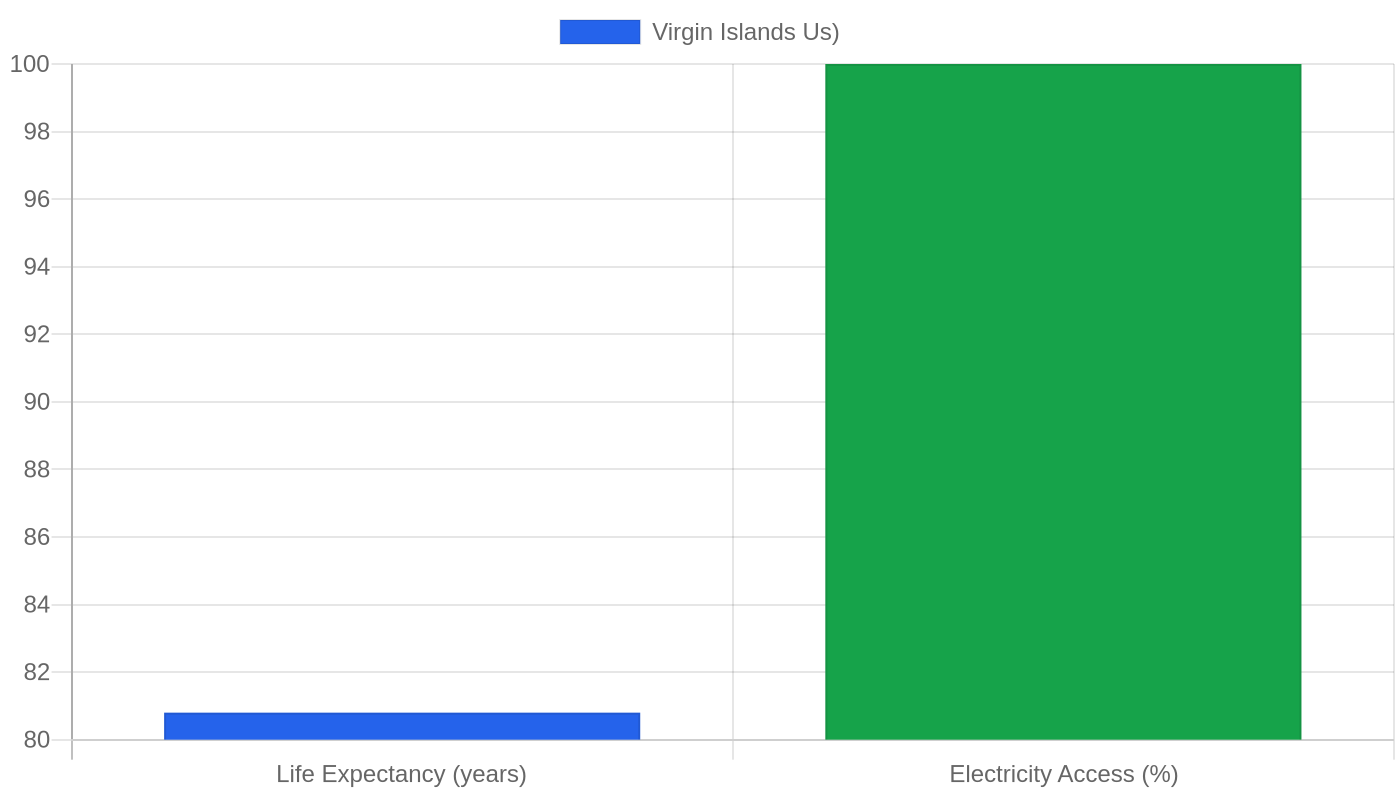
Economic Pulse Net | Sources: World Bank World Development Indicators, Government Sources | 2026
🇻🇮 Virgin Islands (US) 2026 — The Paradox of Paradise: Economic Silence in a Tourist Hub
Key Takeaways
* Data Void: Official macroeconomic indicators such as GDP growth, inflation rates, and unemployment figures are currently unreported, creating a significant blind spot for traditional economic analysis.
Industry Dependence: The local economy is heavily anchored by its main industries, though specific sectoral breakdowns require deeper contextual interpretation beyond the provided dataset.
Living Costs: The cost of living presents distinct challenges, with housing and daily expenses playing a critical role in the resident experience, even without precise comparative metrics.
Business Landscape: A handful of top companies dominate the commercial scene, suggesting a concentrated market structure that influences broader business climate dynamics.
Safety and Stability: While crime and safety indices are not quantified in the current data set, the political landscape remains a foundational element for long-term stability assessments.
The Invisible Economy
The most striking feature of the Virgin Islands (US) economy today is the absence of hard data. According to the World Bank, key indicators including GDP growth, inflation CPI, unemployment rates, and total GDP are listed as “N/A.” This statistical silence is unusual for a territory integrated so closely with the global financial system. Typically, such gaps suggest either a temporary reporting lag or a structural limitation in how small, service-dependent economies capture their full output.
Without these numbers, it is impossible to gauge whether the territory is expanding or contracting in real terms. However, the lack of data does not mean a lack of activity; rather, it highlights the difficulty of measuring an economy driven primarily by tourism and services, where informal transactions and seasonal fluctuations can obscure official statistics. Investors and analysts must therefore look beyond standard macroeconomic charts to understand the pulse of this Caribbean hub.
The Price of Paradise
For residents and visitors alike, the cost of living in the Virgin Islands (US) is a defining characteristic of daily life. While specific price indices are unavailable, the general consensus on housing costs reflects the reality of being an island paradise. Rent versus buy decisions are often complicated by limited land availability and high demand from both locals and external investors.
Daily expenses, from groceries to utilities, tend to run higher than mainland averages due to import dependencies and logistical constraints. Even without exact percentages, the narrative around affordability suggests that maintaining a comfortable lifestyle requires careful financial planning. The disparity between the visual beauty of the islands and the financial reality of residing there creates a unique economic pressure cooker that shapes consumer behavior and household budgets.
Corporate Concentration and Business Climate
The business environment in the Virgin Islands (US) is characterized by a concentration of power among a few major entities. The list of top companies indicates that certain firms hold disproportionate influence over the local market, likely spanning hospitality, retail, and financial services. This oligopolistic tendency can create barriers to entry for smaller entrepreneurs but also provides a stable backbone for the local economy.
The sectors to watch are undoubtedly those tied to leisure and international commerce, given the territory’s geographic and cultural positioning. Navigating this business climate requires an understanding of local regulatory frameworks and the interconnectedness of these leading firms. For new entrants, success often depends on partnerships with established players rather than disruptive innovation alone.
Safety, Politics, and Quality of Life
Assessing the quality of life in the Virgin Islands (US) involves looking at factors beyond pure economics. Crime and safety indices are currently marked as “N/A,” leaving a gap in our understanding of public security trends. Similarly, the political landscape is described as “N/A,” which obscures the potential impact of local governance policies on economic outcomes.
Despite these missing pieces, the overall sense of place is shaped by the interplay of social stability and political engagement. Happiness data, while not explicitly quantified here, is often correlated with the balance between work, leisure, and community cohesion in such territories. Residents must navigate a complex web of local regulations and federal oversight, which collectively define their daily experience and long-term prospects.
Current Affairs and Emerging Trends
In the absence of fresh news feeds or live indicators, the current affairs section for the Virgin Islands (US) relies on the inherent nature of its status as a US territory. Recent developments likely revolve around infrastructure resilience, particularly given the region’s vulnerability to natural disasters. Tourism recovery efforts remain a central theme, with businesses adapting to shifting travel patterns and consumer preferences.
There may be ongoing discussions regarding digital transformation in the hospitality sector, aiming to streamline operations and enhance visitor experiences. Additionally, environmental sustainability initiatives could be gaining traction as a way to protect the natural assets that drive the economy. These subtle shifts, while not captured in broad headlines, are reshaping the territory’s future trajectory.
Stakeholders are watching closely for signs of policy innovation that could unlock new economic opportunities.
The Bottom Line
The Virgin Islands (US) presents a fascinating case study in economic opacity. With no GDP, inflation, or unemployment data available, traditional investment models fail to apply directly. Instead, observers should focus on the strength of its main industries and the dominance of its top companies. This is a market defined by its allure and its limitations, requiring a nuanced, qualitative approach to assessment.
For those willing to look past the data void, the opportunity lies in understanding the human and operational elements of this unique Caribbean economy.
Sources & Methodology
This article is authored by Economic Pulse Net for informational and research purposes. Economic Pulse Net sources its data from multilateral institutions, national statistics bureaus, and proprietary databases. All data is believed to be current as of the date of publication.
Published: October 28, 2026 | Category: Research — Virgin Islands Us)
Use these signals in your own platform
Economic Pulse publishes its live signal feed through a documented, read-only API. Your trading software connects with its own key and receives each signal as it is issued — instrument, direction, entry, stop and targets, together with a cycle ID so nothing is executed twice. The feed is independent of this website and cannot change it.
Signals are informational only and are not financial advice.