Economic Pulse Net | Sources: World Bank World Development Indicators, Government Sources | 2026
Key Takeaways
* Political Polarization: The nation is defined by a sharp divide between the incumbent United Socialist Party of Venezuela (PSUV) bloc and the opposition-led Mesa de la Unidad Democrática coalition, shaping all policy directions.
Corporate Concentration: Key economic players are heavily concentrated in consumer services and goods, with major entities like Alimentos Polar and Alcasa driving daily commerce.
Data Gaps: Official macroeconomic indicators such as GDP growth, inflation, and unemployment figures are currently reported as unavailable, creating a blind spot for traditional investors.
Service-Heavy Economy: The top listed companies suggest a market where logistics, aviation, and basic consumer necessities remain central to business activity despite broader economic uncertainties.
Economic Structure: A View Through the Fog
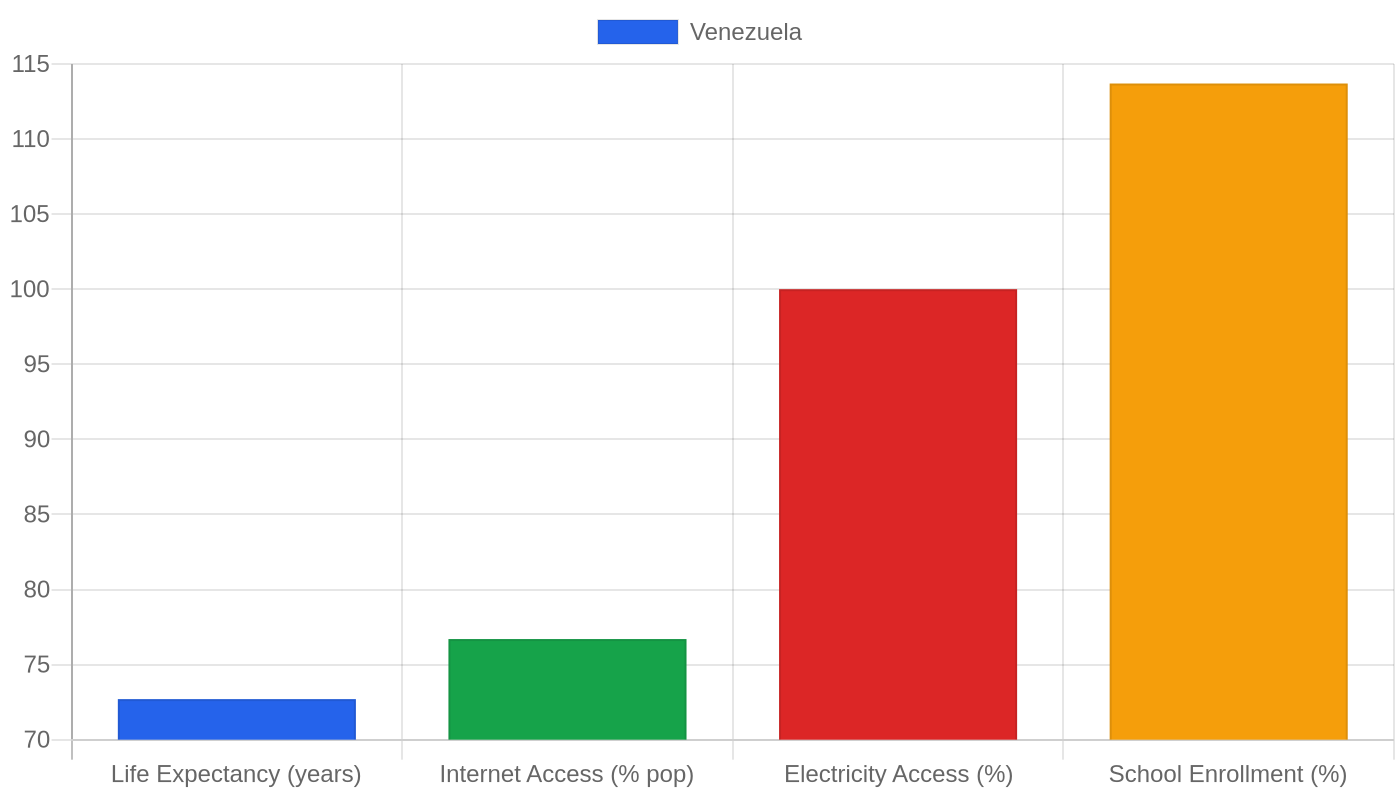
Understanding the current economic state of Venezuela requires navigating a landscape where traditional metrics have largely vanished from public reporting. According to the World Bank, critical data points including GDP growth, inflation CPI, unemployment rates, and total GDP in USD are marked as “N/A” or unavailable. This absence of official statistical transparency makes it difficult to assess the true velocity of the economy or the purchasing power of the population through standard lenses.
Without concrete figures on GDP per capita or Gross National Income, analysts cannot rely on historical trends to predict short-term volatility, leaving the economic health of the country shrouded in ambiguity. However, the structure of the corporate sector offers a glimpse into where value is being generated today.
The presence of major firms in basic materials and consumer goods indicates that foundational industries continue to operate, even if their financial outputs are not publicly aggregated into national accounts. For international observers, this lack of data is itself a significant risk factor, suggesting that any investment or trade decision must be based on ground-level observation rather than macroeconomic modeling.
The invisibility of these numbers implies a disconnect between formal economic reporting and the actual day-to-day commercial activities occurring within the borders.
Daily Expenses and Living Costs
For residents and expatriates alike, the cost of living in Venezuela remains a complex variable that defies simple regional comparison due to the lack of standardized housing and rental data. While specific indices for crime and safety are also listed as unavailable, the daily reality of living in the country is dictated by the availability of essential goods and services.
The prominence of companies like Alcasa, which operates in the basic materials sector, suggests that access to fundamental commodities is a primary driver of household budgets. Similarly, the existence of numerous consumer service providers, including various aviation and news agencies, indicates that while some sectors may be active, the affordability of these services for the average citizen is likely strained.
Without clear data on rent versus buy ratios or inflation-adjusted prices, estimating the cost of daily life requires relying on anecdotal evidence and local market dynamics rather than official price baskets. This uncertainty often leads to a dual-economy experience, where those with access to foreign currency or informal networks can secure better quality of life, while others face scarcity.
The lack of transparent cost-of-living metrics means that families must navigate expenses with limited visibility, making financial planning an exercise in adaptation rather than calculation.
Investment & Business Climate: Who Runs the Market?
The business environment in Venezuela is characterized by a distinct set of major players that dominate the consumer services and goods sectors. An analysis of the top companies reveals a landscape where established brands hold significant sway over daily commerce. Entities such as Alimentos Polar and Alimentos La Giralda control substantial portions of the food and beverage market, serving as critical infrastructure for the population’s nutritional needs.
In the services sector, the presence of multiple aviation and transport companies—including Aeropostal Alas de Venezuela, Aserca Airlines, Aero Ejecutivos, and Aeroexpresos Ejecutivos—highlights the importance of connectivity and logistics, albeit potentially constrained by broader economic challenges. Additionally, media outlets like Agencia Venezolana de Noticias and Asamblea Nacional Televisión play a role in information dissemination, reflecting the intersection of commerce and public discourse.
For investors, these companies represent the most visible nodes of economic activity, yet their performance is heavily influenced by the political climate and regulatory framework. The concentration of key enterprises in consumer-facing roles suggests that businesses focused on essential goods and services may find more stability than those in speculative or luxury markets.
Understanding the operational constraints and opportunities within these specific firms is crucial for anyone looking to engage with the Venezuelan market.
Safety, Politics & Quality of Life: Navigating Division
The social fabric of Venezuela is deeply intertwined with its intense political polarization, which directly impacts safety perceptions and quality of life. The political landscape is split between two major blocs: the incumbent leftist alliance comprising the United Socialist Party of Venezuela (PSUV), Fatherland for All (PPT), and the Communist Party of Venezuela (PCV); and the opposition bloc organized under the Mesa de la Unidad Democrática electoral coalition.
This opposition group includes A New Era (UNT) alongside allies such as Project Venezuela, Justice First, and Movement for Socialism (MAS). This binary division often translates into social tension, although specific crime and safety indices are currently listed as unavailable, making precise risk assessment difficult. The absence of official safety data does not negate the lived experiences of citizens who must navigate a complex security environment shaped by these political fault lines.
Quality of life is further complicated by the lack of comprehensive happiness or well-being metrics, leaving individuals to rely on personal networks and community support systems. For those living or working in the country, understanding the political allegiances of local institutions and businesses is essential for maintaining safety and operational continuity.
The ongoing ideological struggle between the PSUV bloc and the Mesa de la Unidad Democrática creates a dynamic where loyalty and affiliation can significantly influence access to resources and services.
Current Affairs: The Pulse of Political Realignment
At present, the most defining feature of Venezuela’s current affairs is the continued friction between the ruling party and the opposition coalition. The political scene remains dominated by the standoff between the United Socialist Party of Venezuela (PSUV) and its allies, including the Communist Party of Venezuela (PCV), and the diverse array of parties within the Mesa de la Unidad Democrática.
Recent developments continue to center on electoral strategies and governance models, with each bloc vying for legitimacy and control over state resources. The inclusion of groups like Justice First and Movement for Socialism (MAS) in the opposition framework highlights the breadth of dissent against the incumbent administration. Meanwhile, the PSUV maintains its grip on power through alliances with Fatherland for All (PPT), ensuring a unified front in legislative and executive matters.
This political stalemate has direct implications for economic policy, as reforms are often viewed through the lens of partisan ideology rather than technical necessity. Businesses operating in this environment must remain agile, adapting to sudden shifts in regulation or enforcement that may result from political maneuvering.
The lack of new economic data releases suggests that the government is prioritizing political consolidation over statistical transparency, keeping the global community guessing about the true state of the economy.
The Bottom Line
Venezuela presents a unique case study for economists and journalists: a nation where the political narrative is loud and clear, but the economic data is silent. Investors and researchers should watch this country closely, not for its GDP figures, but for the resilience of its key consumer brands and the evolving dynamics between the PSUV and the opposition coalition.
The absence of reliable statistics means that traditional valuation methods will fail; instead, success depends on deep local knowledge and an understanding of the corporate players like Alimentos Polar and Alcasa. Ultimately, Venezuela remains a high-risk, high-complexity environment where political alignment often dictates economic opportunity.
Sources & Methodology
This article is authored by Economic Pulse Net for informational and research purposes. Economic Pulse Net sources its data from multilateral institutions, national statistics bureaus, and proprietary databases. All data is believed to be current as of the date of publication.
Published: September 24, 2026 | Category: Research — Venezuela
Use these signals in your own platform
Economic Pulse publishes its live signal feed through a documented, read-only API. Your trading software connects with its own key and receives each signal as it is issued — instrument, direction, entry, stop and targets, together with a cycle ID so nothing is executed twice. The feed is independent of this website and cannot change it.
Signals are informational only and are not financial advice.