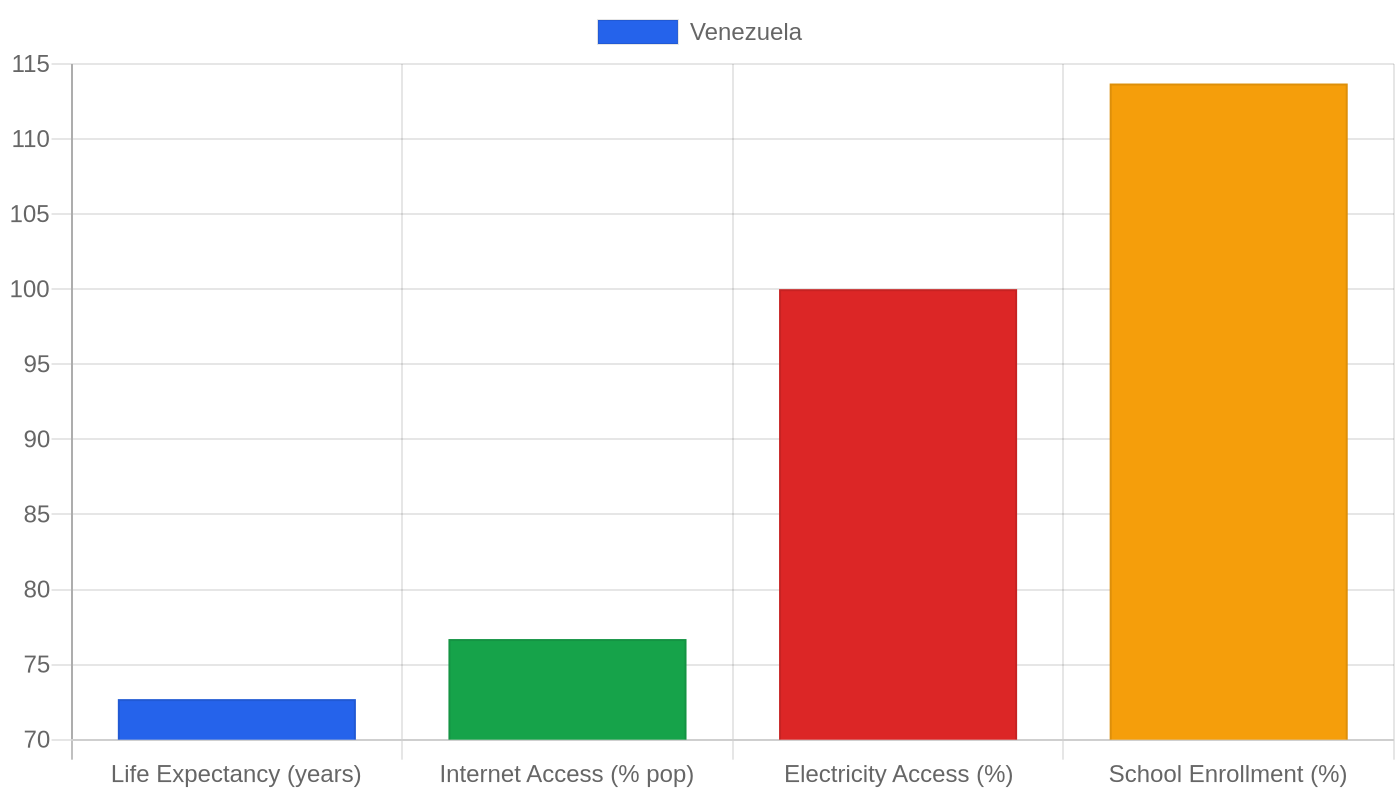
Economic Pulse Net | Sources: World Bank World Development Indicators, Government Sources | 2026
Key Takeaways
* Data Vacuum: Official economic indicators such as GDP growth, inflation, and unemployment are currently unreported by the World Bank, creating a significant blind spot for international investors and analysts.
Consumer-Centric Corporate Landscape: The most prominent listed entities operate within consumer services and basic materials, highlighting a domestic focus on essential goods and local mobility rather than heavy industrial export.
Deep Political Polarization: The nation remains sharply divided between the incumbent leftist bloc led by the United Socialist Party of Venezuela (PSUV) and a fragmented opposition coalition known as the Mesa de la Unidad Democrática.
Safety Uncertainty: With crime and safety indices marked as N/A, the security environment remains opaque, complicating risk assessments for both expatriates and foreign direct investment.
Economic Stagnation in the Dark
The Venezuelan economy presents a unique challenge to global observers: it is an entity where the absence of data is itself a critical data point. According to the latest reports from the World Bank, key macroeconomic metrics including GDP growth, Consumer Price Index (CPI) inflation, and unemployment rates are listed as “N/A.” This lack of transparency suggests that either official statistical mechanisms have been suspended or that the volatility of the economy renders standard quarterly reporting impossible.
Without concrete figures on GDP per capita or Gross National Income (GNI), it is difficult to gauge the precise depth of the contraction or the pace of any potential recovery. However, the mere existence of this data gap signals a severe disconnect between the state and international financial institutions. When a country cannot provide its own economic health report, it implies a systemic failure in governance or a deliberate obfuscation of reality.
For economists, this void forces reliance on anecdotal evidence and informal market prices rather than structured national accounts. The implication is clear: Venezuela’s economic narrative is being written in silence, leaving stakeholders to navigate without a reliable compass.
The High Cost of Invisible Prices
While specific housing costs and rent-to-buy ratios are not quantified in the provided datasets, the structure of the available corporate data offers a window into daily expenses. The prominence of companies like Alimentos Polar and Alimentos La Giralda indicates that food production remains a central pillar of the cost-of-living equation for the average citizen. In economies where official inflation data is missing, the price of these staple consumer goods often becomes the primary barometer of purchasing power.
Furthermore, the presence of multiple aviation and transport firms, such as Aero Ejecutivos and Aserca Airlines, suggests that mobility costs are a significant component of household budgets. If these services are operating at all, they likely cater to a niche market, implying that general transportation may be expensive or unreliable for the broader population.
Without regional comparison averages, we must infer that the cost of living is driven by scarcity and logistical challenges rather than competitive market forces. Daily expenses are thus likely dictated by availability more than by stable pricing mechanisms.
Investment & Business Climate
The business landscape in Venezuela is heavily skewed toward domestic consumption and service provision, with very few large-scale industrial or technological conglomerates visible in the current corporate registry. The top companies are dominated by the consumer services sector, including Aeropostal Alas de Venezuela and Agencia Venezolana de Noticias, which points to a market focused on internal connectivity and information dissemination.
In the realm of tangible goods, Alcasa represents the basic materials sector, while Alimentos Polar and Alimentos La Giralda anchor the consumer goods industry. This concentration suggests that investment opportunities are largely confined to sectors that serve immediate local needs rather than export-oriented manufacturing. For foreign investors, the lack of diverse industrial giants means there are fewer established partners for joint ventures outside of the resource or utility sectors.
The business environment appears to prioritize survival and local distribution over expansion. Consequently, the corporate ecosystem reflects a constrained economy where agility and local supply chain management are more valuable than scale.
Safety, Politics & Quality of Life
The social fabric of Venezuela is currently underpinned by intense political polarization and undefined security metrics. The political landscape is rigidly split between two major blocs: the incumbent leftist alliance comprising the United Socialist Party of Venezuela (PSUV), Fatherland for All (PPT), and the Communist Party of Venezuela (PCV); and the opposition grouped under the electoral coalition Mesa de la Unidad Democrática.
This opposition block includes diverse parties such as A New Era (UNT), Project Venezuela, Justice First, and Movement for Socialism (MAS). Such deep ideological divides create a volatile policy environment where government stability is frequently questioned. Compounding this political tension is the complete lack of data regarding crime and safety indices. With both Crime Index and Safety Index marked as N/A, it is impossible to quantify the level of personal risk for residents or visitors.
This opacity extends to quality of life metrics, leaving happiness and well-being data absent from official records. The combination of political strife and security uncertainty creates a high-risk atmosphere for long-term settlement.
What’s Happening Now / Current Affairs
Currently, the defining characteristic of Venezuela’s news cycle is the ongoing struggle between the ruling PSUV bloc and the unified opposition coalition. The political battle lines are firmly drawn, with the PSUV leveraging state resources against the coordinated efforts of the Mesa de la Unidad Democrática. While no recent legislative reforms or election dates are specified in the provided text, the persistence of this two-bloc structure indicates that political negotiation remains deadlocked.
The operational status of companies like Aserca Airlines and Aeropostal Alas de Venezuela serves as a live indicator of whether the state can maintain even basic infrastructure services amidst this turmoil. The fact that consumer goods producers like Alimentos Polar remain active suggests that despite political chaos, the demand for basic sustenance continues to drive economic activity. However, without updated inflation or employment data, it is unclear if these companies are thriving or merely surviving.
The current affairs landscape is thus one of static conflict, where the status quo is maintained through force rather than consensus. Investors and diplomats alike are watching for any shift in this equilibrium, as even minor changes could trigger significant market reactions.
The Bottom Line
Venezuela remains a high-risk, low-transparency jurisdiction that requires extreme caution from all external stakeholders. The absence of core economic data from the World Bank makes traditional financial analysis impossible, forcing reliance on qualitative political and corporate indicators. The deep polarization between the PSUV and the opposition ensures that policy shifts will remain unpredictable and potentially disruptive.
Only those with a specialized interest in emerging markets or humanitarian contexts should consider engaging with the Venezuelan economy at this time.
Sources & Methodology
This article is authored by Economic Pulse Net for informational and research purposes. Economic Pulse Net sources its data from multilateral institutions, national statistics bureaus, and proprietary databases. All data is believed to be current as of the date of publication.
Published: October 26, 2026 | Category: Research — Venezuela
Use these signals in your own platform
Economic Pulse publishes its live signal feed through a documented, read-only API. Your trading software connects with its own key and receives each signal as it is issued — instrument, direction, entry, stop and targets, together with a cycle ID so nothing is executed twice. The feed is independent of this website and cannot change it.
Signals are informational only and are not financial advice.