Economic Pulse Net | Sources: World Bank World Development Indicators, Government Sources | 2026
Key Takeaways
– Suriname operates as a representative democratic republic under its 1987 Constitution, but economic data gaps make it difficult to assess the true health of the nation’s finances.
– The country’s political system features a 51-member unicameral National Assembly elected every five years, providing a stable framework for governance amid regional volatility.
– Suriname’s corporate landscape is dominated by media, financial services, and aviation companies, suggesting a services-oriented economy with limited industrial diversification.
– Despite a functioning democratic structure, the absence of recent World Bank economic indicators raises questions about transparency and data reporting in the nation.
– Investors and analysts should watch Suriname for its political stability in a turbulent region, but must navigate a significant information vacuum when assessing economic fundamentals.
The Numbers That Aren’t There — Reading Between the Lines
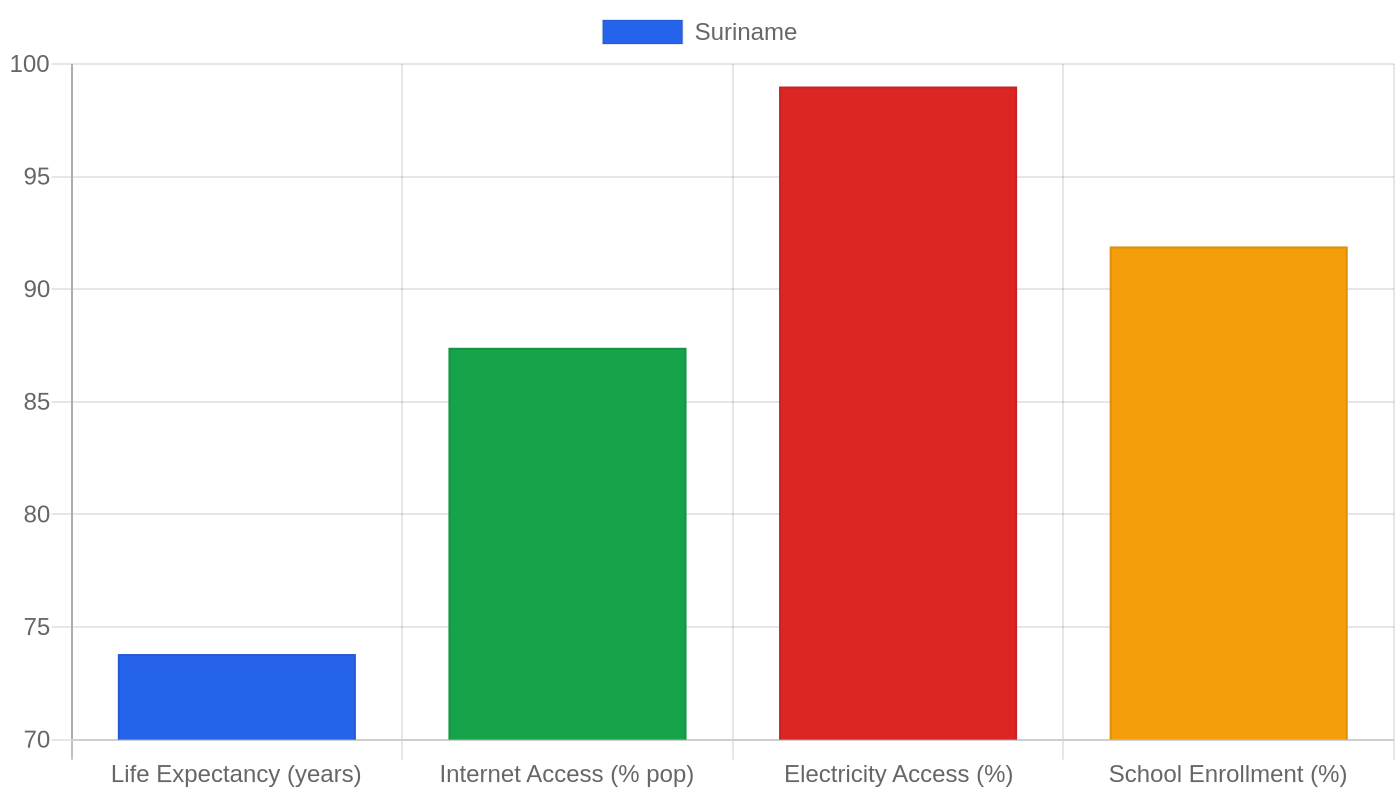
The World Bank’s latest data on Suriname presents an unusual challenge for any economic journalist: the numbers simply are not there. GDP growth, inflation, unemployment, GDP per capita, GNI per capita, and population figures all register as unavailable. This absence is itself a story.
For a nation that has been a functioning democracy since the adoption of its 1987 Constitution, the lack of fundamental economic indicators suggests either a reporting lag, a statistical system under strain, or a deliberate opacity that should concern international observers.
What we do know is that Suriname operates within a framework that the World Bank classifies as a representative democratic republic with an assembly-independent system. This political architecture, enshrined in the 1987 Constitution, provides for a 51-member unicameral National Assembly elected by popular vote for five-year terms.
The existence of this system implies a legal and institutional foundation for economic governance, but without the data to measure outcomes, it is impossible to verify whether the machinery is functioning effectively.
The absence of inflation figures is particularly telling. In a global environment where price stability has become a central concern, not knowing whether Suriname’s currency is holding its value or eroding purchasing power leaves investors flying blind. Similarly, without unemployment data, there is no way to gauge whether the economy is generating opportunities for its citizens or leaving them behind. The World Bank’s silence on these metrics should be read as a red flag, not a blank slate.
The Cost of Living in the Dark — Housing and Daily Life in a Data Vacuum
When the World Bank provides no cost-of-living data, analysts must rely on inference and context. Suriname’s corporate landscape offers some clues. The presence of multiple airlines — Blue Wing Airlines, Caricom Airways, Fly All Ways, and Surinam Airways — suggests a population that relies heavily on air travel, likely due to the country’s geography and the limited road infrastructure connecting its interior to the coast.
This dependence on aviation almost certainly drives up the cost of transportation for ordinary citizens.
Housing costs in Suriname’s capital, Paramaribo, can be inferred from the broader economic structure. With a financial sector anchored by the Central Bank of Suriname and De Surinaamsche Bank, there is a formal banking system capable of supporting mortgages and property transactions. However, without data on income levels or GDP per capita, it is impossible to assess whether housing is affordable relative to earnings.
The absence of this information is particularly problematic for anyone considering relocation or investment in real estate.
Daily expenses for food, utilities, and transportation remain a mystery in the official data. What is clear is that a country with a media sector dominated by Ampie’s Broadcasting Corporation and Apintie, and a telecommunications sector led by Telesur, has at least a functioning modern infrastructure. But whether the average citizen can afford these services, or whether they represent a luxury for the wealthy few, is a question the data cannot answer.
Investment and Business Climate — A Services Economy in Search of Substance
Suriname’s top companies, as identified by available data, paint a picture of an economy oriented toward services rather than manufacturing or natural resources. The financial sector is represented by the Central Bank of Suriname and De Surinaamsche Bank, suggesting a formal banking system capable of handling international transactions and local lending.
The aviation sector is surprisingly robust, with four airlines operating under the country’s flag: Blue Wing Airlines, Caricom Airways, Fly All Ways, and Surinam Airways.
The telecommunications sector is anchored by Telesur, which likely provides both fixed-line and mobile services to the population. Media companies Ampie’s Broadcasting Corporation and Apintie round out the corporate landscape, indicating a functioning media environment that, under Suriname’s democratic system, presumably operates with some degree of independence.
For investors, the key question is what lies beneath this services-oriented surface. Without data on main industries or GDP composition, it is impossible to identify growth sectors or assess the business environment’s regulatory quality. The absence of this information should give pause to anyone considering significant capital deployment in Suriname.
The country has a political system that provides theoretical stability, but the lack of economic transparency introduces a risk premium that cannot be calculated.
Safety, Politics, and Quality of Life — Democracy’s Unanswered Questions
Suriname’s political landscape is defined by the 1987 Constitution, which established the current system of governance. The country operates as a representative democratic republic with an assembly-independent system, meaning the National Assembly holds significant power and the executive is accountable to the legislature. Elections every five years for the 51-member unicameral body provide a regular mechanism for political turnover and public accountability.
The crime and safety indices are listed as unavailable, which is concerning for anyone evaluating quality of life. In a region where security concerns often dominate political discourse, not knowing whether Suriname is safe or dangerous leaves a critical gap in understanding. Similarly, without happiness or well-being data, it is impossible to assess whether the democratic system is delivering improved living standards for its citizens.
What can be said is that Suriname’s political stability, at least in terms of institutional continuity, stands in contrast to some of its neighbors. The 1987 Constitution has survived for nearly four decades, providing a framework for peaceful political competition. However, without economic data to measure outcomes, the quality of that democracy remains an open question. A political system can function perfectly on paper while failing its citizens in practice.
What’s Happening Now — The Silence That Speaks Volumes
The most striking feature of Suriname’s current economic situation is the absence of recent data. While other nations in the region publish regular updates on GDP growth, inflation, and employment, Suriname’s World Bank profile remains blank. This is not necessarily a sign of crisis — small nations often face challenges in statistical capacity — but it is a significant impediment to informed decision-making.
The corporate landscape suggests that aviation and financial services remain active sectors. The presence of multiple airlines indicates that both business and leisure travel continue, and the existence of two major banks suggests that the financial system is functioning. Telesur’s position as a telecommunications provider points to ongoing investment in digital infrastructure. These are positive signals, but they are incomplete without macroeconomic context.
For policymakers, the priority should be closing the data gap. Without reliable statistics, the government cannot effectively target social programs, manage inflation, or attract foreign investment. The National Assembly, as the country’s legislative body, has a responsibility to ensure that the statistical agencies have the resources and independence to produce timely and accurate data.
Until that happens, Suriname will remain an economic mystery — a democracy with a constitution, an assembly, and a corporate sector, but without the numbers needed to tell its story.
The Bottom Line
Suriname is a country worth watching for its political stability and institutional continuity in a region where both are often in short supply. The 1987 Constitution has provided a durable framework for democratic governance, and the presence of a formal banking system, multiple airlines, and a telecommunications provider suggests a functioning modern economy. However, the complete absence of basic economic data from the World Bank should give any investor or analyst serious pause.
Until Suriname closes its information gap, it will remain a high-risk proposition — not because of what is known, but because of what is not. Those with a tolerance for uncertainty and a belief in the country’s democratic foundations may find opportunity, but they will be navigating without a map.
Sources & Methodology
This article is authored by Economic Pulse Net for informational and research purposes. Economic Pulse Net sources its data from multilateral institutions, national statistics bureaus, and proprietary databases. All data is believed to be current as of the date of publication.
Published: July 20, 2026 | Category: Research — Suriname
Use these signals in your own platform
Economic Pulse publishes its live signal feed through a documented, read-only API. Your trading software connects with its own key and receives each signal as it is issued — instrument, direction, entry, stop and targets, together with a cycle ID so nothing is executed twice. The feed is independent of this website and cannot change it.
Signals are informational only and are not financial advice.