Economic Pulse Net | Sources: World Bank World Development Indicators, Government Sources | 2026
Key Takeaways
* Data Transparency Gap: The World Bank currently reports no available figures for Suriname’s GDP growth, inflation, unemployment, or population, signaling a significant challenge in assessing the country’s real-time economic health.
Political Stability Framework: The nation operates as a representative democratic republic with a unicameral National Assembly of 51 members, elected for five-year terms under the 1987 Constitution.
Sectoral Concentration: The local corporate landscape is heavily weighted toward consumer services, specifically aviation, alongside key players in media, telecommunications, and financial services.
Limited Economic Visibility: With key macroeconomic indicators marked as unavailable, international investors and analysts face a “black box” environment, making traditional fundamental analysis difficult.
The Invisible Economy: A Crisis of Metrics
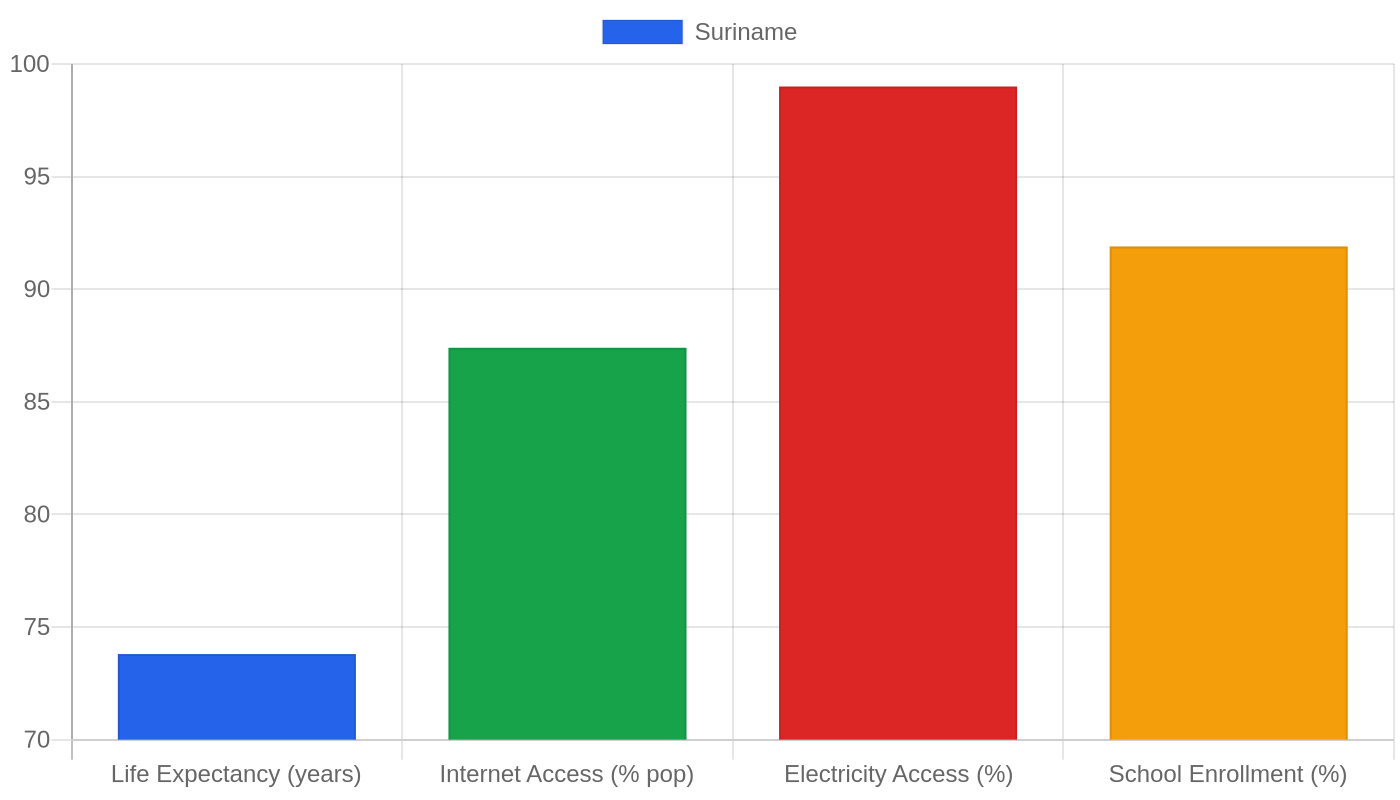
In the world of global economics, data is oxygen. For Suriname, however, the air currently feels thin. According to the World Bank, the latest figures for GDP growth, inflation (CPI), unemployment rates, total GDP in USD, and GDP per capita are all reported as “N/A.” This is not merely a statistical footnote; it is a profound signal that the country’s economic pulse is difficult to measure externally.
When a nation’s core macroeconomic indicators are absent from major global databases, it creates a vacuum of confidence for both local policymakers and international stakeholders. The lack of a defined GDP per capita (PPP) or GNI per capita means that comparisons with regional peers or global averages are impossible, isolating Suriname in a statistical fog.
The implications of this data void are significant. Without a clear trajectory for inflation or employment, it is challenging to determine whether the economy is in a phase of expansion, stagnation, or contraction. The World Bank’s absence of data on these fundamental metrics suggests that either the national statistical bureau is not reporting in a format compatible with global aggregators, or there are structural issues in data collection and dissemination.
For an economy of Suriname’s size, these gaps can be particularly damaging, as small economies often rely heavily on external capital flows that are driven by data-driven confidence. The current state of affairs implies that the economic narrative is being written in silence, forcing observers to rely on qualitative assessments rather than quantitative proof.
This lack of transparency does not necessarily indicate economic failure, but it does indicate a disconnect between the domestic economic reality and the global analytical framework.
Living in the Margins: The Cost of Existence
With the World Bank providing no specific figures for the cost of living, housing costs, or daily expenses in Suriname, any attempt to quantify the financial burden on the average citizen is inherently speculative. In a typical economic feature, one would compare rent-to-income ratios or analyze the purchasing power parity of local currencies against global benchmarks.
However, in this instance, the absence of data on housing costs and daily expenses means that the true cost of living remains an opaque variable for external observers. We cannot definitively state whether the average Surinamese citizen faces a housing crisis or if daily essentials are affordable relative to their wages.
This data gap complicates the understanding of social welfare. Without concrete numbers on the cost of living, it is difficult to assess the effectiveness of any social safety nets or wage policies that may be in place. The lack of information on rent versus buy dynamics further obscures the real estate market, leaving potential residents or investors without a clear picture of the property landscape.
While other nations might use cost-of-living indices to track inflation’s impact on household budgets, Suriname’s current statistical profile offers no such metric. This absence forces a reliance on anecdotal evidence or ground-level reporting, which, while valuable, lacks the statistical rigor required for broad economic analysis. The result is an economic environment where the lived experience of the populace is difficult to quantify on a macro scale.
Business in the Air: Aviation and Media Dominate
The corporate landscape of Suriname, as reflected in the available list of top companies, reveals a distinct tilt toward consumer services, particularly the aviation sector, and media. Companies such as Blue Wing Airlines, Caricom Airways, Fly All Ways, and Surinam Airways form a notable cluster in the consumer services space, suggesting that air transport is a critical component of the local economy and connectivity.
This concentration in aviation may reflect the geographic realities of the country, where air travel is often essential for business and personal mobility. The presence of multiple airlines indicates a competitive market in this niche, though the financial health of these entities remains unquantified due to the lack of broader economic data.
Beyond aviation, the media sector is well-represented by Ampie’s Broadcasting Corporation and Apintie, highlighting the importance of information dissemination in a society of Suriname’s size. In telecommunications, Telesur stands as a key player, underscoring the role of digital infrastructure in connecting the population. The financial sector is anchored by the Central Bank of Suriname and De Surinaamsche Bank, which likely play pivotal roles in currency stability and local lending.
However, the absence of data on these companies’ revenues, market capitalization, or performance metrics means that their influence is assessed primarily by their presence rather than their financial scale. This business environment appears to be driven by service-oriented industries that facilitate connectivity and information, rather than heavy industry or large-scale export manufacturing.
The focus on these sectors suggests a domestic market that is self-contained and reliant on local services to drive economic activity.
Governance and Security: A Democratic Framework
Politically, Suriname is established as a representative democratic republic with an installed assembly-independent system, based on the Constitution of 1987. The legislative branch consists of a 51-member unicameral National Assembly, with members elected simultaneously and popularly for five-year terms. This structure provides a clear, if simple, framework for governance, where legislative power is concentrated in a single chamber.
The five-year term for the National Assembly suggests a degree of political stability, as elected officials have a substantial period to implement policies and build legislative agendas.
However, the picture of safety and quality of life remains incomplete. The World Bank data provided does not include a Crime Index or a Safety Index, leaving a significant gap in understanding the security environment for residents and visitors. Without these metrics, it is difficult to gauge the level of public safety or the effectiveness of law enforcement. The political landscape appears orderly in its structural design, but the lack of security data prevents a comprehensive assessment of the quality of life.
In many emerging markets, a stable political system is often paired with robust security indices to provide a full picture of the living environment. In Suriname’s case, the political stability is clear, but the social stability, as measured by safety, remains an unknown variable in this dataset. This partial view requires caution when evaluating the overall livability of the country.
The Current Pulse: Navigating Uncertainty
The most pressing aspect of Suriname’s current economic and political situation is the pervasive lack of updated data. In a world where real-time economic indicators are standard, the “N/A” status of key World Bank metrics for Suriname stands out as a significant anomaly. This is not just a technical issue; it reflects a current state of economic opacity that challenges both domestic and international actors.
Without recent news or live indicators to provide context, the “current affairs” section of this analysis is defined by what is missing rather than what is present.
The absence of recent news items or live economic indicators means that there are no specific reforms, elections, or inflation trends to report on in this instance. This silence in the data stream is, in itself, a story. It suggests that the economic narrative is not being actively communicated to global platforms, or that the data collection processes are not yielding results that can be integrated into standard international reports.
For observers tracking the country, this means that the “freshest” development is the continued lack of visibility. Any policy shifts or business developments are likely occurring within a closed loop of domestic information, inaccessible to the broader global economic community. This creates a scenario where the current state of affairs is best described as one of quiet isolation from global economic monitoring systems.
The Bottom Line
Suriname presents a complex case study in economic opacity. While the political framework is clearly defined as a democratic republic with a unicameral legislature, the economic data required to make informed judgments is largely unavailable. Investors and analysts must approach the country with extreme caution, recognizing that the lack of data is a risk factor in itself.
The business landscape, dominated by aviation, media, and financial services, suggests a service-oriented economy, but without financial metrics, the scale and health of these sectors remain unverified.
For those watching this country, the key takeaway is that traditional fundamental analysis is currently ineffective. Success in understanding Suriname’s economy will require on-the-ground reporting and local knowledge rather than reliance on global databases. The nation’s future economic trajectory will depend on its ability to close the data gap and integrate its economic statistics into the global mainstream.
Until then, Suriname remains an enigma—a country with a clear political structure but an invisible economic pulse.
Sources & Methodology
This article is authored by Economic Pulse Net for informational and research purposes. Economic Pulse Net sources its data from multilateral institutions, national statistics bureaus, and proprietary databases. All data is believed to be current as of the date of publication.
Published: September 08, 2026 | Category: Research — Suriname
Use these signals in your own platform
Economic Pulse publishes its live signal feed through a documented, read-only API. Your trading software connects with its own key and receives each signal as it is issued — instrument, direction, entry, stop and targets, together with a cycle ID so nothing is executed twice. The feed is independent of this website and cannot change it.
Signals are informational only and are not financial advice.