Economic Pulse Net | Sources: World Bank World Development Indicators, Government Sources | 2026
🇭🇺 Hungary 2026 — Stability Amidst Slow Growth and Structural Shifts
Key Takeaways
* Modest Expansion: Hungary’s economy is projected to grow by just over 0.5% in 2025, reflecting a period of cautious stabilization rather than rapid acceleration.
Resilient Labor Market: Despite slow GDP growth, the unemployment rate remains tight at 4.521%, indicating a robust demand for labor within key sectors.
Inflationary Pressures: Consumer price inflation is hovering around 4.41%, presenting ongoing challenges for household purchasing power and cost management.
Corporate Landscape: The business environment is anchored by major players in telecommunications, banking, and consumer services, with significant foreign and domestic investment presence.
Political Framework: Governance operates under a constitutional framework established in 2012, featuring specific “eternity clauses” that protect core state structures from amendment.
Economic Pulse: Navigating Low-Growth Waters
Hungary’s economic trajectory in 2025 is characterized by measured caution, with Gross Domestic Product (GDP) growth forecasted at a modest 0.509542309726868% according to World Bank data. This near-flat expansion suggests an economy that is stabilizing after previous volatility but lacks the momentum for aggressive scaling.
However, the underlying health of the market is supported by a strong labor force; the unemployment rate stands at a low 4.521%, which signals that businesses are still hiring despite the slower overall output. In terms of sheer scale, the Hungarian economy generates a GDP of approximately $246.49 billion USD, providing a substantial base for regional influence.
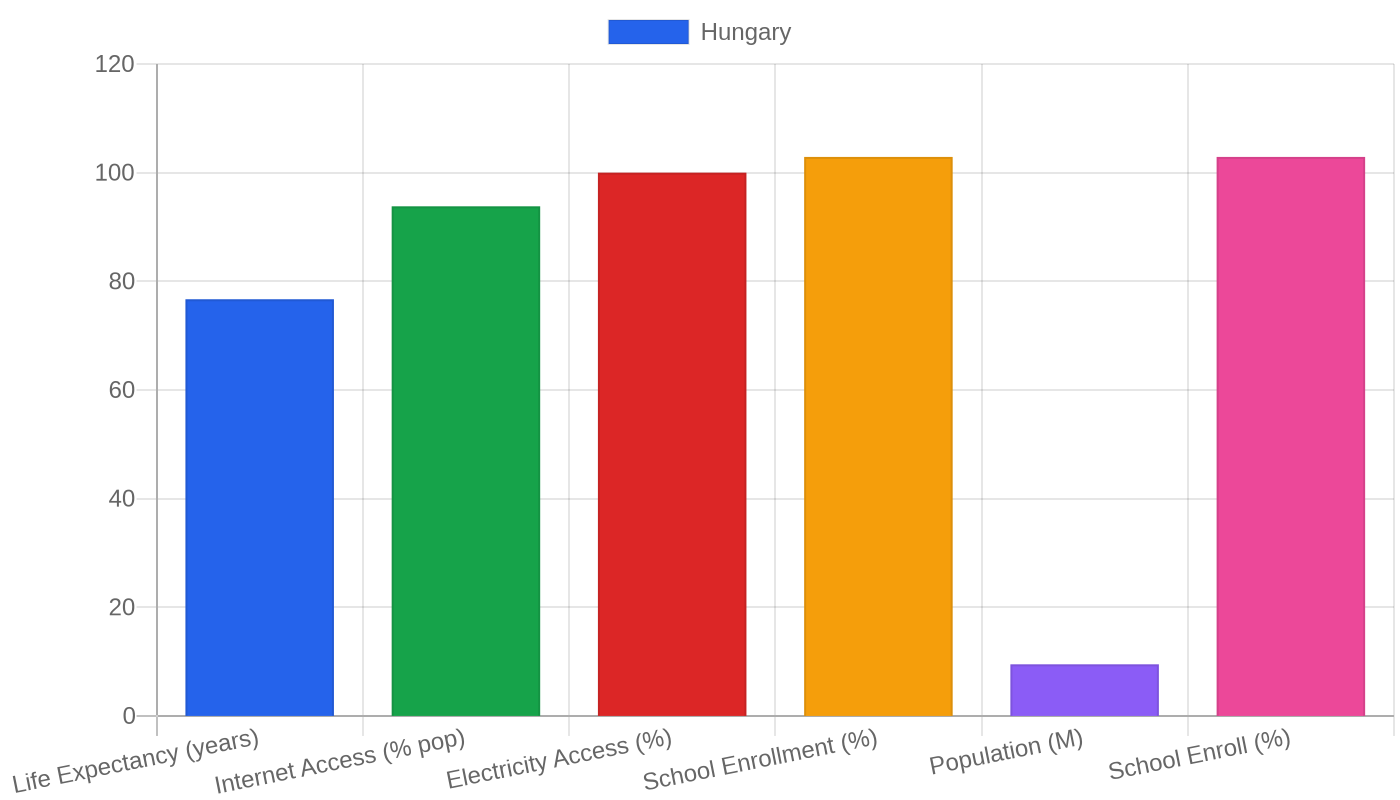
When adjusted for purchasing power parity (PPP), the GDP per capita reaches $49,837.60, highlighting a relatively high standard of living compared to many neighboring economies. Conversely, the Gross National Income (GNI) per capita sits at $23,850.0, offering a different lens on national wealth distribution. With a population of roughly 9.51 million, these figures underscore an economy where productivity per worker is critical to sustaining growth amidst global headwinds.
Living Costs and Housing Dynamics
For residents and expatriates alike, the cost of living in Hungary presents a mixed picture shaped by current inflation trends. The Consumer Price Index (CPI) is recorded at 4.41198445905566%, meaning that daily expenses are rising at a moderate pace, eroding some of the gains from wage increases.
While specific housing rental metrics are not detailed in the provided dataset, the general inflationary pressure implies that both rent and purchase prices are subject to upward adjustments, particularly in urban centers like Budapest. Consumers must navigate a landscape where basic goods and services are becoming incrementally more expensive, requiring careful budgeting.
The disparity between GNI per capita ($23,850.0) and PPP-adjusted GDP per capita ($49,837.60) suggests that local purchasing power may be higher than international nominal comparisons indicate, potentially offsetting some inflationary pain for those earning local wages. Ultimately, while costs are rising, they remain manageable relative to the broader Western European context, keeping Hungary an affordable destination for certain demographics.
Investment & Business Climate: Corporate Pillars
The Hungarian business ecosystem is defined by a diverse array of established companies spanning telecommunications, finance, and consumer goods. In the tech sector, 4iG stands out as a key player in telecommunications, driving digital infrastructure development. The financial sector is robustly represented by institutions such as CIB Bank and CIG Pannonia, which provide essential capital and insurance services to both individuals and corporations.
Consumer services form another critical pillar, with entities like CBA, ASL Airlines Hungary, and Budapest Aircraft Service facilitating daily commerce and mobility. For those interested in manufacturing and materials, BorsodChem and Ajka Crystal offer insights into the industrial and luxury goods markets, respectively. Additionally, the healthcare sector is bolstered by firms like AstridBio, indicating a growing focus on medical innovation and services.
These companies operate within a regulatory environment that favors stability, making Hungary an attractive hub for mid-sized European investments seeking access to Central European markets.
Safety, Politics & Quality of Life
Safety indices for Hungary are currently listed as N/A in the provided data, leaving crime statistics undefined for this specific report. However, the political landscape offers a clear window into the country’s governance structure. Hungary operates as a unitary parliamentary republic, governed by the Fundamental Law (alaptörvény), which was significantly reformed in 2012.
This constitutional framework requires a two-thirds parliamentary supermajority to amend, ensuring that changes to the state structure are difficult to enact without broad consensus. Notably, the constitution includes “eternity clauses” that permanently protect human dignity, the separation of powers, the state structure, and the rule of law from any future amendments. This legal rigidity provides a predictable, albeit rigid, political environment for businesses and citizens.
While happiness data is not explicitly quantified in the source material, the combination of low unemployment and stable constitutional order suggests a society focused on institutional continuity and social cohesion.
Current Affairs: Policy Shifts and Economic Realities
As we look at the immediate horizon, Hungary’s economic narrative is being shaped by the interplay between slow growth and structural reforms. The projected 0.5% GDP growth for 2025 indicates that policymakers are prioritizing stability over rapid expansion, likely in response to global economic uncertainties. Inflation, currently at 4.41%, remains a focal point for government intervention, with potential monetary policies aimed at curbing price hikes without stifling the labor market.
The low unemployment rate of 4.521% continues to attract foreign direct investment, particularly in the telecommunications and financial sectors led by companies like 4iG and CIB Bank. Meanwhile, the political emphasis on the unamendable clauses of the Fundamental Law suggests that recent years have seen a consolidation of power, influencing how business regulations are implemented.
Stakeholders should watch for further adjustments in fiscal policy designed to balance the CPI decline with the need to maintain consumer spending power. The coming months will likely see continued dialogue between the central bank and the government regarding interest rates and inflation targets.
The Bottom Line
Hungary presents a compelling case for investors and observers seeking a stable, mid-sized European economy with strong corporate foundations. The combination of low unemployment and a robust GDP per capita (PPP) offers a resilient domestic market, even as headline growth remains subdued. While safety data gaps require caution, the clear political framework and established major companies provide a degree of predictability rare in emerging markets.
Those looking for steady, long-term engagement rather than explosive short-term gains will find Hungary’s current trajectory worth monitoring closely.
Sources & Methodology
This article is authored by Economic Pulse Net for informational and research purposes. Economic Pulse Net sources its data from multilateral institutions, national statistics bureaus, and proprietary databases. All data is believed to be current as of the date of publication.
Published: October 24, 2026 | Category: Research — Hungary
Use these signals in your own platform
Economic Pulse publishes its live signal feed through a documented, read-only API. Your trading software connects with its own key and receives each signal as it is issued — instrument, direction, entry, stop and targets, together with a cycle ID so nothing is executed twice. The feed is independent of this website and cannot change it.
Signals are informational only and are not financial advice.