Economic Pulse Net | Sources: World Bank World Development Indicators, Government Sources | 2026
Key Takeaways
– Peru’s economy is expanding at a steady 3.43% in 2025, according to the World Bank, signaling resilience in a region often marked by volatility.
– Unemployment remains low at just over 5%, suggesting a labor market that is absorbing workers even as global headwinds persist.
– The country’s consumer goods sector dominates the corporate landscape, with giants like Alicorp and Ajegroup anchoring domestic consumption.
– Peru operates under a semi-presidential, multi-party system that has maintained liberal democratic governance since its 1993 constitution, though political fragmentation remains a risk.
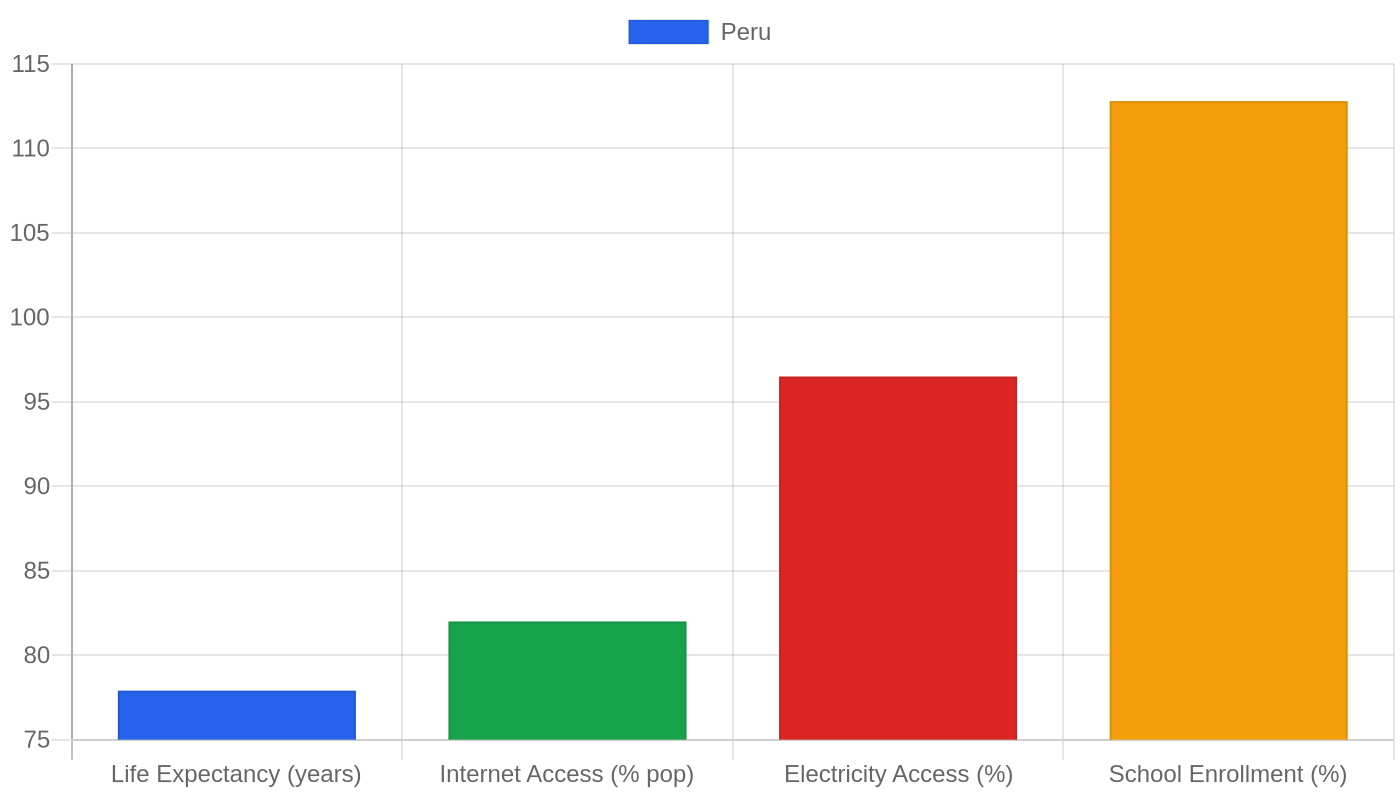
– With GDP per capita at just over $18,800 on a purchasing power parity basis, Peru sits in the upper-middle-income bracket, but inequality and cost-of-living pressures pose ongoing challenges.
Growth Without Glory — The Peruvian Economy in Context
Peru’s economy is moving forward, if not exactly surging. The World Bank reports GDP growth of 3.43% for 2025 — a respectable figure by global standards, though it does not quite match the breakneck expansion rates seen in some of its faster-growing neighbors. Still, for a country that has weathered political turbulence and commodity price swings in recent years, this steady pace is no small achievement.
The number tells a story of an economy that is holding its ground, powered by domestic consumption and a resilient services sector.
Unemployment stands at 5.117%, a figure that would be the envy of many developed economies. That low jobless rate suggests that formal and informal labor markets alike are absorbing workers, though the quality of employment — whether those jobs offer stability, benefits, and decent wages — is a separate question. The World Bank data does not provide inflation figures for Peru, but in an environment of global price pressures, the absence of runaway inflation would be a welcome sign for policymakers.
The country’s economic structure is heavily tilted toward consumer goods and services. The top companies list reads like a who’s who of Peruvian household names: Alicorp, Ajegroup, Agroindustrial Casa Grande, and América Televisión. These are not mining giants or energy behemoths — they are companies that sell food, beverages, and entertainment to Peruvians. That tells you something important about where the economy’s center of gravity lies.
Peru is not just a commodities exporter; it is a consumer-driven economy where domestic demand plays a starring role. The industrials sector is represented by Aeropuertos del Perú, while Aero Cóndor and Avianca Perú point to a competitive aviation market serving both domestic and regional routes.
The Price of Living in Lima and Beyond
The World Bank data does not include cost-of-living figures, but the broader picture can be inferred from what we know about Peru’s economic structure and income levels. With a GNI per capita of $8,430, Peru sits firmly in the upper-middle-income category, but that national average masks significant variation. Lima, the capital, is considerably more expensive than rural areas in the Andes or the Amazon basin.
Housing costs in desirable districts of Lima — such as Miraflores, San Isidro, or Barranco — can rival those in mid-tier European cities, while wages often lag behind.
For the average Peruvian household, the biggest expenses are food, transportation, and housing. The dominance of consumer goods companies like Alicorp and Ajegroup suggests that packaged foods and beverages are central to daily life, and their pricing power can squeeze household budgets. Rent versus buy decisions are heavily influenced by access to credit: mortgage penetration remains low compared to more developed economies, so renting is the norm for many urban professionals.
Compared to regional peers, Peru’s cost of living is moderate — not as cheap as Bolivia or Paraguay, but more affordable than Chile or Uruguay. The challenge for many Peruvians is that while headline growth looks solid, real incomes do not always keep pace with the cost of essential goods.
Where the Money Moves — Investment and Corporate Power
Peru’s business environment is shaped by its corporate champions and the sectors they dominate. The top companies list reveals a striking concentration in consumer goods and services. Alicorp, one of the country’s largest conglomerates, has its fingers in everything from cooking oil and pasta to personal care products. Ajegroup is best known for its Big Cola brand, which has successfully challenged Coca-Cola in parts of Latin America.
These companies are not just domestic players; they have regional ambitions, and their success reflects Peru’s integration into broader Latin American supply chains.
For investors, the sectors to watch are consumer staples, aviation, and infrastructure. Aeropuertos del Perú, the airport operator, is a proxy for tourism and trade flows — two areas with significant growth potential if political stability holds. Aero Cóndor and Avianca Perú indicate that aviation is a competitive space, though margins are thin and fuel costs are a perennial concern.
The absence of major mining companies from the top ten list is notable: while mining remains crucial to Peru’s export earnings, the corporate giants that dominate the headlines are increasingly consumer-facing. That shift suggests an economy that is maturing, diversifying away from its historical reliance on copper and gold.
The political landscape, as described by the World Bank, is that of a unitary semi-presidential republic with a multi-party system. Since the 1993 constitution, Peru has maintained a liberal democratic framework, but the “multi-party” nature of its politics has often led to fragmentation and gridlock. Investors watch Peru’s political dynamics closely because policy uncertainty — especially around mining taxes, labor laws, and social spending — can shift the ground beneath business plans.
Democracy Under Strain — Safety, Politics, and Daily Life
Peru’s political system is a study in contrasts. The World Bank notes that the country is a unitary semi-presidential republic with a multi-party system, operating under a 1993 constitution that replaced an earlier framework. That constitution shifted power toward the presidency while maintaining checks and balances, but in practice, Peru has seen a revolving door of presidents in recent years. The multi-party system, while democratic, has produced legislative paralysis and periodic crises of confidence.
The crime and safety indices are not available in the provided data, but Peru’s reputation in this area is mixed. Lima is generally safe for visitors in tourist-friendly districts, but petty crime and theft are common in crowded areas. More concerning is the persistence of organized crime and illegal mining in remote regions, where the state’s presence is weak.
For ordinary Peruvians, quality of life is heavily influenced by where they live: coastal cities offer better infrastructure and services, while highland and jungle regions lag behind. The political turbulence of recent years has eroded trust in institutions, but the democratic framework remains intact — a fact that should not be taken for granted in a region where democratic backsliding has become more common.
The Moment of Truth — What’s Happening in Peru Right Now
Peru is navigating a period of cautious optimism. The 3.43% growth figure from the World Bank for 2025 suggests that the economy is on a stable trajectory, but the absence of inflation data leaves a gap in our understanding of whether that growth is translating into real gains for households. The low unemployment rate is a positive signal, but it does not tell us about the quality of jobs or the size of the informal sector, which in Peru has historically been large.
The political landscape remains the wild card. With a multi-party system that has produced frequent changes in leadership, investors and citizens alike are watching to see whether the current administration can maintain stability long enough to push through meaningful reforms. The corporate sector, led by consumer giants like Alicorp and Ajegroup, is betting on continued domestic demand.
The aviation industry, represented by Aero Cóndor and Avianca Perú, is betting on tourism and business travel recovering fully from pandemic-era disruptions.
What happens next depends on whether Peru can square the circle of democratic governance and economic growth. The country has the fundamentals — a diversified economy, a young population, and strategic trade links — but it has struggled with the political discipline needed to unlock its full potential. For now, the numbers say Peru is moving forward. The question is whether that forward momentum can survive the next political storm.
The Bottom Line
Peru is a country to watch for anyone interested in the intersection of emerging-market growth and democratic governance. The World Bank data paints a picture of an economy that is growing steadily, with low unemployment and a consumer-driven corporate sector that is deeply embedded in daily life. But the political system, while democratic on paper, has proven fragile in practice.
Investors should keep an eye on Peru for its consumer market and its potential as a regional hub, but they should also brace for volatility. For travelers, journalists, and policy analysts, Peru offers a fascinating case study of how a middle-income democracy navigates the tension between growth and governance.
Sources & Methodology
This article is authored by Economic Pulse Net for informational and research purposes. Economic Pulse Net sources its data from multilateral institutions, national statistics bureaus, and proprietary databases. All data is believed to be current as of the date of publication.
Published: July 19, 2026 | Category: Research — Peru
Use these signals in your own platform
Economic Pulse publishes its live signal feed through a documented, read-only API. Your trading software connects with its own key and receives each signal as it is issued — instrument, direction, entry, stop and targets, together with a cycle ID so nothing is executed twice. The feed is independent of this website and cannot change it.
Signals are informational only and are not financial advice.