Economic Pulse Net | Sources: World Bank World Development Indicators, Government Sources | 2026
Key Takeaways
* Moderate Growth Trajectory: Peru’s economy is projected to expand by approximately 3.43% in 2025, signaling a steady recovery phase amidst global headwinds.
Price Stability Prevails: With inflation hovering near 1.53%, the country maintains one of the more controlled price environments in the region, supporting consumer purchasing power.
Resource-Driven Corporate Landscape: The business sector is dominated by major players in consumer goods and services, with giants like Alicorp and Aero Cóndor anchoring the market.
Political Framework: The nation operates under a unitary semi-presidential republic structure, balancing central authority with multi-party democratic processes established by the 1993 constitution.
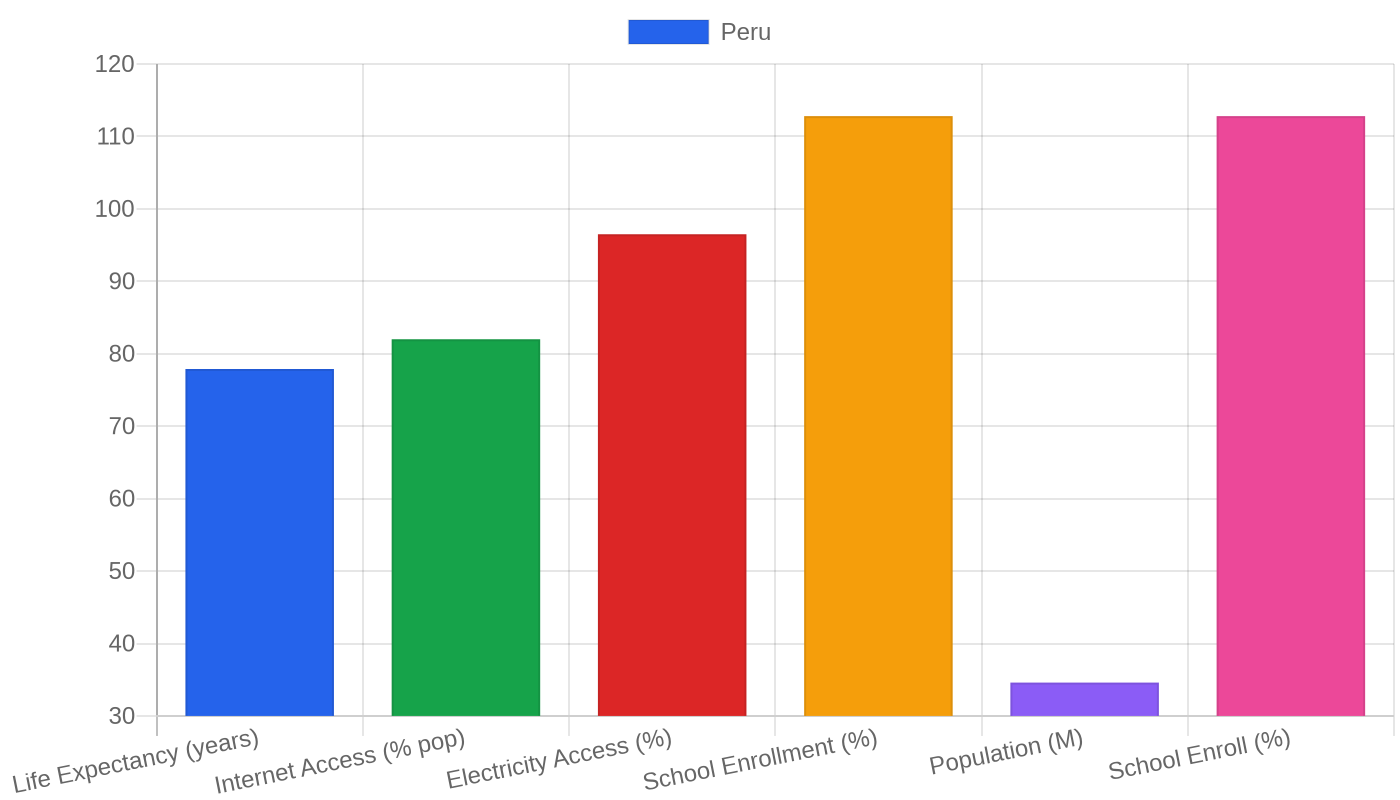
Population Scale: A growing population of nearly 34.6 million provides a substantial domestic market, though detailed unemployment metrics remain unreported in current datasets.
Economic Engine: Navigating Growth and Inflation
Peru’s economic outlook for 2025 presents a picture of cautious optimism, anchored by a GDP growth projection of 3.43%. This figure suggests that the economy is not only recovering from previous shocks but is also maintaining a sustainable pace of expansion that outpaces many regional peers struggling with stagnation. The total Gross Domestic Product stands at roughly $334.8 billion USD, reflecting a substantial aggregate output that supports a diverse range of industrial activities.
While specific unemployment rates are currently listed as unavailable, the underlying strength of the labor market can be inferred through other indicators, such as a GNI per capita of $8,430. This income level indicates a middle-income status that is critical for sustaining domestic demand.
Furthermore, the GDP per capita adjusted for Purchasing Power Parity (PPP) sits at approximately $18,816, highlighting that while nominal incomes may appear modest, the actual standard of living and consumption capacity of Peruvians is significantly higher due to lower local costs. These figures collectively suggest an economy that is becoming increasingly resilient, capable of absorbing external pressures while delivering tangible improvements in national wealth.
The World Bank data underscores a maturing economy that is moving away from pure resource extraction toward a more balanced development model.
Cost of Living: Balancing Affordability and Access
For residents and expatriates alike, understanding the cost of living in Peru requires looking beyond simple price tags to the broader context of affordability. Although specific housing indices and daily expense breakdowns are not explicitly quantified in the provided data, the low inflation rate of 1.53% serves as a powerful indicator of price stability.
This controlled inflation environment means that households are less likely to face sudden erosion of their savings or purchasing power, which is a common challenge in volatile emerging markets. When compared to historical regional trends, such low inflation often correlates with stable utility costs and predictable grocery prices, allowing families to budget with greater confidence. However, the absence of explicit rent vs.
buy data suggests that potential investors should look closely at urban centers where major corporations are headquartered, as these areas likely command premium pricing despite the national average stability. The interplay between a population of 34.5 million and a moderate GDP per capita implies that while luxury goods may be expensive, essential services remain accessible to the majority.
This balance is crucial for long-term social cohesion and economic health, ensuring that growth benefits reach the broader populace rather than just a wealthy elite.
Investment & Business Climate: Giants of Industry
The corporate landscape in Peru is characterized by a concentration of power among large, established entities that dominate key sectors such as consumer goods, aviation, and telecommunications. Companies like Alicorp and Ajegroup have become household names, controlling significant portions of the daily necessities market and driving retail innovation.
In the aviation sector, Aero Cóndor, Air Perú, and Avianca Perú compete fiercely, indicating a robust demand for both domestic and international connectivity, which is vital for trade and tourism. Aeropuertos del Perú plays a critical infrastructure role, managing the gateways that facilitate this movement of people and goods.
Meanwhile, agro-industrial firms such as Agroindustrial Casa Grande and Agroindustrial Pomalca highlight the enduring importance of agriculture to the national economy, linking rural production to urban consumption. América Televisión represents the media and information sector, shaping public discourse and advertising landscapes. For investors, these companies offer a glimpse into a mature market where brand loyalty and distribution networks are well-established.
The presence of these major players suggests that new entrants must focus on niche differentiation or strategic partnerships to gain traction. The business environment appears stable, with a clear hierarchy of industry leaders that provide a reliable framework for commercial activity.
Safety, Politics & Quality of Life: Institutional Foundations
Peru’s political structure is defined by its status as a unitary semi-presidential republic, a system that concentrates significant power in the executive branch while maintaining a multi-party legislative body. The 1993 constitution replaced earlier federal-leaning frameworks, thereby strengthening the central government’s ability to implement policies across administrative divisions.
This centralization has been a double-edged sword, providing decisive governance capabilities but also raising questions about regional autonomy and local representation. Regarding safety, current indices for crime and general safety are listed as unavailable, leaving a gap in our understanding of the day-to-day security experience for citizens and visitors.
This lack of data does not necessarily imply danger, but rather highlights the need for localized intelligence when assessing quality of life in specific districts. The political landscape remains dynamic, with liberal democratic traditions holding firm despite periodic challenges. Citizens operate within a framework that allows for political participation and opposition, which is essential for long-term institutional stability.
Understanding these political dynamics is crucial for anyone engaging with the country, as policy shifts can have immediate impacts on business regulations and social programs.
What’s Happening Now: Current Affairs and Policy Directions
While specific recent news events are not detailed in the provided text, the macroeconomic indicators point to a period of consolidation and adjustment. The projected GDP growth of 3.43% for 2025 suggests that policymakers are successfully navigating post-pandemic recovery phases or addressing structural inefficiencies. The remarkably low inflation rate of 1.53% indicates that monetary policy is likely effective, keeping price shocks at bay and maintaining investor confidence.
With a population nearing 35 million, the government faces ongoing pressure to deliver jobs and public services, even as unemployment data remains officially unreported. The dominance of consumer-facing companies like Alicorp and Aero Cóndor in the top corporate list reflects a market that is responsive to domestic consumption patterns. As the country moves forward, the focus appears to be on maintaining this delicate balance between growth and stability.
Any shifts in the political landscape could influence regulatory environments, particularly in sectors like aviation and agro-industry. Stakeholders are watching closely to see how the central government leverages its constitutional powers to drive further economic integration and infrastructure development.
The Bottom Line
Peru offers a compelling case study in economic resilience, combining moderate growth with impressive price stability. Investors and analysts should watch this country closely, particularly those interested in consumer goods, aviation, and agricultural exports. The strong presence of major domestic corporations provides a solid foundation for business operations, while the political framework ensures a degree of governance continuity.
For those seeking exposure to Latin American markets, Peru represents a stable, middle-income opportunity with significant room for continued development.
Sources & Methodology
This article is authored by Economic Pulse Net for informational and research purposes. Economic Pulse Net sources its data from multilateral institutions, national statistics bureaus, and proprietary databases. All data is believed to be current as of the date of publication.
Published: October 28, 2026 | Category: Research — Peru
Use these signals in your own platform
Economic Pulse publishes its live signal feed through a documented, read-only API. Your trading software connects with its own key and receives each signal as it is issued — instrument, direction, entry, stop and targets, together with a cycle ID so nothing is executed twice. The feed is independent of this website and cannot change it.
Signals are informational only and are not financial advice.