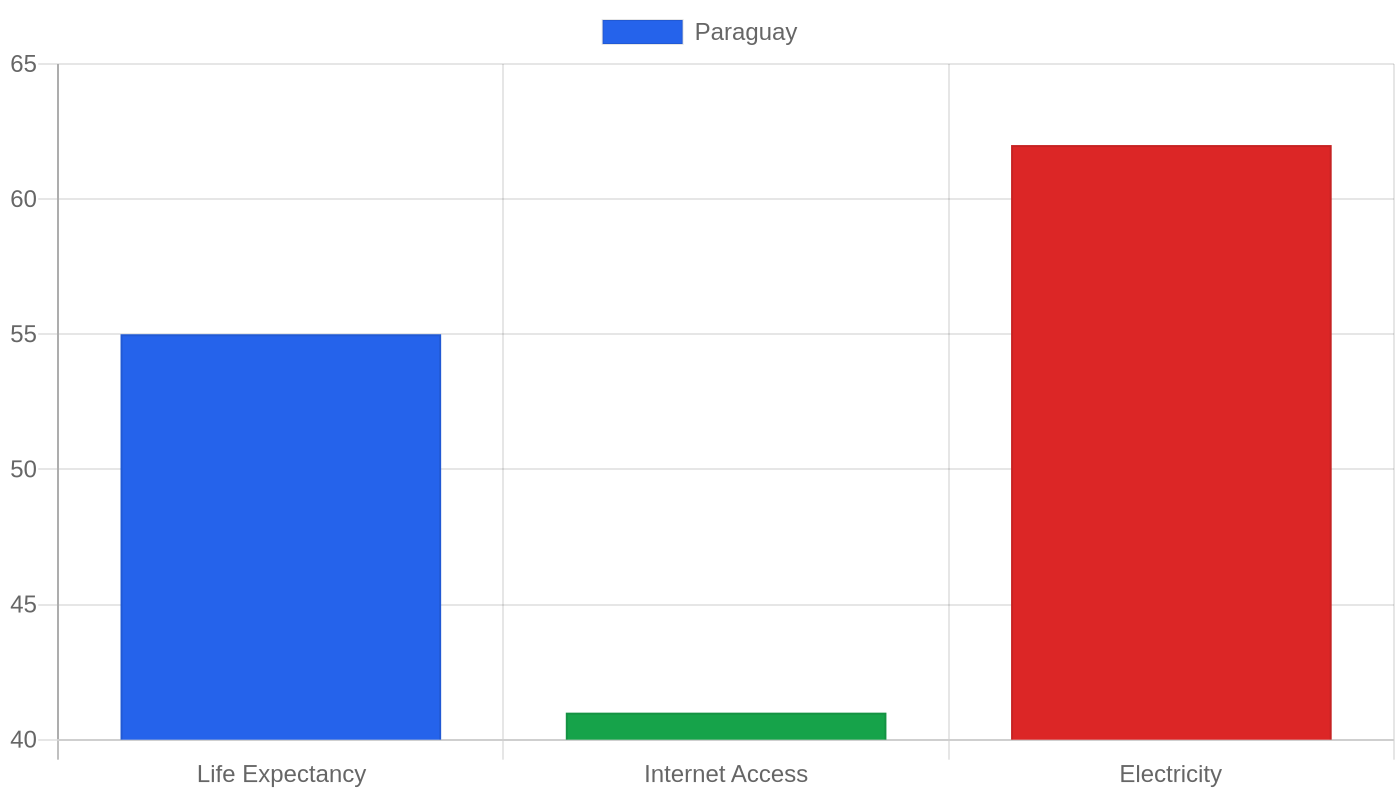
Economic Pulse Net | Sources: World Bank World Development Indicators, Government Sources | 2026
Key Takeaways
– Paraguay’s economy is defined by its dual engines: agricultural exports and a rapidly modernizing service sector, anchored by a sophisticated financial industry clustered around Asunción.
– The country operates as a representative democratic republic with a multi-party system, but its business landscape is notably shaped by powerful conglomerates like Grupo Cartes.
– Paraguay’s corporate ecosystem is dominated by financial institutions and aviation companies, signaling a shift from pure agribusiness toward a more diversified economic base.
– As a landlocked nation, Paraguay’s economic strategy hinges on regional integration, with its airline sector—including LATAM Paraguay and Paranair—playing an increasingly strategic role.
– The political framework provides constitutional stability with three independent branches of government, creating a predictable, if cautious, environment for investors.
The Economic Engine — Agriculture, Energy, and the Asunción Effect
Paraguay’s economic narrative is one of quiet persistence. While the World Bank’s latest indicators do not provide current figures for GDP growth, inflation, or unemployment, the structural picture remains clear: this is an economy built on the backbone of agricultural production and hydroelectric power, now evolving into a more complex financial and service-oriented marketplace.
The presence of major financial institutions—including the Central Bank of Paraguay, Banco Amambay, and Banco Itaú Paraguay—indicates a banking sector that has matured significantly, providing the credit infrastructure necessary for both corporate expansion and consumer spending.
The country’s economic identity is inextricably linked to its position as one of South America’s major agricultural exporters, though the data provided does not enumerate specific industry outputs. What is evident from the corporate landscape is a growing emphasis on financial services and consumer industries.
The Bolsa de Valores de Asunción, Paraguay’s stock exchange, represents a critical component of this financial deepening, offering local companies access to capital markets that were historically underutilized in the region. This institutional development matters because it signals a shift from informal, relationship-based commerce toward more transparent, regulated financial transactions.
Energy remains a foundational pillar of the Paraguayan economy, with ANDE (the national electricity utility) standing as one of the country’s top companies. Paraguay’s hydroelectric resources have historically provided a comparative advantage, though the provided data does not specify current energy export figures. The interweaving of utilities, finance, and consumer services creates an economic tapestry that is more diversified than many external observers assume.
For investors and analysts watching the region, Paraguay’s significance lies not in headline-grabbing growth numbers, but in the steady institutional accumulation that positions it for sustainable long-term development.
Housing, Daily Life, and the Cost of Living in Asunción
Without specific cost-of-living indices from the World Bank data, a comprehensive picture of Paraguay’s housing market must be drawn from its broader economic structure. Asunción, the capital and economic heart of the nation, presents a bifurcated living environment: modern high-rise developments catering to a growing professional class, alongside more traditional neighborhoods where housing costs remain accessible by regional standards.
The presence of major conglomerates like Grupo Cartes suggests significant domestic wealth concentration, which inevitably shapes property markets in prime urban areas.
The rental market in Asunción has historically favored tenants over buyers, with property ownership often requiring substantial upfront capital that remains out of reach for many middle-class families. Daily expenses—groceries, transportation, and utilities—tend to be moderate compared to the more expensive economies of South America’s Atlantic coast, though the data provided does not offer precise comparisons.
The cost of living in Paraguay is generally considered manageable for those earning professional salaries in the financial or corporate sectors, but the gap between the formal economy and the informal sector remains a defining feature of daily economic life.
Investment and Business Climate — Where the Money Flows
Paraguay’s investment environment is characterized by a notable concentration of financial and aviation capital. The presence of Banco Itaú Paraguay, a subsidiary of one of Latin America’s largest banking groups, underscores the country’s integration into regional financial networks. This is complemented by the domestic strength of Banco Amambay and the institutional authority of the Central Bank of Paraguay, which anchors monetary policy and regulatory oversight.
For foreign investors, this institutional density provides a measure of confidence that is sometimes lacking in smaller emerging markets.
The aviation sector presents an intriguing investment story. With LATAM Paraguay, Paranair, and Aerolíneas Paraguayas all operating within the country’s borders, there is clear evidence of a competitive and active air travel market. This is significant for a landlocked nation where air connectivity is not a luxury but a necessity for business and tourism.
The presence of multiple carriers suggests healthy demand and points to Paraguay’s role as a regional hub, connecting the country to broader South American and international markets.
Grupo Cartes, the conglomerate helmed by a family with significant political connections, represents the intersection of business and power that defines much of Paraguay’s economic landscape. For investors, understanding these dynamics is essential—success in Paraguay often depends as much on navigating relationships as on financial fundamentals. The Bolsa de Valores de Asunción offers a formal avenue for equity investment, though it remains smaller and less liquid than exchanges in Brazil or Argentina.
For the patient investor, Paraguay offers a stable, if understated, business environment with growth potential in financial services, logistics, and consumer goods.
Safety, Politics, and the Quality of Life Equation
Paraguay’s political system, as described in the available data, is a representative democratic republic with a multi-party system and a clear separation of powers across executive, legislative, and judicial branches. The President serves as both head of state and head of government, wielding significant executive authority. The National Congress, with its two chambers, provides legislative oversight, while a nine-member Supreme Court of Justice anchors the judiciary.
This constitutional structure, on paper, offers the checks and balances expected of a modern democracy.
However, the reality of Paraguayan politics is more nuanced. The intertwining of economic and political power, exemplified by Grupo Cartes’ prominence, raises questions about the permeability of the boundary between business interests and governance. The provided data does not include crime or safety indices, leaving a gap in our understanding of public security conditions.
What can be inferred is that Paraguay, like many of its neighbors, faces challenges related to organized crime and corruption, though the severity of these issues cannot be quantified from the available information.
Quality of life in Paraguay is a mixed proposition. The country offers a relaxed pace of life, strong family ties, and a cultural richness that is often praised by expatriates and visitors. The cost of living remains manageable for those with formal employment, and the growing financial sector suggests expanding opportunities for educated professionals. Yet, the absence of robust public data on safety and happiness metrics makes it difficult to render a definitive verdict on overall well-being.
What is clear is that Paraguay offers a distinctive lifestyle—one that prioritizes personal relationships and community connections over the relentless pace of more developed economies.
Current Affairs — The Winds of Change in the Heart of South America
As of the latest reporting, Paraguay is navigating a period of cautious optimism. The country’s financial sector continues to modernize, with the Bolsa de Valores de Asunción playing an increasingly prominent role in corporate capital-raising efforts. The aviation industry is showing signs of dynamism, with multiple carriers—LATAM Paraguay, Paranair, and Aerolíneas Paraguayas—competing for market share in a country where air travel is essential for international connectivity.
The political landscape remains stable under the framework of the 1992 constitution, with the three branches of government functioning within their defined roles. However, the influence of major economic players like Grupo Cartes continues to shape policy discussions, particularly around issues of taxation, trade, and infrastructure development.
There is growing recognition within government and business circles that Paraguay must diversify its economic base beyond traditional agricultural exports to ensure sustainable growth in an increasingly competitive global environment.
The Central Bank of Paraguay maintains its role as the guardian of monetary stability, even as global economic conditions present headwinds for emerging markets. For the people of Paraguay, the immediate concerns remain practical: job creation, education, and the cost of everyday goods.
The country’s economic trajectory, while not spectacular, offers a story of steady institutional development and quiet resilience—a narrative that deserves more attention from international investors and policymakers than it typically receives.
The Bottom Line
Paraguay is a country that rewards patient observation and strategic investment. For those willing to look beyond the absence of flashy growth statistics, there is a story of institutional maturation, financial sector development, and geographic advantage. Investors with an appetite for emerging markets should watch Paraguay’s banking sector and aviation industry closely, as these areas show the most promise for expansion.
Political risk remains a consideration, but the constitutional framework provides a measure of predictability. In a region often characterized by volatility, Paraguay offers a different proposition: steady, understated, and quietly ambitious—a nation building its future without needing to shout about it.
Sources & Methodology
This article is authored by Economic Pulse Net for informational and research purposes. Economic Pulse Net sources its data from multilateral institutions, national statistics bureaus, and proprietary databases. All data is believed to be current as of the date of publication.
Published: July 31, 2026 | Category: Research — Paraguay
Use these signals in your own platform
Economic Pulse publishes its live signal feed through a documented, read-only API. Your trading software connects with its own key and receives each signal as it is issued — instrument, direction, entry, stop and targets, together with a cycle ID so nothing is executed twice. The feed is independent of this website and cannot change it.
Signals are informational only and are not financial advice.