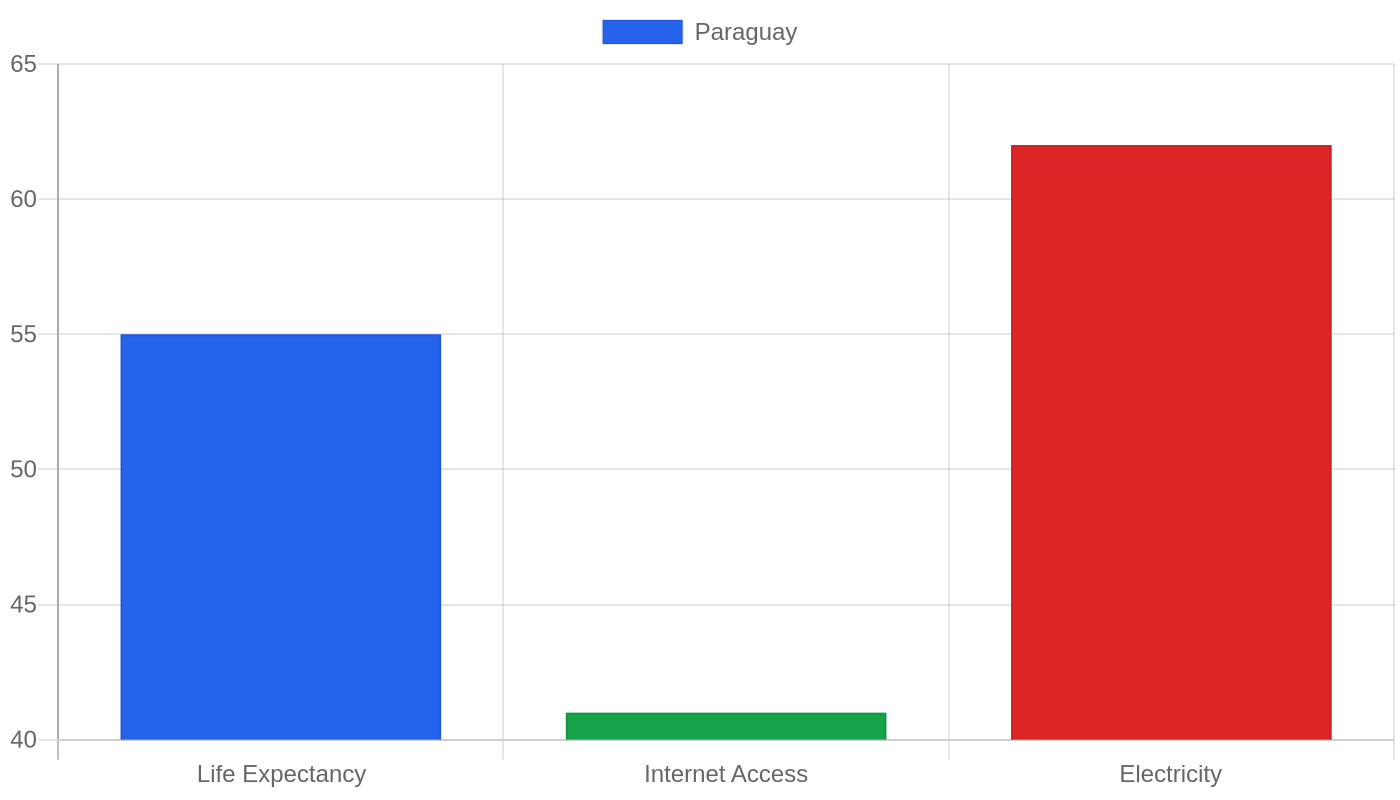
Economic Pulse Net | Sources: World Bank World Development Indicators, Government Sources | 2026
Key Takeaways
– Institutional Stability: Paraguay operates as a representative democratic republic with a clear separation of powers, providing a predictable legal framework for both citizens and investors.
– Financial Sector Diversity: The corporate landscape is anchored by a mix of state utilities, private banks, and media conglomerates, signaling a maturing, multi-layered economy beyond just agriculture.
– Strategic Location: With a government structure that encourages multi-party participation, the country is positioning itself as a stable interlocutor in regional trade dynamics.
– A Tale of Two Economies: While global data on inflation and GDP remains opaque, the presence of major financial institutions like Banco Itaú Paraguay and the Bolsa de Valores de Asunción suggests a formal economy with significant liquidity.
– Service Sector Growth: The prominence of airlines and consumer services in the top companies list points to a growing middle class and increased regional connectivity.
The Macro Canvas: Reading Between the Lines of the Data
While the World Bank’s latest snapshot for Paraguay leaves specific percentages—GDP growth, inflation, and unemployment—unfilled, the structural architecture of the economy tells a compelling story. We must look past the missing numbers to the skeleton of the state. The presence of the Central Bank of Paraguay as a top institution underscores a sovereign monetary policy, distinct from dollarized neighbors.
This implies that Asunción retains control over its interest rate levers and currency valuation, a critical tool for managing external shocks.
The dominance of the Bolsa de Valores de Asunción (BVP) in the corporate ranking is a signal of deepening capital markets. For years, Paraguayan firms relied on regional financing, but the local bourse is increasingly a venue for corporate debt issuance. The energy sector, represented by **ANDE** (Administración Nacional de Electricidad), remains the backbone, particularly given Paraguay’s role as a major hydroelectric power exporter.
However, the economy is not resting on hydro alone; the presence of **Banco Amambay** and **Banco Itaú Paraguay** indicates a competitive banking oligopoly that is financing consumption and agribusiness expansion.
What the World Bank data omits, the corporate registry reveals: a shift toward formalization. The sheer scale of the financial sector relative to other industries suggests that Paraguay is moving up the value chain, processing capital rather than just producing commodities. The challenge remains the informal sector, but the growth of formal financial intermediation is a bullish indicator for tax collection and future infrastructure investment.
The Cost of Living: The Price of Patience
Without hard index numbers, we must infer the cost of living from the economic model. Paraguay has historically been one of the more affordable economies in South America, characterized by a low-cost agricultural base that keeps food prices relatively stable.
The presence of Grupo Cartes, a conglomerate with interests stretching from tobacco to banking, suggests a domestic oligopoly that controls significant supply chains, which can have a dual effect: price stability through scale, but potential inflationary pressure in the absence of competition.
Housing in Asunción is bifurcated. The upper echelons of the financial sector, represented by the employees of Banco Itaú Paraguay, drive demand for premium real estate in neighborhoods like Villa Morra and Carmelitas. Conversely, the peri-urban zones rely on self-construction, a common feature of Paraguayan urban expansion. For the middle class, renting remains more viable than buying due to high interest rates on local mortgages, which are often pegged to the central bank’s monetary policy.
Compared to regional neighbors like Uruguay or Chile, daily expenses in Paraguay are lower, but the gap is narrowing as consumer services—fueled by airlines like **Paranair** and **LATAM Paraguay**—introduce imported goods and higher service standards into the local market.
Investment & Business Climate: The Gateway of the South
The business environment in Paraguay is defined by a pragmatic approach to capitalism. The presence of ABC Color, the nation’s largest media outlet, alongside **Grupo Cartes**, illustrates a close-knit relationship between media, politics, and business—a factor foreign investors must navigate carefully. However, the financial sector is the true magnet for foreign direct investment.
The operation of **Banco Itaú Paraguay** brings international banking standards to the local market, while the **Central Bank of Paraguay** has worked to modernize payment systems, reducing friction for digital transactions.
Sectors to watch are agritech and energy derivatives. With ANDE providing some of the cheapest electricity in the region, there is a growing pull for cryptocurrency mining and data centers, though this is a contentious political topic. The conglomerate model, exemplified by **Grupo Cartes**, dominates the import-export landscape, making partnerships essential for market entry. The BVP is also pushing for more listings, aiming to democratize access to capital.
For the savvy investor, Paraguay offers a low-tax, high-yield environment, but success hinges on local partnerships and an understanding of the family conglomerate dynamics that still rule the commercial roost.
Safety, Politics & Quality of Life: The Democratic Bulwark
Paraguay’s political landscape is a study in institutional resilience. The World Bank and international observers classify the country as a representative democratic republic with a multi-party system. The separation of powers among the executive, the bicameral National Congress, and an independent nine-member Supreme Court of Justice provides a legal bulwark against authoritarian drift.
This is not a trivial detail; it offers a predictable dispute resolution mechanism for investors, something lacking in several neighboring states.
While specific crime index data is unavailable, the political stability suggests a society where the rule of law, while imperfect, is functional. The judiciary’s independence is crucial for contract enforcement, and the presence of a vibrant media through ABC Color ensures a level of public scrutiny that acts as a check on corruption. Quality of life in Paraguay is characterized by a slower pace, strong family ties, and a growing cultural scene in Asunción.
The influx of regional travelers via **Aerolíneas Paraguayas** and **Paranair** is slowly opening the country to international influence, improving service standards and culinary diversity. However, the gap between the political class and the rural poor remains a persistent source of social tension, even if it rarely boils over into the instability seen elsewhere in the region.
What’s Happening Now: The Capital Flows and Connectivity Push
The current pulse of Paraguay is being dictated by the boardrooms of its financial institutions. The recent focus of the Central Bank of Paraguay has been on maintaining liquidity in the face of global volatility, a delicate balancing act given the country’s reliance on commodity exports. There is a palpable push within the **Bolsa de Valores de Asunción** to attract more retail investors, a move that would deepen the domestic capital pool and reduce reliance on foreign credit lines.
In the corporate sector, the expansion of Paranair and **LATAM Paraguay** signals a bet on regional tourism and business travel, with new routes connecting Asunción more directly to the Southern Cone hubs. This is complemented by a modernization drive at **ANDE**, which is seeking to upgrade grid infrastructure to handle the dual load of residential growth and industrial demand from the tech sector.
Meanwhile, **Grupo Cartes** continues to consolidate its logistics and agribusiness assets, positioning itself to capitalize on the global food security crisis. The political climate is dominated by internal party maneuvering ahead of the next electoral cycle, with the executive branch promoting a “green energy” narrative to attract ESG-conscious investment. The story here is not one of crisis, but of quiet, steady positioning.
The Bottom Line
Paraguay is the sleeper economy of the Southern Cone—a nation that lacks the headline-grabbing drama of its neighbors but offers a stable, business-friendly environment with a genuine commitment to democratic processes. Investors looking for a low-volatility entry point into South American markets should watch Asunción closely, particularly in the financial and agribusiness sectors.
This is a country that doesn’t need a bailout or a revolution; it needs sustained capital to unlock its hydroelectric and agricultural potential. For the diplomatic observer, it is a reminder that stability, not just growth, is the ultimate currency in emerging markets.
Sources & Methodology
This article is authored by Economic Pulse Net for informational and research purposes. Economic Pulse Net sources its data from multilateral institutions, national statistics bureaus, and proprietary databases. All data is believed to be current as of the date of publication.
Published: August 07, 2026 | Category: Research — Paraguay
Use these signals in your own platform
Economic Pulse publishes its live signal feed through a documented, read-only API. Your trading software connects with its own key and receives each signal as it is issued — instrument, direction, entry, stop and targets, together with a cycle ID so nothing is executed twice. The feed is independent of this website and cannot change it.
Signals are informational only and are not financial advice.