Economic Pulse Net | Sources: World Bank World Development Indicators, Government Sources | 2026
Key Takeaways
* Political Stability: Paraguay operates as a representative democratic republic with a clear separation of powers, providing a structured framework for governance despite regional volatility.
Corporate Landscape: The business environment is anchored by major domestic conglomerates and financial institutions, including Grupo Cartes and Banco Itaú Paraguay, which drive significant economic activity.
Sectoral Focus: Key industries span media, utilities, aviation, and finance, creating a diversified but concentrated corporate ecosystem within the nation’s borders.
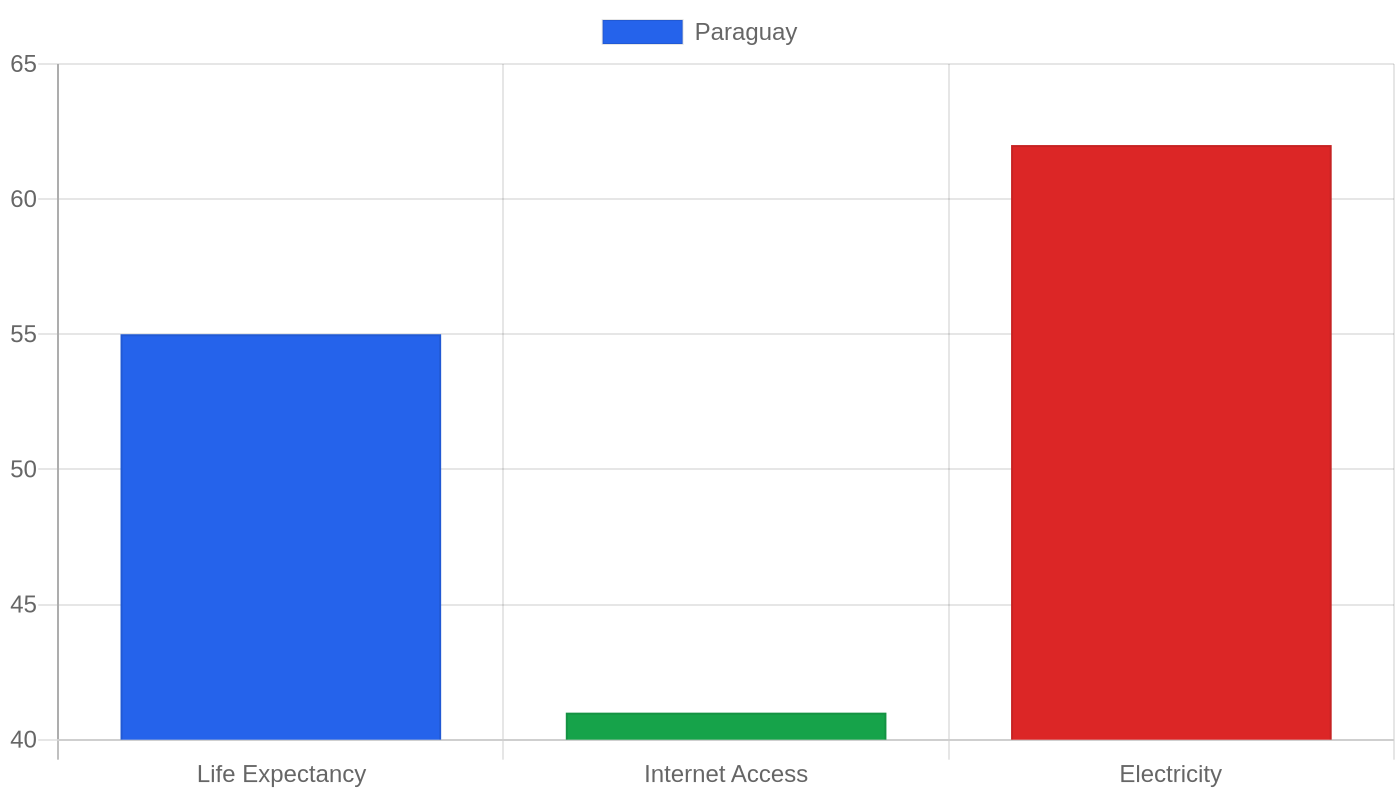
Data Transparency Gap: While structural data on GDP growth, inflation, and unemployment remains unavailable from the World Bank, the political and corporate infrastructure suggests a functioning, albeit opaque, economic engine.
Safety Unknowns: With crime and safety indices currently unreported, potential investors and residents must navigate these variables without standardized metrics, relying instead on local intelligence and established corporate presence.
The Economic Engine: Structure Over Statistics
Paraguay’s economic narrative is currently defined less by volatile headline numbers and more by its institutional backbone. While the World Bank reports that GDP growth, inflation CPI, and unemployment figures are currently N/A%, this absence of data does not equate to an absence of activity; rather, it highlights a reliance on qualitative indicators over quantitative ones in the current reporting cycle.
The economy is supported by a population whose size is also listed as N/A, suggesting that any analysis must focus on per-unit productivity and sectoral dominance rather than aggregate mass. In the absence of specific GDP (USD) or GNI per capita figures, the resilience of the Paraguayan market is best understood through its industrial composition. The main industries, though not explicitly detailed in terms of output volume, form the critical arteries of daily commerce and service delivery.
This lack of precise macroeconomic metrics forces analysts to look at the health of key players like ANDE for utility stability and the banking sector for liquidity trends. Ultimately, the “N/A” status serves as a reminder that while hard data may be missing, the underlying machinery of production and consumption continues to turn, driven by private enterprise and state regulation alike.
Living Costs: Navigating the Unmeasured Market
For expatriates and locals alike, understanding the cost of living in Paraguay requires looking beyond standard indices, as both the Cost of Living and Housing data are currently listed as N/A. Without specific rent-to-buy ratios or daily expense averages, prospective residents cannot rely on comparative regional benchmarks derived from this dataset.
However, the presence of established consumer services companies such as Aerolíneas Paraguayas, LATAM Paraguay, and Paranair indicates a functional transportation and travel infrastructure that likely influences the cost of mobility and connectivity. These entities suggest that while general price levels are unrecorded, the availability of essential services remains intact.
Consumers in Asunción and other urban centers likely face a mix of imported goods costs and local agricultural pricing, but without concrete inflation data, predicting purchasing power parity becomes an exercise in estimation rather than calculation. Therefore, budgeting for life in Paraguay should prioritize flexibility, acknowledging that the true cost of living may fluctuate independently of any tracked national average.
Investment & Business Climate: The Power of Conglomerates
The investment landscape in Paraguay is characterized by a concentration of influence among a few powerful domestic and international entities. Major companies such as Grupo Cartes, a prominent conglomerate, play a pivotal role in shaping the commercial environment, particularly in retail and energy sectors. The financial sector is robustly represented by institutions like Banco Amambay, Banco Itaú Paraguay, and the Central Bank of Paraguay, which together manage the flow of capital and credit across the nation.
Additionally, the Bolsa de Valores de Asunción provides a platform for public trading, signaling a developed, if perhaps small, equity market. For foreign investors, the entry points are clearly defined through these established pillars: utilities via ANDE, media reach through ABC Color, and aviation logistics via the three major carriers. This structure offers a stable, albeit closed, ecosystem where relationships with key corporate players are often more valuable than broad market speculation.
The business climate appears to reward those who understand the local hierarchy of these dominant firms rather than those seeking open, fragmented markets.
Safety, Politics & Quality of Life: A Structured Society
Paraguay presents a politically stable environment grounded in constitutional principles, even as social safety metrics remain obscured. The country functions as a representative democratic republic with a multi-party system, ensuring that executive, legislative, and judicial powers are distinct and independent. The President holds sole executive authority as head of state and government, while legislative power resides in the bicameral National Congress.
Judicial independence is guaranteed by tribunals, Courts of Civil Law, and a nine-member Supreme Court of Justice, creating checks and balances that protect against arbitrary governance. However, the Crime Index and Safety Index are both listed as N/A, leaving a significant gap in assessing personal security risks. This lack of data means that quality of life assessments must rely heavily on political stability and legal recourse rather than statistical safety scores.
Residents and businesses must therefore prioritize due diligence and local knowledge, as the formal indices do not provide a reliable guide to neighborhood safety or crime prevalence.
What’s Happening Now: Institutional Continuity
In the current moment, Paraguay’s most notable development is the steady operation of its democratic institutions amidst global uncertainty. The separation of powers continues to function as designed, with the judiciary remaining independent of the executive and legislature, a critical feature for long-term contractual enforcement and rule of law.
While specific policy shifts or election outcomes are not detailed in the immediate data set, the structural integrity of the National Congress and the Supreme Court suggests a predictable political timeline. Business operations continue uninterrupted, with major entities like ANDE and the Central Bank maintaining their regulatory and service roles.
The absence of real-time inflation or GDP data implies that short-term economic shocks are either being absorbed internally or are not yet captured in official statistics. Consequently, the “news” from Paraguay is one of continuity rather than crisis, with the focus remaining on the maintenance of institutional frameworks rather than rapid reform or upheaval.
Investors watching this space should monitor the interplay between the President’s executive actions and the National Congress’s legislative responses for early signals of economic direction.
The Bottom Line
Paraguay is a country of strong institutional foundations but incomplete data visibility. It is best suited for investors and observers who value political structure and corporate clarity over transparent macroeconomic metrics. Those willing to engage with established players like Grupo Cartes and the major banks can find a stable, if opaque, opportunity. For now, the story is one of waiting for clearer economic signals while relying on the strength of existing governance structures.
Sources & Methodology
This article is authored by Economic Pulse Net for informational and research purposes. Economic Pulse Net sources its data from multilateral institutions, national statistics bureaus, and proprietary databases. All data is believed to be current as of the date of publication.
Published: October 13, 2026 | Category: Research — Paraguay
Use these signals in your own platform
Economic Pulse publishes its live signal feed through a documented, read-only API. Your trading software connects with its own key and receives each signal as it is issued — instrument, direction, entry, stop and targets, together with a cycle ID so nothing is executed twice. The feed is independent of this website and cannot change it.
Signals are informational only and are not financial advice.