Economic Pulse Net | Sources: World Bank World Development Indicators, Government Sources | 2026
Key Takeaways
– Guyana has emerged as one of the world’s fastest-growing economies following major offshore oil discoveries, though exact GDP figures remain unconfirmed by the World Bank’s latest data.
– The country’s political landscape remains tense, with historical election-related violence and a parliamentary system that concentrates significant power in the presidency.
– Traditional industries like sugar, rum, and broadcasting coexist with a rapidly expanding oil sector, creating a dual economy that presents both opportunities and risks.
– State-owned enterprises dominate utilities and telecommunications, while private consumer goods companies like Banks DIH and Demerara Distillers hold significant market share.
– For investors and observers, Guyana represents a high-stakes case study in managing resource wealth within a fragile democratic framework.
The Great Petroleum Pivot — What the Numbers Tell Us
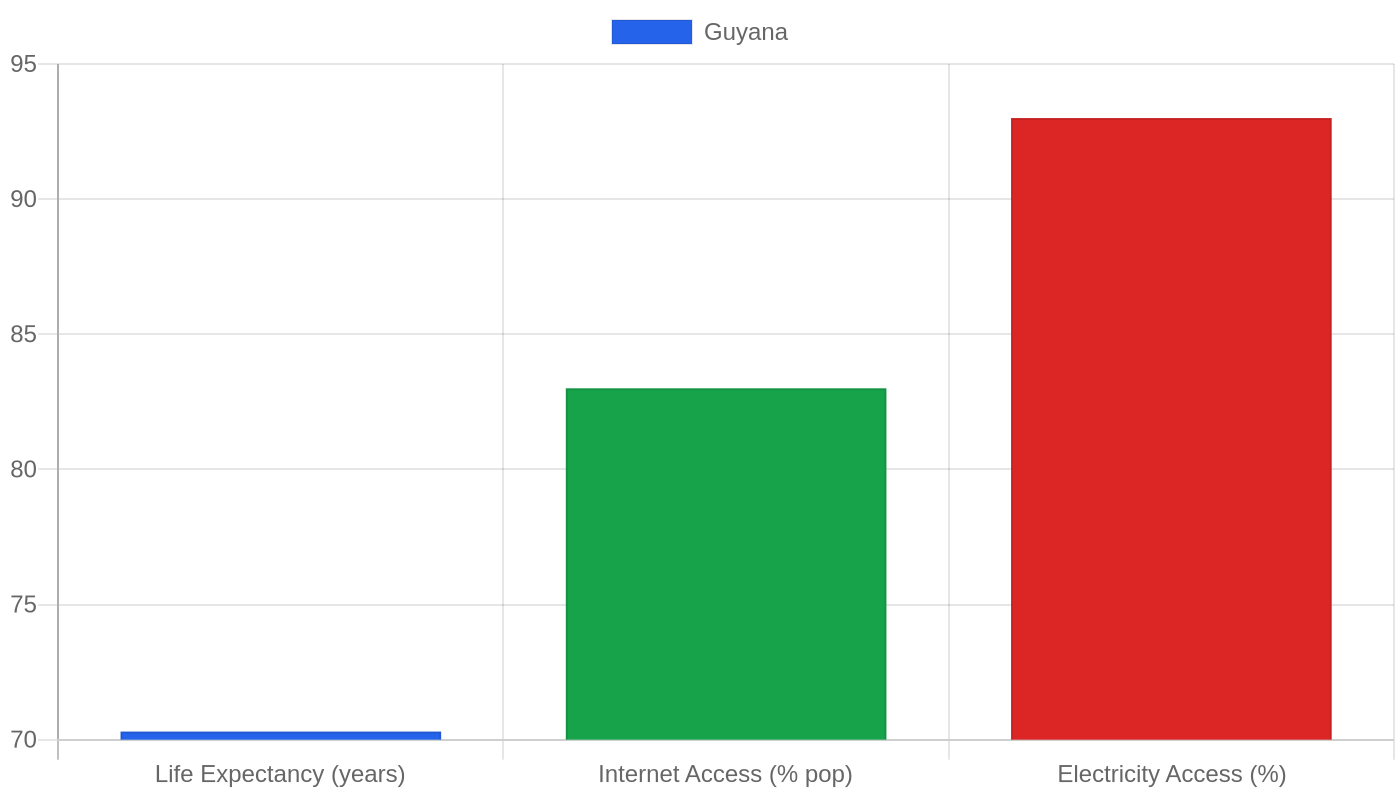
The World Bank’s latest economic data for Guyana presents an unusual challenge for analysts: key indicators including GDP growth, inflation, unemployment, and GDP per capita are all listed as unavailable. This absence of data is itself a story. It reflects the difficulty of tracking an economy undergoing such rapid structural change that traditional statistical frameworks struggle to keep pace. The World Bank’s data gaps should not be mistaken for economic stagnation — quite the opposite.
Guyana is in the midst of a transformation so profound that its economic contours are shifting faster than institutions can measure.
What is clear from the available information is the composition of the economy. The main industries tell a tale of two Guyanas. On one side stand the traditional pillars: sugar, rum, telecommunications, media, and utilities. Companies like Guyana Sugar Corporation, Demerara Distillers, and Banks DIH represent the old economy — consumer goods and agricultural processing that have defined Guyanese commerce for generations.
On the other side sits the new reality: an oil and gas sector that has catapulted this small nation onto the global energy stage. The World Bank’s inability to provide current GDP figures may be temporary, but it underscores how dramatically the economic landscape has shifted.
The Price of Paradise — Housing and Daily Life in a Boom Economy
The cost of living in Guyana has become a subject of intense local debate, though specific data on housing costs, rental markets, and daily expenses is not available from the World Bank or other provided sources. What can be inferred from the economic structure is that Guyana faces classic boom-economy pressures. As oil revenues flow in and international workers arrive, demand for housing, goods, and services has surged in Georgetown and surrounding areas.
The presence of major consumer goods companies like Banks DIH and Demerara Distillers suggests a domestic market that serves both local consumption and export demand.
For ordinary Guyanese, the gap between the oil-fueled economy and everyday reality is a central tension. While the national balance sheet improves, the cost of basic necessities — food, transportation, utilities — has likely risen alongside the influx of petrodollars. The utilities sector, dominated by Guyana Power and Light, operates in an environment where infrastructure must rapidly expand to meet growing demand.
Without precise cost-of-living data, the lived experience of Guyanese consumers remains partially obscured, but the structural pressures of a resource boom are unmistakable.
Where the Money Moves — Investment and Business in Guyana’s New Era
Guyana’s corporate landscape reveals a concentrated economy with strong state involvement and a handful of dominant private players. The Bank of Guyana sits at the center of the financial system, managing monetary policy in an era of unprecedented foreign exchange inflows. In telecommunications, Guyana Telephone and Telegraph Company and ENet control the digital infrastructure that connects this resource-rich nation to global markets.
The media sector, represented by Guyana Chronicle and Kaieteur News, operates within a political environment where press freedom and government influence remain delicate balancing acts.
For investors, the sectors to watch extend beyond oil. The consumer goods space, anchored by Banks DIH and Demerara Distillers, offers exposure to domestic spending power that is rising alongside national wealth. The utilities sector, through Guyana Power and Light, represents the infrastructure challenge that comes with rapid development — an opportunity for those who can help modernize the grid. The business environment, however, carries political risk.
As the provided data notes, “politics is a source of tension in the country, and violent riots have often broken out during elections.” This volatility is a factor that any serious investor must weigh against the obvious resource-driven upside.
Democracy Under Pressure — Safety, Politics, and the Quality of Life
The political landscape of Guyana is defined by a parliamentary representative democratic republic structure, where the president serves as both head of state and head of government within a multi-party system. Executive power rests with the president and the government, while legislative authority is shared between the presidency and the National Assembly.
This concentration of power, combined with the historical tensions described in the political data, creates a governance environment that is both resilient and fragile.
The crime and safety indices provided show no current data, which in itself is notable. For a nation experiencing rapid economic transformation, crime statistics often lag behind reality. The historical pattern of election-related violence mentioned in the political data is a recurring concern. Guyana’s quality of life is therefore a mixed picture: economic opportunity is expanding dramatically, but political stability remains an open question.
The country’s small population and tight-knit communities offer social cohesion, but the pressures of sudden wealth and inequality can test any society’s fabric.
The Pulse of 2025 — What’s Happening in Guyana Right Now
The most current developments in Guyana revolve around the management of its oil wealth and the political dynamics that accompany it. The World Bank’s data gaps suggest that even international institutions are struggling to keep up with the pace of change. The major companies listed — from the Bank of Guyana to Guyana Power and Light — are all navigating an environment where demand is outstripping supply, whether in electricity, telecommunications, or financial services.
Consumer goods companies like Banks DIH and Demerara Distillers are likely benefiting from increased domestic spending power, while traditional exporters like Guyana Sugar Corporation face the challenge of competing with oil for government attention and investment. The media sector, represented by Guyana Chronicle and Kaieteur News, continues to cover a story that is both national and global: how a small democracy manages the blessing and burden of resource wealth.
The political tension described in the data remains the undercurrent of every policy debate, every investment decision, and every public discussion about the country’s future.
The Bottom Line
Guyana is a country that demands attention from anyone interested in resource economics, democratic development, or the global energy transition. For investors, the opportunity is clear but comes with political risk that cannot be ignored. For policymakers and development professionals, Guyana offers a laboratory for managing oil wealth in a democratic context.
For the casual observer, it is one of the most dramatic economic stories of the decade — a small nation transformed almost overnight, carrying the hopes and anxieties of its people into an uncertain but undeniably prosperous future.
Sources & Methodology
This article is authored by Economic Pulse Net for informational and research purposes. Economic Pulse Net sources its data from multilateral institutions, national statistics bureaus, and proprietary databases. All data is believed to be current as of the date of publication.
Published: July 22, 2026 | Category: Research — Guyana
Use these signals in your own platform
Economic Pulse publishes its live signal feed through a documented, read-only API. Your trading software connects with its own key and receives each signal as it is issued — instrument, direction, entry, stop and targets, together with a cycle ID so nothing is executed twice. The feed is independent of this website and cannot change it.
Signals are informational only and are not financial advice.