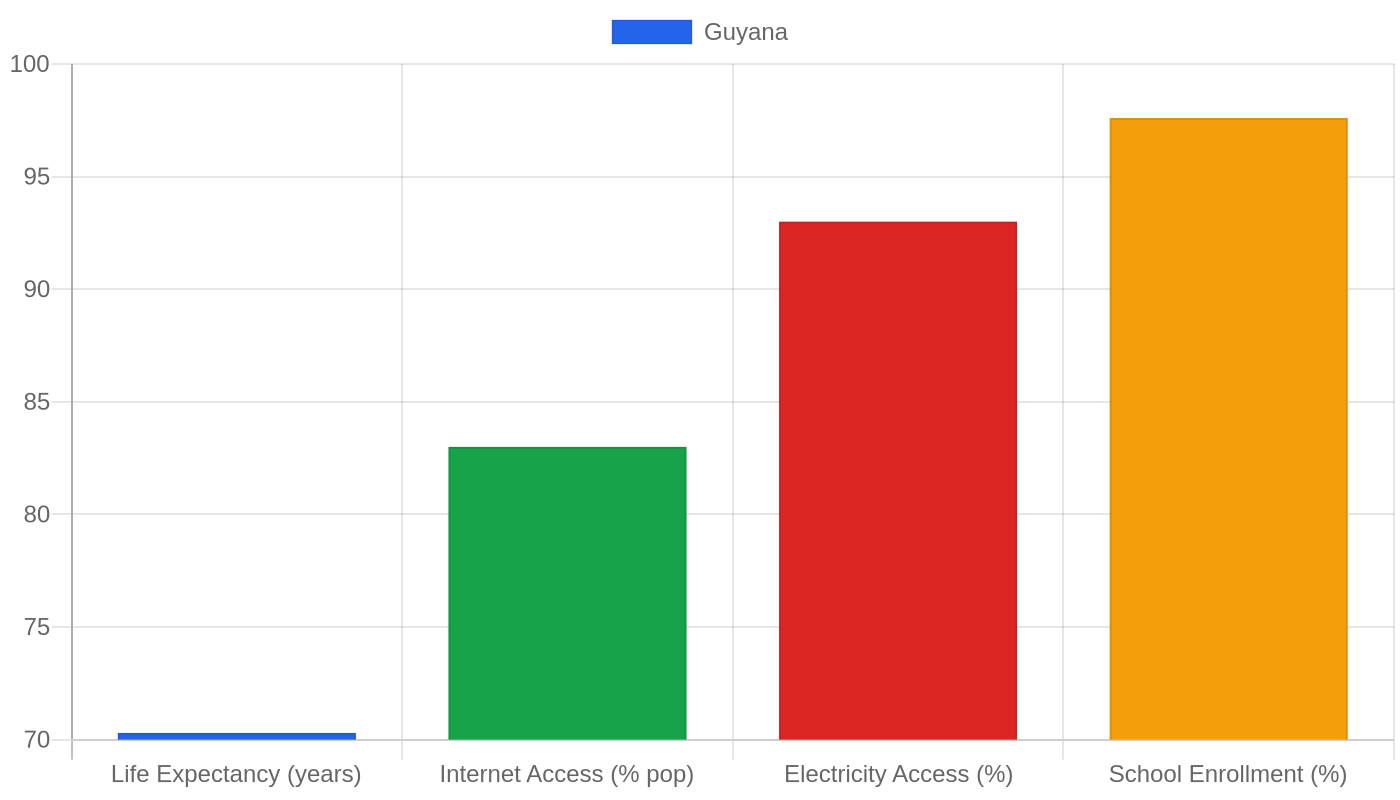
Economic Pulse Net | Sources: World Bank World Development Indicators, Government Sources | 2026
Key Takeaways
– Guyana is undergoing one of the most dramatic economic transformations in the developing world, driven by offshore oil discoveries that have reshaped its fiscal landscape and global standing.
– Political tensions remain a defining feature of national life, with historically volatile elections and deep ethnic divisions that periodically erupt into civil unrest.
– The economy remains heavily dependent on a handful of traditional industries—sugar, rum, telecommunications, and utilities—even as oil revenues flood state coffers.
– Cost of living pressures persist, with inflation and housing affordability emerging as critical concerns for ordinary Guyanese despite headline GDP growth.
– The country’s infrastructure—from power generation to internet connectivity—is struggling to keep pace with the demands of a rapidly expanding economy.
The Great Oil Gamble — Growth Without Guarantees
Guyana’s economic story is no longer a quiet Caribbean narrative of sugar exports and remittances. It is now a global headline. The discovery of massive offshore oil reserves has catapulted this small nation into the ranks of the world’s fastest-growing economies, yet the World Bank data available for this feature presents a paradox: the headline figures for GDP growth, inflation, unemployment, and GDP per capita are all marked as unavailable. This absence is itself telling.
It suggests a statistical system under strain, struggling to capture the velocity of change in real time.
What is clear from the data provided is that Guyana’s economic backbone remains a curious mix of the old and the new. The main industries list is dominated by traditional players: Guyana Sugar Corporation and **Demerara Distillers** in consumer goods, **Banks DIH** in beverages, and **Guyana Power and Light** in utilities. These are not the names of a high-tech petro-state. They are the institutions of an agrarian and industrial economy that has existed for decades.
The sugar industry, long a symbol of colonial legacy and post-independence struggle, continues to employ thousands, even as global sugar prices fluctuate and production costs rise.
The telecommunications sector, represented by Guyana Telephone and Telegraph Company and **ENet**, hints at a digital transition underway, but the presence of state-linked utilities like **Guyana Power and Light** underscores a fundamental reality: the infrastructure that underpins modern economic activity—reliable electricity, fast internet, stable financial systems—is still being built.
The Bank of Guyana, the central bank, sits atop the financials list, tasked with managing a monetary environment that must balance the inflationary pressures of oil wealth with the needs of a population that has not yet felt the boom in their daily lives.
The core economic challenge is one of distribution. Oil revenues are accruing to the state, but the mechanisms for translating that wealth into broad-based prosperity—better roads, hospitals, schools, and affordable goods—are still nascent. Inflation, though unquantified in the data, is a persistent concern in economies experiencing sudden resource inflows. When money pours in faster than the economy can produce goods and services, prices rise.
For the Guyanese shopper, that means the cost of imported food, construction materials, and fuel can climb even as the national accounts look spectacular.
The Price of Progress — Housing, Rent, and Daily Survival
For the average citizen, the oil boom is not yet visible in the grocery bill or the rent cheque. The cost of living data provided is sparse, but the absence of numbers does not mean the absence of pressure. In Georgetown, the capital, housing costs have become a flashpoint. The influx of expatriate workers, consultants, and oil industry personnel has driven up rental prices in desirable neighbourhoods, pushing long-term residents toward the periphery.
The gap between those who can capitalize on the boom and those who cannot is widening.
Rent versus buy calculations have shifted dramatically. A generation ago, homeownership was an achievable goal for middle-class Guyanese families. Today, land prices in and around the capital have soared, fueled by speculation and the expectation of continued economic expansion. Young professionals face a choice: pay exorbitant rent for a modest apartment or commute from distant suburbs where infrastructure—water, electricity, roads—remains unreliable.
The cost of construction materials, many of which are imported, has risen in tandem with global supply chain pressures, making new builds prohibitively expensive for all but the wealthy.
Daily expenses for food and transport reflect a similar strain. Guyana imports a significant portion of its consumer goods, from rice varieties to canned goods to electronics. The depreciation of the local currency against major trading partners, combined with global inflation, means that the purchasing power of the Guyanese dollar is under constant pressure.
Street vendors and small shopkeepers, the backbone of the informal economy, report that customers are buying less, buying cheaper, and stretching meals further. The paradox of a booming economy and a squeezed household is the defining lived experience of contemporary Guyana.
Business and the Boom — Who Is Winning?
The corporate landscape of Guyana is dominated by a small group of entrenched players, many of which are listed in the data. Banks DIH, a beverage and food conglomerate, is a household name, producing everything from beer to soft drinks to ice cream. **Demerara Distillers** is famous globally for its rums, particularly the El Dorado brand, and represents one of the country’s few successful export stories outside of commodities.
These companies have deep roots in the economy and are well-positioned to supply the growing domestic market as oil wealth trickles down.
Guyana Power and Light (GPL) is a critical but troubled entity. The state-owned utility has long struggled with aging infrastructure, frequent blackouts, and high transmission losses. For businesses, unreliable power is a major constraint. Manufacturing, cold storage, and even basic retail operations require consistent electricity. The government has pledged to modernize GPL, but progress has been slow.
Similarly, **Guyana Telephone and Telegraph Company** (GTT) and **ENet** are locked in a battle to expand broadband access, a prerequisite for the digital economy that oil wealth is supposed to enable.
The business environment is a study in contrasts. For international oil companies and their supply chains, Guyana offers enormous opportunity. For local entrepreneurs, the picture is more complex. Access to credit, bureaucratic red tape, and the dominance of established players create barriers to entry. The media sector, represented by Guyana Chronicle, **Kaieteur News**, and **Guyana Broadcasting Corporation**, reflects a vibrant but polarized public sphere, where business and politics are deeply intertwined.
The sectors to watch are construction, logistics, hospitality, and financial services—all of which are being reshaped by the influx of petrodollars.
Politics, Safety, and the Fragile Social Contract
The political landscape of Guyana, as described in the data, is a “source of tension,” with “violent riots” breaking out during elections. This is not a footnote; it is the central reality of Guyanese public life. The country’s politics are organized along ethnic lines, primarily between the Indo-Guyanese and Afro-Guyanese communities, a legacy of British colonial divide-and-rule policies.
The two main political parties—the People’s Progressive Party (PPP) and the People’s National Congress (PNC)—have alternated power in an atmosphere of mutual suspicion and, at times, open hostility.
Elections are high-stakes affairs. The 2020 general election was marred by a five-month delay, allegations of fraud, and international pressure before the PPP’s Irfaan Ali was eventually sworn in as president. The aftermath saw protests and clashes. This volatility has real consequences for investment and quality of life. Businesses factor political risk into their planning. Citizens live with the knowledge that the next election cycle could bring instability.
The data notes that “violent riots have often broken out during elections,” a phrase that carries the weight of lived experience for many Guyanese.
Crime and safety indices are listed as unavailable, but anecdotal evidence from local reporting suggests that property crime, petty theft, and gang-related violence are concerns, particularly in urban areas. The police force is under-resourced and sometimes accused of politicization. For the average citizen, safety is a matter of neighbourhood vigilance and personal caution rather than institutional trust.
The quality of life, beyond material consumption, is shaped by these realities: a society that is simultaneously hopeful about its economic future and anxious about its political stability.
What’s Happening Now — The Present Tense of Transformation
Right now, Guyana is in a phase of feverish construction and cautious expectation. The government is racing to build the infrastructure that a modern economy requires: new roads, a deep-water port, expanded electricity generation, and housing developments. The oil sector is generating revenues that were unimaginable a decade ago, but the debate in Georgetown is not about whether the money is coming—it is about where it is going.
Transparency advocates, civil society groups, and opposition politicians are demanding accountability, warning of the “resource curse” that has afflicted other petro-states.
Inflation is the quiet crisis of the moment. While the data does not provide a specific CPI figure, the central bank, the Bank of Guyana, has been active in managing liquidity and attempting to stabilize prices. The cost of imported goods, from food to fuel to construction materials, is a constant topic of conversation. The government has introduced some subsidies and price controls, but these are short-term measures.
The long-term solution—diversifying the economy away from imports and building domestic productive capacity—remains a work in progress.
The political temperature is never low for long. With the next general election on the horizon, the opposition is mobilizing, and the ruling party is consolidating its base. The media landscape, dominated by outlets like Kaieteur News and **Guyana Chronicle**, is fiercely partisan, and debates over oil revenue management, corruption allegations, and ethnic representation dominate the headlines.
The international community is watching closely, with institutions like the World Bank and the International Monetary Fund offering technical assistance and policy advice. The question on everyone’s mind is whether Guyana can defy the odds and build a stable, inclusive, and prosperous society on the foundation of its oil wealth.
The Bottom Line
Guyana is not a country to watch from a distance—it is a country that demands attention. For investors, the opportunities in energy, infrastructure, and consumer markets are genuine, but they come with political risk that cannot be ignored. For policymakers and development professionals, Guyana offers a rare and urgent case study in how to manage sudden resource wealth in a fragile democracy.
For the ordinary citizen, it is a place of profound hope and deep anxiety, where the promise of prosperity must contend with the weight of history. The next five years will determine whether Guyana becomes a model for the developing world or another cautionary tale of oil and unrest.
Sources & Methodology
This article is authored by Economic Pulse Net for informational and research purposes. Economic Pulse Net sources its data from multilateral institutions, national statistics bureaus, and proprietary databases. All data is believed to be current as of the date of publication.
Published: July 23, 2026 | Category: Research — Guyana
Use these signals in your own platform
Economic Pulse publishes its live signal feed through a documented, read-only API. Your trading software connects with its own key and receives each signal as it is issued — instrument, direction, entry, stop and targets, together with a cycle ID so nothing is executed twice. The feed is independent of this website and cannot change it.
Signals are informational only and are not financial advice.