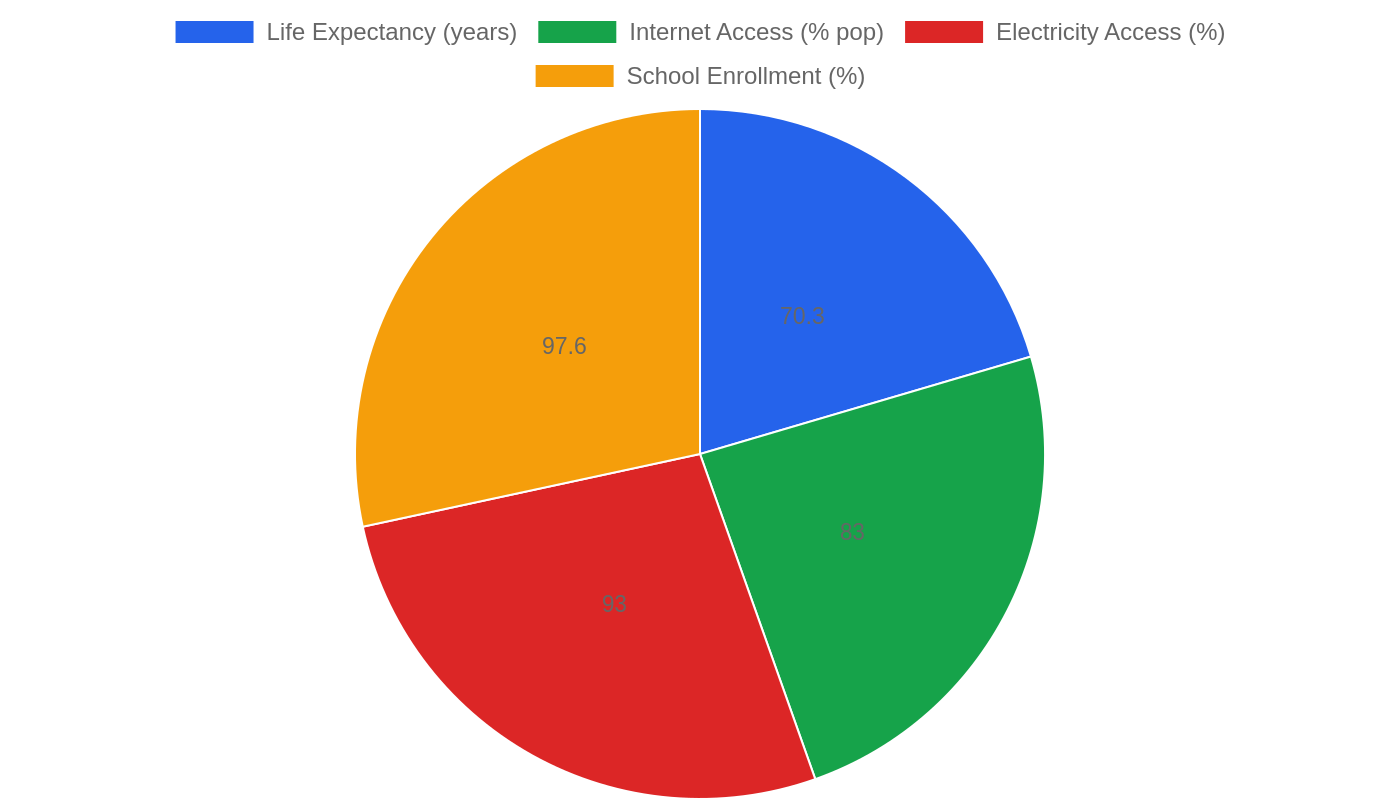
Economic Pulse Net | Sources: World Bank World Development Indicators, Government Sources | 2026
Key Takeaways
– Guyana is undergoing one of the most dramatic economic transformations in the developing world, driven by a massive offshore oil and gas sector that has fundamentally altered the country’s fiscal landscape.
– The nation’s political environment remains a critical variable, with historical tensions between ethnic-based parties frequently boiling over during election cycles and threatening social stability.
– Traditional industries like sugar, rum, and broadcasting continue to operate alongside a rapidly expanding energy sector, creating a dual economy of old and new capital.
– Cost of living pressures are mounting in Georgetown and other urban centers as new wealth flows in, though comprehensive national data on inflation and housing remains limited.
– Investors and multinational corporations are closely watching Guyana’s regulatory evolution, as the government balances rapid resource extraction with long-term development planning.
The Great Energy Pivot — Guyana’s Economic Earthquake
The economic story of Guyana is no longer about sugar cane and rum. It is about crude oil. While the World Bank has not released the most recent GDP growth figures, the trajectory is unmistakable: Guyana has emerged as one of the fastest-growing economies on the planet, driven by discoveries in the Stabroek Block that have transformed a small, agrarian nation into a frontier energy producer.
The numbers that are available from the World Bank tell only part of the story — the absence of current GDP data itself reflects how rapidly the ground is shifting beneath the country’s feet.
What matters most is not the precise percentage of growth, but the structural change underway. Guyana’s economy was historically anchored in agriculture, mining, and light manufacturing. Today, oil and gas revenues are flooding state coffers, enabling infrastructure spending and social programs that were unimaginable a decade ago.
Yet the World Bank data also shows significant gaps in key indicators like inflation and unemployment, suggesting that the statistical apparatus has not kept pace with the economic transformation. This is a common challenge in resource-boom economies: the macro picture improves dramatically while micro-level data collection lags.
The implications are profound. A country that once relied on remittances and commodity exports now finds itself managing windfall revenues that could either build a diversified, resilient economy or create the classic “resource curse” of Dutch disease, inequality, and institutional decay. The absence of reliable inflation data from the World Bank is itself a warning sign — without accurate price indices, policymakers cannot calibrate monetary policy effectively.
The Bank of Guyana, listed among the country’s top companies, faces the monumental task of maintaining stability in an economy awash in petrodollars.
Georgetown’s New Price Tag — Living in a Boom Economy
For ordinary Guyanese, the oil boom is a double-edged sword. While the World Bank has not provided specific cost-of-living data, the anecdotal evidence from Georgetown and the coastal belt is consistent: rents have surged, imported goods have become more expensive, and the gap between those connected to the oil industry and those outside it has widened.
The country’s main industries — sugar, rum, telecommunications, and utilities — employ thousands, but their workers now compete for housing and services with expatriate oil workers and returning diaspora professionals.
The housing market in Georgetown has become particularly tight. Properties that were once affordable to middle-class civil servants are now out of reach, as new demand from energy sector employees and foreign contractors drives up prices. The option to buy versus rent is increasingly skewed toward those with access to foreign currency or oil-linked incomes.
For the majority of Guyanese who work in traditional sectors like sugar production at Guyana Sugar Corporation or consumer goods at Banks DIH and Demerara Distillers, the rising cost of daily necessities — food, transport, utilities — is squeezing household budgets.
Regional comparisons are difficult without hard data, but the pattern is familiar across resource-rich small economies. The cost of living in Georgetown likely now exceeds that of other Caribbean capitals that lack oil wealth, while rural areas remain significantly cheaper. This geographic disparity mirrors the economic divide: the oil boom is concentrated offshore and in the capital, leaving the interior and traditional agricultural regions to grapple with inflation without the compensating income growth.
Old Money, New Players — Guyana’s Evolving Corporate Landscape
The list of Guyana’s top companies reveals a country in transition. Alongside legacy firms like Banks DIH, Demerara Distillers, and Guyana Sugar Corporation — names that have defined Guyanese commerce for generations — sit utilities and telecommunications giants like Guyana Power and Light, Guyana Telephone and Telegraph Company, and ENet.
The media sector is also well-represented, with Guyana Broadcasting Corporation, Guyana Chronicle, and Kaieteur News reflecting a relatively vibrant, if politically charged, public sphere.
What is striking is the absence of major international oil companies from this list — not because they are unimportant, but because the data provided reflects locally registered firms. The real economic action is happening through subsidiaries and joint ventures of global energy majors, which do not appear in the top companies ranking but whose influence dwarfs every other sector.
This creates an unusual dynamic: the most powerful economic actors in Guyana are not headquartered in Georgetown, and their local supply chains are still developing.
For investors, the business climate is a study in contrasts. The energy sector offers enormous opportunities in logistics, services, and infrastructure. But the broader business environment faces challenges common to small, post-colonial economies: bureaucratic hurdles, infrastructure gaps, and political risk.
The presence of multiple media companies suggests a relatively open information environment, which can be a double-edged sword for businesses — transparency can attract investment, but it also means that political battles are fought publicly, often with economic consequences.
The Politics of Division — Stability and Risk in a Young Republic
The political landscape of Guyana, as described in the data, operates within a framework of a parliamentary representative democratic republic. The president serves as both head of state and head of government, and power is divided between the executive and the National Assembly. On paper, this is a stable, multi-party system. In practice, the data warns that “politics is a source of tension in the country, and violent riots have often broken out during elections.”
This is the critical context for any assessment of Guyana’s future. The country’s politics are deeply ethnicized, with the two major parties drawing support primarily from Afro-Guyanese and Indo-Guyanese communities respectively. Every election cycle carries the risk of unrest, and the memory of past violence — most notably the 2020 election crisis, which saw months of tension before a change in government — remains fresh.
For a country attracting billions in foreign investment, political stability is not a given; it is a daily negotiation.
The crime and safety indices are listed as not available, which itself is telling. In the absence of reliable data, perceptions are shaped by anecdote and media coverage. Georgetown has areas of genuine concern, particularly at night, and the combination of rapid wealth creation, inequality, and political polarization creates conditions that can fuel crime.
For expatriates and investors, security is a genuine consideration, though the risks are concentrated and manageable for those who can afford private precautions.
Current Affairs — Navigating the Post-Election Landscape
As of this writing, Guyana is living through the aftershocks of its most recent election and the continued ramp-up of oil production. The government, led by the People’s Progressive Party, is pursuing an aggressive development agenda funded by petroleum revenues. Infrastructure projects — roads, bridges, hospitals, schools — are underway across the coastal region.
The challenge is execution: Guyana’s institutional capacity is stretched thin, and the pace of spending has raised concerns about oversight and corruption.
The energy sector itself continues to expand. New production vessels are being brought online, and exploration is ongoing. The government is also pushing for a local content policy that would require oil companies to source more goods and services from Guyanese firms, a move that could reshape the business landscape significantly.
Meanwhile, the traditional sugar industry, represented by Guyana Sugar Corporation, continues to struggle with global prices and aging infrastructure, raising questions about the social cost of the energy transition.
Inflation remains a live concern. While the World Bank has not provided a current CPI figure, prices for food, fuel, and housing have risen noticeably, driven by both global factors and domestic demand. The Bank of Guyana faces the delicate task of managing monetary policy in an economy where oil revenues are denominated in foreign currency but most transactions occur in Guyanese dollars. The risk of overheating is real, and the tools available to a small central bank are limited.
The Bottom Line
Guyana is a nation at a crossroads, experiencing a resource boom that could lift millions out of poverty or deepen existing inequalities. The World Bank data gaps reflect the reality of a country whose statistical systems are struggling to keep up with its economic transformation. Investors and policymakers should watch Guyana closely — not just for the oil, but for the test case it represents in whether rapid resource wealth can be managed democratically and equitably in a small, divided society.
The next five years will determine whether Guyana becomes a Caribbean success story or a cautionary tale.
Sources & Methodology
This article is authored by Economic Pulse Net for informational and research purposes. Economic Pulse Net sources its data from multilateral institutions, national statistics bureaus, and proprietary databases. All data is believed to be current as of the date of publication.
Published: July 18, 2026 | Category: Research — Guyana
Use these signals in your own platform
Economic Pulse publishes its live signal feed through a documented, read-only API. Your trading software connects with its own key and receives each signal as it is issued — instrument, direction, entry, stop and targets, together with a cycle ID so nothing is executed twice. The feed is independent of this website and cannot change it.
Signals are informational only and are not financial advice.