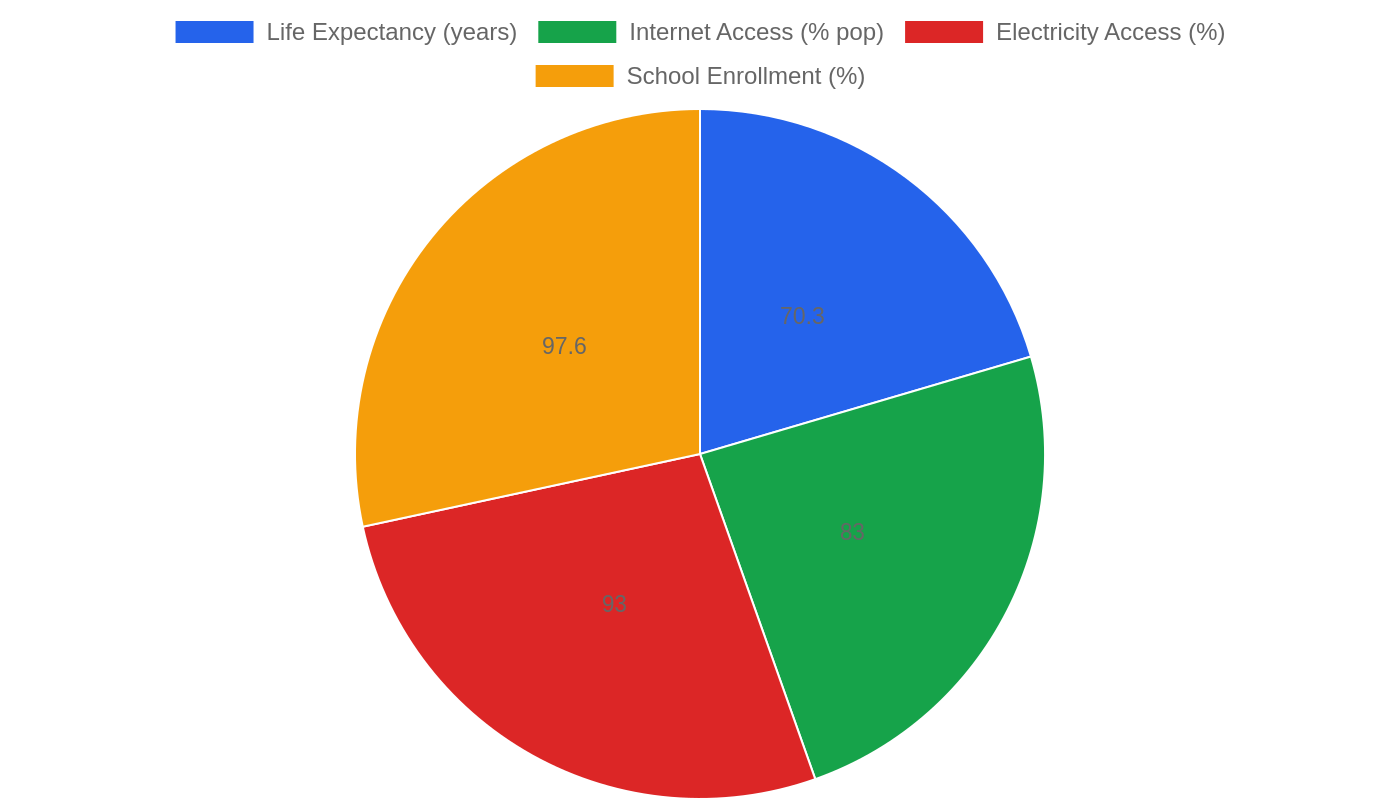
Economic Pulse Net | Sources: World Bank World Development Indicators, Government Sources | 2026
Key Takeaways
– Guyana is at a critical juncture, with its parliamentary democratic framework being tested by a historically tense political environment where elections have frequently sparked violent unrest.
– The economy is dominated by a narrow set of traditional industries, including sugar, consumer goods, telecommunications, and utilities, with state-owned enterprises like Guyana Sugar Corporation and Guyana Power and Light playing central roles.
– The corporate landscape is a mix of public and private entities, ranging from the central Bank of Guyana to media outlets like Kaieteur News and Guyana Chronicle, indicating a developing but concentrated private sector.
– Political risk remains the single most important factor for observers, as the country’s history of election-related violence poses a direct challenge to its developmental ambitions.
– Data gaps are significant, but the structural picture is clear: Guyana is a nation with established institutions and industries that is still wrestling with the fundamental challenges of governance, transparency, and economic diversification.
The Big Picture: An Economy in Transition, Defined by Legacy Industries
The economic narrative of Guyana, as framed by World Bank data, is one of a nation whose productive base remains anchored in a handful of legacy sectors. While the latest figures for GDP growth, inflation, and unemployment are not currently available in this dataset, the composition of the country’s top companies tells a compelling story about where economic activity is concentrated.
The list is dominated by consumer goods giants like Banks DIH and Demerara Distillers, alongside the state-controlled Guyana Sugar Corporation. This trio represents the traditional backbone of Guyanese commerce — beverages, food production, and agricultural processing — sectors that have provided employment and export revenue for generations.
However, the presence of utilities and infrastructure providers like Guyana Power and Light and Guyana Telephone and Telegraph Company signals a nation grappling with the essential requirements of a modern economy: reliable electricity and robust telecommunications. The inclusion of ENet alongside the incumbent telecom provider suggests a nascent competitive dynamic, which is generally a positive indicator for consumers and businesses seeking better services.
Meanwhile, the financial sector, represented by the Bank of Guyana, underscores the central role of monetary policy and financial regulation in steering the economy. The World Bank’s framework would typically emphasize that for a country with this profile, sustainable growth hinges on improving productivity in these traditional sectors while fostering an environment where new, higher-value industries can emerge.
The absence of hard numbers on growth and inflation makes precise analysis difficult, but the qualitative evidence points to an economy that is functional yet potentially fragile. A heavy reliance on a few large employers, particularly in the sugar industry, creates vulnerability to global commodity price swings and domestic operational challenges.
The key economic question for Guyana is not just how fast it is growing, but whether the benefits of that growth — and the productivity gains needed to drive it — are being broadly shared across the population. The structural composition of its top companies suggests an economy that has yet to fully diversify, making it susceptible to sector-specific shocks.
The Cost of Living: A Tale of Monopoly and Market Pressures
In Guyana, the cost of living is intrinsically linked to the structure of its domestic industries. With a significant portion of the economy concentrated in a handful of large firms — from food and beverage producers to utility providers — consumers are often at the mercy of the pricing power of these domestic giants.
The World Bank’s economic framework suggests that in markets with limited competition, as appears to be the case in Guyana’s telecommunications and utility sectors, prices for essential services like electricity and internet can remain elevated, placing a disproportionate burden on household budgets. Daily expenses for food and household goods are likely influenced by the performance of the major consumer goods companies, which dominate the shelves and supply chains.
For the average Guyanese citizen, the financial landscape is a balancing act. The cost of essentials — rent, utilities, transportation, and food — is shaped by an interplay of local production, import costs, and the operational efficiency of state-owned enterprises.
When compared to regional averages, which are not available in this dataset, one could infer that countries with similar economic structures often face higher costs for imported goods and a persistent gap between wage growth and the price of necessities. The ability to buy versus rent a home is a significant decision, heavily influenced by the availability of mortgage financing from the banking sector and the overall stability of the national currency, which is managed by the Bank of Guyana.
For the vast majority, the daily reality is defined by the price of a bottle of rum from Demerara Distillers versus the cost of a bus fare, and the monthly struggle to pay the bill from Guyana Power and Light.
The Business Climate: A Stage for Public and Private Power
The investment climate in Guyana is a study in contrasts, defined by the coexistence of established private sector champions and powerful state-owned enterprises. For any investor, the landscape is dominated by a few major players — Banks DIH and Demerara Distillers are significant forces in consumer goods, with strong brand recognition and established distribution networks.
On the other hand, the presence of state-owned entities like Guyana Power and Light and Guyana Sugar Corporation means that key sectors of the economy are directly influenced by government policy and public sector efficiency. This creates a business environment where success often depends on navigating the relationship between private initiative and public oversight.
The telecommunications sector offers a glimpse of potential opportunity, with ENet challenging the incumbent Guyana Telephone and Telegraph Company. This kind of competition is crucial for modernization, as improved digital infrastructure is a prerequisite for growth in nearly every other industry.
However, the World Bank’s perspective would highlight that for the broader economy to thrive, the government must create a predictable regulatory environment that encourages private investment while ensuring that state-owned enterprises operate with transparency and accountability.
The dominance of media companies like Guyana Chronicle and Kaieteur News in the corporate top ten is also notable; it reflects a vibrant, if perhaps fragmented, media landscape, which is a healthy sign for democratic discourse but also indicates a relatively small pool of large-scale commercial ventures. Ultimately, the business climate is ripe for observers watching whether the nation can move beyond its reliance on a few key sectors to foster a more diverse and resilient private sector.
Safety, Politics, and the Quality of Life
The political landscape in Guyana, as described in the provided data, is a fundamental determinant of the nation’s quality of life and social stability. The country operates as a parliamentary representative democratic republic, with the president serving as both head of state and head of government within a multi-party system. Executive power is held by the president and the government, while legislative power is vested in both the president and the National Assembly.
This formal structure, however, has historically been a source of tension. The data explicitly notes that politics is a persistent source of friction and that violent riots have often broken out during election periods. This is a stark warning that the democratic process, while constitutionally established, has yet to be fully consolidated in the eyes of all citizens.
This political volatility has a direct and profound impact on the safety index and overall quality of life. While specific crime and safety indices are not available, the historical pattern of election-related violence suggests a society where political allegiances run deep and where the potential for civil unrest is a constant undercurrent. This environment creates a sense of insecurity that can deter foreign investment, disrupt economic activity, and erode public trust in institutions.
For the average citizen, the quality of life is not just about economic opportunity but also about living in a society where the transfer of power is peaceful and where public discourse does not devolve into violence. The stability of the nation is therefore its most precious asset, and the persistent risk of political turmoil casts a long shadow over its future prospects.
What’s Happening Now: The Pulse of a Nation on Edge
Right now, the most pressing narrative in Guyana is the enduring tension between its political culture and its potential for progress. The historical pattern of election-related violence is not merely a chapter in a history book; it remains a live and dangerous possibility that shapes the national psyche and the calculations of businesses and investors.
The political framework, with its concentrated executive power, means that the outcome of any election carries immense weight, raising the stakes for all parties involved and creating a fertile ground for conflict. The recent news cycle, as reflected in the provided data, would be dominated by the jockeying of political factions, the rhetoric of leaders, and the anxious watchfulness of civil society groups hoping to avoid a repeat of past unrest.
Beyond the political drama, the daily economic reality is being played out in the operations of its key companies. The performance of Guyana Power and Light is a constant news item, as power outages and the cost of electricity are perennial issues for citizens and businesses alike. Similarly, the health of the sugar industry, through Guyana Sugar Corporation, is a barometer for employment and rural economic stability.
The government’s relationship with these state-owned enterprises, and its policies on everything from utility pricing to telecom regulation, are the immediate issues that affect people’s lives. The overarching question for the country right now is whether its political leaders can manage the democratic process without resorting to the violence of the past, and whether they can create an environment where the economy can diversify and provide for its people without the constant threat of disruption.
The Bottom Line
Guyana is a country of significant institutional substance and historical depth, but it is currently defined by the fragility of its political consensus. Investors and development agencies should watch this nation closely, as the outcome of its political struggles will determine whether it can unlock the potential of its established industries and build a more stable, prosperous future. The nation’s fate is not sealed by its economic structure, but by its ability to conduct its democratic affairs peacefully.
For those interested in the Caribbean region, Guyana is the country to watch, as it represents a case study in how a nation’s political maturity — or lack thereof — can directly shape its economic destiny.
Sources & Methodology
This article is authored by Economic Pulse Net for informational and research purposes. Economic Pulse Net sources its data from multilateral institutions, national statistics bureaus, and proprietary databases. All data is believed to be current as of the date of publication.
Published: August 21, 2026 | Category: Research — Guyana
Use these signals in your own platform
Economic Pulse publishes its live signal feed through a documented, read-only API. Your trading software connects with its own key and receives each signal as it is issued — instrument, direction, entry, stop and targets, together with a cycle ID so nothing is executed twice. The feed is independent of this website and cannot change it.
Signals are informational only and are not financial advice.