Economic Pulse Net | Sources: World Bank World Development Indicators, Government Sources | 2026
Key Takeaways
* Political Volatility: Guyana operates as a parliamentary democratic republic, but its history is marked by significant tension, with violent riots frequently breaking out during election cycles.
Corporate Landscape: The business environment is dominated by key players in financials, utilities, and consumer goods, including Bank of Guyana, Guyana Power and Light, and Banks DIH.
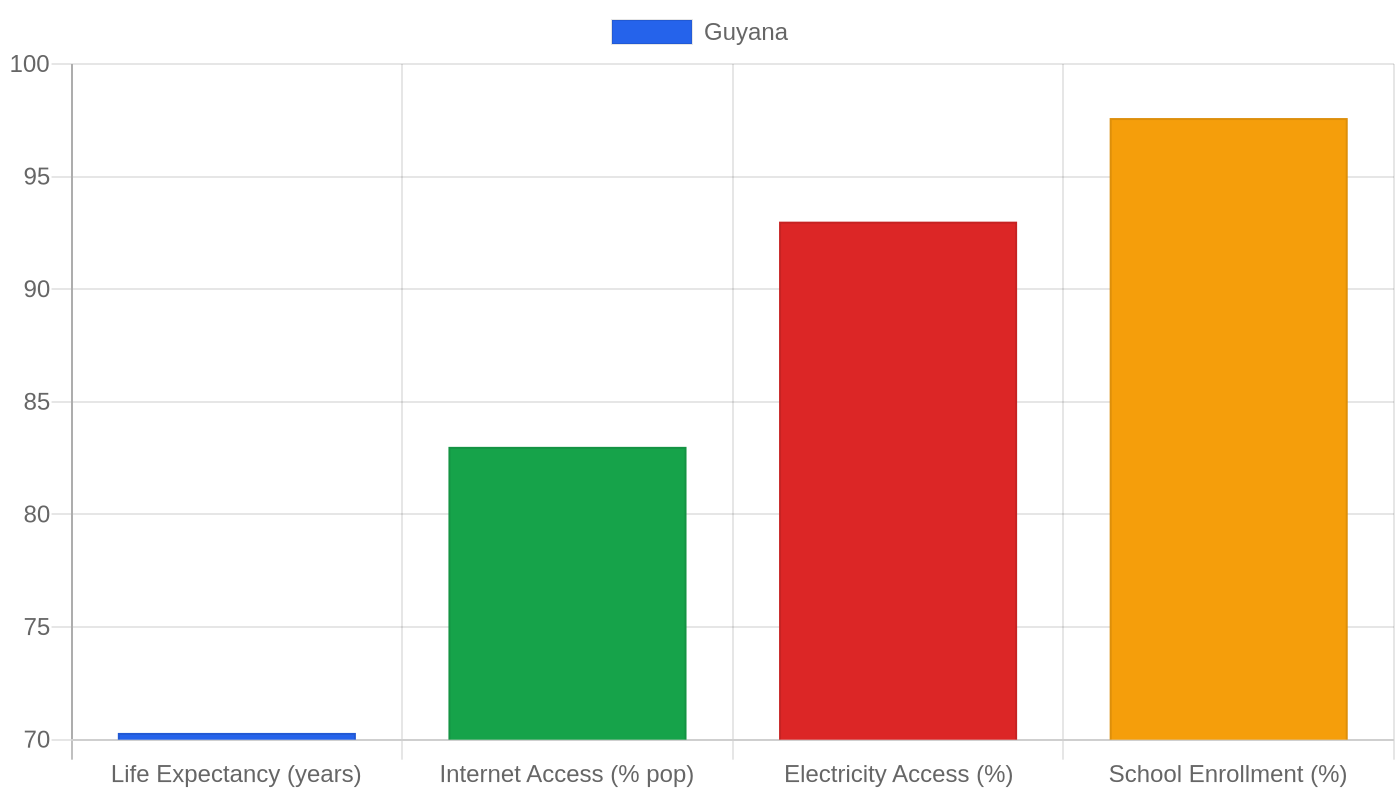
Data Gaps: Current World Bank metrics for GDP growth, inflation, unemployment, and per capita income are not available, requiring investors to rely on structural indicators rather than macroeconomic snapshots.
Safety Concerns: Specific crime and safety indices are currently unreported, suggesting that security considerations remain a critical, albeit undefined, variable for residents and expatriates.
Media Freedom: A diverse array of media outlets, from Kaieteur News to the Guyana Chronicle, plays a vital role in informing the public within this multi-party system.
Economic Foundations Amidst Data Vacuums
The economic narrative of Guyana is currently defined as much by what is missing as by what is present, presenting a unique challenge for analysts seeking precise macroeconomic diagnostics. According to the World Bank, critical indicators such as GDP growth, inflation rates measured by CPI, and unemployment figures are listed as N/A, leaving a void in quantitative assessment.
Similarly, hard data on GDP in USD, GDP per capita at purchasing power parity (PPP), and Gross National Income (GNI) per capita are unavailable, complicating efforts to gauge the standard of living or the sheer scale of the economy relative to global peers.
This lack of granular statistical reporting means that traditional economic health checks—such as comparing inflation trends against central bank targets or analyzing labor market tightness through unemployment rates—cannot be performed with current official datasets.
Consequently, observers must look beyond headline numbers to understand the underlying structure of the economy, which appears heavily reliant on a handful of established industrial pillars rather than a broad, statistically tracked services or manufacturing sector. The absence of these figures does not imply economic stagnation, but rather highlights a potential gap in data collection infrastructure or reporting transparency that international bodies have yet to fill.
For investors, this creates an environment where qualitative analysis of corporate performance and political stability becomes more valuable than quantitative modeling based on national accounts. It forces a reliance on micro-level signals, such as the operational status of major utilities and the consumer behavior reflected in the top companies’ revenues, to infer broader economic momentum.
Without reliable GDP or inflation data, predicting short-term economic shocks or long-term growth trajectories remains an exercise in speculation rather than empirical analysis. Therefore, the “economy” of Guyana, as currently reported, is best understood as a collection of active industrial entities operating within a framework where aggregate national performance metrics are obscured.
Cost of Living and Daily Expenses
For residents and potential expatriates, the cost of living in Guyana is shaped by the availability of essential services and consumer goods, though specific price indices are not provided in the current dataset. Housing costs, rent versus buy scenarios, and daily expense comparisons to regional averages cannot be quantified precisely due to the lack of cost-of-living data points.
However, the presence of established utility providers like Guyana Power and Light suggests that infrastructure costs are managed by regulated entities, potentially offering some stability compared to markets with privatized, volatile energy sectors. The consumer goods sector is served by prominent local firms such as Banks DIH and Demerara Distillers, indicating that basic consumption needs are met by domestic production and distribution networks rather than solely through imports.
This domestic focus may influence pricing structures, potentially insulating certain goods from global supply chain fluctuations, although without inflation data, the direction of price movements remains unclear. Telecommunications services, handled by ENet and the Guyana Telephone and Telegraph Company, represent another fixed cost component for households, with competition between two major players likely influencing service quality and pricing tiers.
In the absence of comparative regional data, it is difficult to determine if Guyana’s expenses are high or low relative to neighboring Caribbean nations, leaving individuals to assess affordability based on personal income levels and local market conditions. The general impression is one of a self-contained economic ecosystem where daily life revolves around locally produced goods and state-influenced utilities, making budget planning dependent on direct observation rather than standardized indices.
Ultimately, while the financial burden of living in Guyana cannot be calculated via CPI or housing indexes, the structural reliance on local corporations implies that economic pressures are felt most acutely at the level of individual corporate pricing strategies.
Investment and Business Climate
The investment landscape in Guyana is characterized by a concentrated group of dominant enterprises across key sectors, offering both opportunities and risks tied to their market positions. The financial sector is anchored by Bank of Guyana, providing the necessary credit infrastructure for businesses, while the utilities sector is controlled by Guyana Power and Light, ensuring that energy access—a prerequisite for industrial activity—is centralized.
Consumer goods manufacturers such as Banks DIH, Demerara Distillers, and Guyana Sugar Corporation form the backbone of the retail market, suggesting that investments in distribution, logistics, or raw material supply could yield returns given their established market share. Telecommunications, a critical enabler of modern business, is served by ENet and the Guyana Telephone and Telegraph Company, creating a duopoly that likely dictates the pace of digital transformation for other industries.
The media landscape, featuring entities like Guyana Broadcasting Corporation, Guyana Chronicle, and Kaieteur News, indicates a robust flow of information, which is essential for a transparent business environment and consumer awareness. These top companies operate within a regulatory framework that includes legislative oversight by the National Assembly, adding a layer of political accountability to commercial operations.
For foreign investors, the dominance of these local giants means that entry strategies often require joint ventures or partnerships rather than greenfield investments in saturated sectors. The concentration of power in financials, utilities, and consumer goods suggests that growth opportunities may lie in supporting services, technology integration, or niche markets not yet covered by these incumbents.
Furthermore, the multi-party political system provides a mechanism for policy debate, which can influence business regulations, tax policies, and trade agreements, making political engagement a crucial aspect of long-term investment planning. Understanding the interplay between these corporate titans and the legislative body is key to navigating the Guyanese business climate effectively.
Safety, Politics and Quality of Life
Quality of life in Guyana is inextricably linked to its political stability and security environment, both of which present significant challenges despite the country’s democratic framework. Politically, Guyana is a parliamentary representative democratic republic where the president serves as both head of state and head of government, exercising executive power alongside the government.
Legislative authority is shared between the president and the National Assembly, creating a complex system of checks and balances that has historically struggled to prevent social unrest. The political landscape is described as a source of tension, with violent riots often erupting during elections, signaling deep-seated societal divisions that can disrupt daily life and economic activity.
This volatility poses a direct risk to residents and businesses, as civil unrest can lead to property damage, supply chain interruptions, and a general sense of insecurity. On the safety front, specific crime indices and safety scores are not available, leaving a blind spot in assessing personal security risks.
The absence of these metrics makes it difficult to compare Guyana’s safety profile with other nations, but the mention of election-related violence suggests that public spaces and political gatherings may be hazardous during specific periods. For expatriates and travelers, this implies a need for heightened vigilance, particularly around election dates and in areas prone to civil demonstrations.
The combination of political tension and unreported crime levels creates an environment where personal safety is a primary concern, overshadowing other quality-of-life factors such as healthcare or education. While the democratic structure offers a pathway for peaceful resolution of disputes, the historical precedent of violent outbreaks indicates that institutional safeguards may be insufficient to guarantee immediate stability.
Therefore, those considering relocation or long-term stays must weigh the benefits of living in Guyana against the inherent risks associated with its political cycle and security landscape.
What’s Happening Now: Structural Realities and Political Tensions
Currently, the most pressing developments in Guyana revolve around the intersection of its democratic institutions and the recurring threat of political violence. The recent news context highlights that the politics of Guyana take place within a framework of a parliamentary representative democratic republic, yet this structure has not prevented periodic outbreaks of disorder.
Violent riots have often broken out during elections, underscoring the fragility of the social contract and the intensity of partisan rivalries. These events are not merely political spectacles but have tangible economic consequences, disrupting commerce, deterring investment, and straining public resources. The role of the media, represented by outlets like Kaieteur News and the Guyana Chronicle, is critical in shaping public perception and holding the government accountable during these turbulent times.
Meanwhile, the National Assembly continues to exercise legislative power, attempting to navigate the complexities of governance amidst this backdrop of tension. There are no recent reports of new economic reforms or policy shifts in the provided data, suggesting that the current agenda is dominated by maintaining order and managing political fallout rather than implementing transformative economic changes.
The lack of updated GDP or inflation data further implies that immediate economic priorities may be secondary to political stabilization efforts. Businesses are likely operating in a wait-and-see mode, cautious about expanding operations until the political climate shows signs of sustained calm. The ongoing tension suggests that any future economic growth will need to be carefully managed to avoid exacerbating social inequalities that fuel political unrest.
As such, the “now” in Guyana is defined by resilience—resilience of institutions, of businesses, and of citizens—amidst a persistent undercurrent of political risk.
The Bottom Line
Guyana presents a complex picture for observers, characterized by a vibrant corporate sector and a functioning democratic system, yet shadowed by significant data gaps and political volatility. Investors should approach the market with caution, focusing on established players in finance, utilities, and consumer goods while remaining vigilant about election-related risks.
The absence of key economic indicators necessitates a reliance on qualitative assessments and direct engagement with local partners to gauge true market conditions. Ultimately, Guyana is a country where political stability is the primary prerequisite for economic progress, and where success depends on navigating uncertainty with informed, adaptive strategies.
Sources & Methodology
This article is authored by Economic Pulse Net for informational and research purposes. Economic Pulse Net sources its data from multilateral institutions, national statistics bureaus, and proprietary databases. All data is believed to be current as of the date of publication.
Published: September 27, 2026 | Category: Research — Guyana
Use these signals in your own platform
Economic Pulse publishes its live signal feed through a documented, read-only API. Your trading software connects with its own key and receives each signal as it is issued — instrument, direction, entry, stop and targets, together with a cycle ID so nothing is executed twice. The feed is independent of this website and cannot change it.
Signals are informational only and are not financial advice.