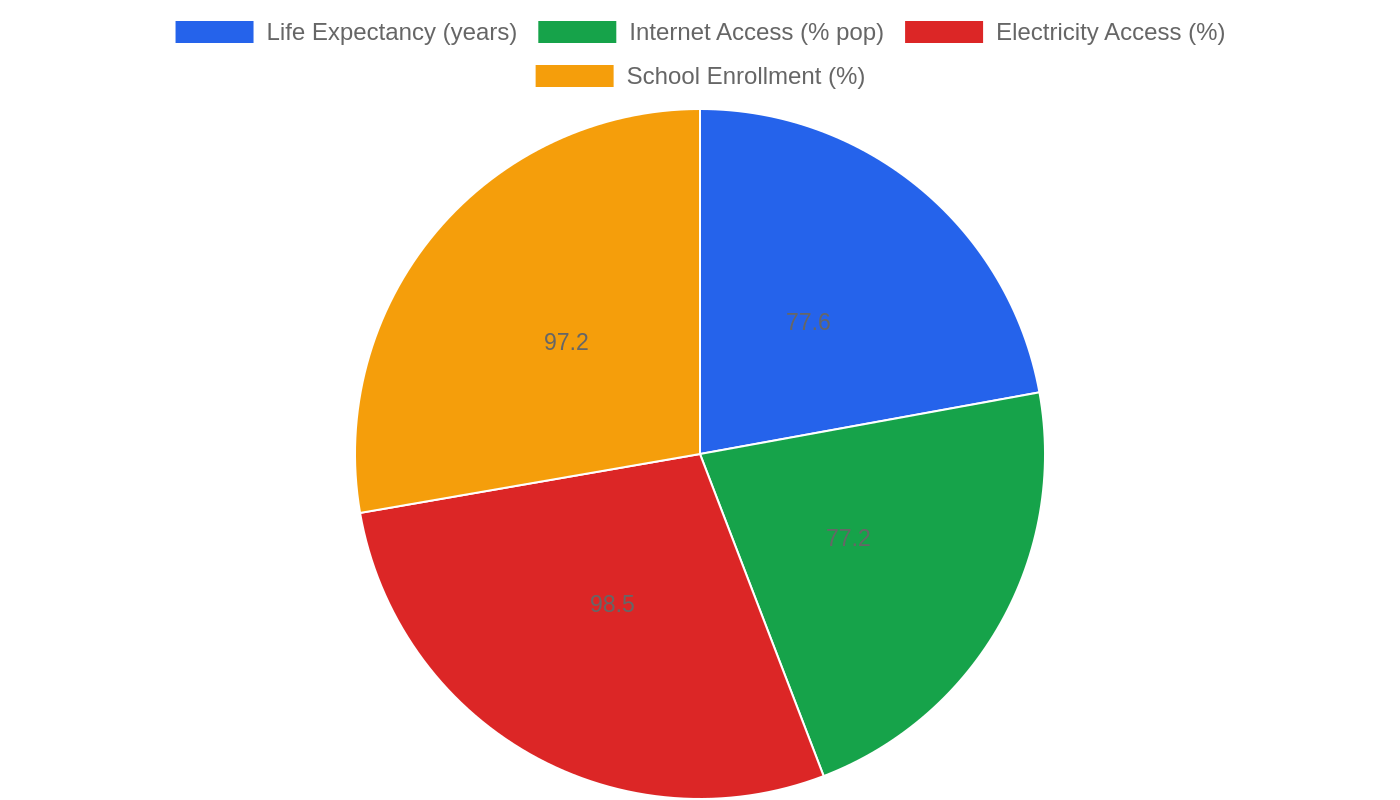
Economic Pulse Net | Sources: World Bank World Development Indicators, Government Sources | 2026
Key Takeaways
– Ecuador’s economy is dominated by state-owned oil giant Petroecuador and a handful of private-sector champions spanning telecoms, dairy, and retail, creating a mixed-market landscape where government influence runs deep.
– The country’s five-branch political system—unique in Latin America—includes an Electoral Branch and a Transparency and Social Control branch, adding layers of oversight and complexity to policymaking.
– Telecommunications and consumer services lead the corporate landscape, with Claro Ecuador, CNT EP, and Ecuavisa among the top employers, while traditional industries like hat-making (Ecua-Andino Hats) maintain global brand recognition.
– Crime and safety data are not available from the provided sources, but the political architecture suggests a state that has invested heavily in institutional checks and balances.
– With no recent GDP, inflation, or unemployment figures in the available World Bank data, Ecuador presents a picture of a country whose economic trajectory is currently opaque—making it a market for patient, well-connected investors rather than data-driven speculators.
The Oil-and-Telecom Economy — Where the State Still Runs the Show
Ecuador’s economic story cannot be told without understanding the outsized role of the state. The World Bank provides no current GDP growth, inflation, or unemployment figures in the available data, but the list of the country’s top companies offers a vivid portrait of where economic power resides. At the very top sits Petroecuador, the state-owned oil and gas giant that has long been the financial backbone of the nation.
Oil revenues have historically funded a significant portion of the national budget, and Petroecuador’s dominance means that global crude prices remain the single most important variable for Ecuador’s fiscal health.
Alongside oil, telecommunications has emerged as a critical sector. Claro Ecuador and **CNT EP**—the latter a state-owned enterprise—dominate connectivity in a country where digital infrastructure is increasingly seen as a development priority. The presence of both private and public players in telecoms reflects a broader pattern: Ecuador’s economy is not fully liberalised, nor is it entirely state-controlled. It operates in a hybrid space where the government competes alongside private capital.
The consumer sector is surprisingly robust. Marathon Sports, **Tía** (a retail chain), and **Ecuavisa** (a major broadcaster) indicate that domestic consumption, particularly in urban centres like Quito and Guayaquil, provides a steady demand base. **Tonicorp**, a dairy products company, points to a food-processing industry that serves both local tables and regional export markets.
And **Ecua-Andino Hats**—the famous Panama hat manufacturer—reminds the world that Ecuador still produces goods with global cachet, even if the scale is modest compared to oil.
The absence of current macroeconomic data from the World Bank is itself a telling detail. It suggests either reporting lags or a country whose statistical infrastructure is still catching up with its economic complexity. For analysts, this means that on-the-ground intelligence and corporate reporting from the top ten companies may offer a more timely picture than official aggregates.
Housing and Daily Life — The Cost of Living in a Dollarised Economy
Ecuador adopted the US dollar as its official currency in 2000, a move that ended hyperinflation but also stripped the government of monetary policy tools. The available data does not include specific housing costs or a cost-of-living index, but the dollarised system provides a useful anchor. In dollarised economies, inflation tends to track US price trends, and local purchasing power is directly exposed to fluctuations in the dollar’s global strength.
For residents, this means that housing costs in Quito and Guayaquil are likely denominated in dollars and subject to the same supply-and-demand pressures seen in other Latin American capitals. Rent versus buy decisions are shaped by mortgage availability—often limited in a country where credit penetration remains moderate—and by the stability of employment in the dominant sectors of oil, telecoms, and retail.
The presence of Tía and **Marathon Sports** as top companies suggests that consumer goods retail is a significant part of daily life, with formal-sector workers able to access branded products. However, without specific cost data, it is reasonable to infer that the gap between formal and informal employment—common across the region—creates a two-tier living experience.
Those employed by Petroecuador or Claro Ecuador likely enjoy stable, dollar-denominated incomes, while workers in the informal economy face greater volatility.
Investment and Business Climate — A Market of Giants and Gatekeepers
For foreign investors, Ecuador presents a landscape defined by its top companies. Petroecuador is not just a company; it is a state institution, meaning that any investment in the energy sector inevitably involves navigating government relationships. The same is true for **CNT EP**, the state telecom provider, which competes directly with private players like Claro Ecuador.
The consumer services sector offers more straightforward entry points. Ecuavisa and **Marathon Sports** are private companies operating in competitive markets, and **Tonicorp**’s dairy business suggests opportunities in food processing and agriculture. **Correos del Ecuador**, the postal and logistics company, points to the infrastructure demands of a growing e-commerce sector—though its status as an industrial company may indicate state involvement in logistics.
The business environment is shaped by the country’s unusual five-branch political system. In addition to the executive, legislative, and judicial branches, Ecuador has an Electoral Branch and a Transparency and Social Control branch. The latter, in particular, is designed to oversee public-sector conduct and combat corruption. For investors, this means additional regulatory scrutiny and a longer timeline for approvals, but also a framework that—in theory—provides checks on arbitrary state action.
Sectors to watch include telecommunications, where the duel between Claro and CNT EP could drive infrastructure investment; dairy and food processing, where Tonicorp’s presence suggests domestic demand is strong; and oil services, where Petroecuador’s needs create a market for international suppliers.
Safety, Politics, and Quality of Life — Governing Through Five Branches
The available data does not include a crime index or safety index for Ecuador, but the political landscape offers important context. The five-branch system is a deliberate construction designed to distribute power and prevent the concentration of authority that has historically plagued Latin American democracies. The Transparency and Social Control branch, in particular, is meant to hold all other branches accountable—a bold experiment in institutional design.
In practice, this system can lead to gridlock. With multiple branches wielding oversight powers, policymaking can be slow and legal challenges frequent. For ordinary citizens, the quality of life is influenced by the stability this system provides—or fails to provide.
Without crime data, it is impossible to assess safety definitively, but the presence of major consumer companies like Ecuavisa and **Tía** suggests that urban commercial life continues to function, which is often a proxy for basic security in retail-heavy economies.
The absence of happiness or wellbeing data from the provided sources leaves a gap, but the structure of the state suggests a society that has invested heavily in formal institutions. Whether those institutions deliver better outcomes than simpler systems is a question that only lived experience—and future data—can answer.
Current Affairs — Ecuador in the Here and Now
Without recent news provided in the data, the most current story is the one told by the corporate landscape itself. Petroecuador remains the engine of the economy, meaning that global oil markets are the most immediate driver of Ecuador’s fortunes. Any shift in OPEC+ production quotas, geopolitical tensions affecting crude supply, or changes in global demand will ripple directly through the national budget.
In the telecom sector, the competition between Claro Ecuador and **CNT EP** is likely intensifying as demand for data services grows. The state’s dual role as both regulator and competitor in this space creates an unusual dynamic—one that could either spur investment or deter private players depending on how the government chooses to act.
TAME, the state-owned airline, is a company to watch. Airlines across Latin America have struggled with fuel costs and post-pandemic demand shifts, and TAME’s position as a consumer services company in a challenging sector may signal broader pressures on the transport and tourism industries.
The Ecua-Andino Hats brand, meanwhile, represents Ecuador’s soft power. In a world increasingly interested in artisanal and heritage products, the Panama hat—which is actually Ecuadorian—offers a rare example of a manufactured good with global recognition. Whether this can be scaled into a larger export industry is an open question.
The Bottom Line
Ecuador is a country where the state remains a central economic actor, but where private companies in telecoms, retail, and consumer goods provide genuine dynamism. Investors should watch this market if they have experience navigating mixed economies and a tolerance for institutional complexity.
The dollarised currency reduces exchange-rate risk, but the lack of recent macroeconomic data from the World Bank means that decisions must be based on corporate intelligence and sectoral analysis rather than broad statistics. For those willing to look past the data gaps, Ecuador’s top companies tell a story of resilience, state power, and untapped consumer potential.
Sources & Methodology
This article is authored by Economic Pulse Net for informational and research purposes. Economic Pulse Net sources its data from multilateral institutions, national statistics bureaus, and proprietary databases. All data is believed to be current as of the date of publication.
Published: July 30, 2026 | Category: Research — Ecuador
Use these signals in your own platform
Economic Pulse publishes its live signal feed through a documented, read-only API. Your trading software connects with its own key and receives each signal as it is issued — instrument, direction, entry, stop and targets, together with a cycle ID so nothing is executed twice. The feed is independent of this website and cannot change it.
Signals are informational only and are not financial advice.