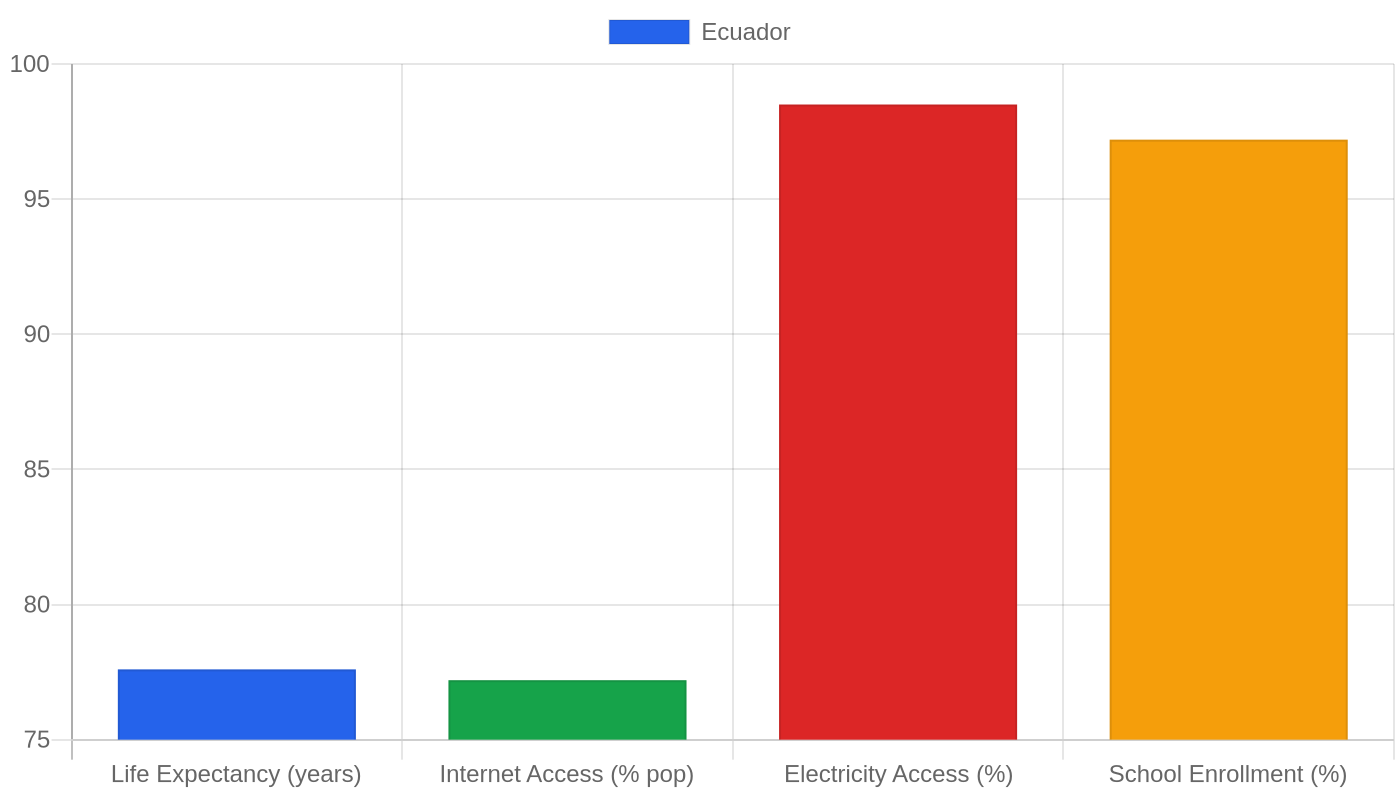
Economic Pulse Net | Sources: World Bank World Development Indicators, Government Sources | 2026
Key Takeaways
– A Unique Political Structure: Ecuador operates with five branches of government, a rarity globally, including an Electoral Branch and a Transparency and Social Control branch, signaling a complex institutional landscape for investors and citizens alike.
– A Dual Economy: The corporate landscape reveals a stark divide between state-driven oil and telecommunications giants (Petroecuador, CNT EP) and a vibrant consumer goods sector (Tía, Marathon Sports, Tonicorp), reflecting an economy in transition.
– The Connectivity Conundrum: Telecommunications is a dominant industrial pillar, with major players like Claro Ecuador and CNT EP competing, highlighting the country’s push toward digital integration despite infrastructural challenges.
– A Consumer Market with Local Champions: From dairy (Tonicorp) to iconic global exports (Ecua-Andino Hats), the data suggests a resilient domestic market where local brands hold significant sway over daily life.
– Institutional Complexity: The five-branch governance model is a defining feature of the political landscape, promising both checks and balances and potential bureaucratic hurdles for business operations.
The Macroeconomic Paradox: Growth, Inflation, and the Search for Stability
When examining Ecuador through the lens of the World Bank’s latest indicators, one is immediately struck by the silences in the data. The absence of a headline GDP growth figure often speaks to a moment of recalibration—a period where the statistical apparatus is catching up with a rapidly shifting reality. For Ecuador, this reality is anchored by its role as a petro-state.
The economy’s pulse is inextricably linked to the global price of crude oil, and the state-owned behemoth Petroecuador remains the single most consequential entity in the nation’s financial health. When oil prices fluctuate, the entire national budget feels the tremors. This dependency is the central economic fact of life here, influencing everything from the government’s ability to fund public services to the availability of foreign currency reserves.
The lack of specific inflation and unemployment data from the World Bank in this snapshot does not mean these challenges have vanished; rather, it suggests a period of opacity that often precedes significant policy shifts. In economies like Ecuador, which has historically navigated the delicate balance of dollarization, the cost of living is not just a matter of local wage negotiations but a reflection of international monetary flows.
The unemployment picture, too, is likely a tale of two cities: formal employment in the oil and service sectors coexisting with a vast informal economy that provides a living for many but offers little security. The GDP per capita (PPP) figure, which remains unlisted here, would typically offer a window into the average citizen’s purchasing power.
Without it, we must look to the corporate data to infer the state of the middle class—the presence of consumer goods companies like Tía and Marathon Sports suggests a consumer base with disposable income, yet the absence of hard numbers reminds us that this prosperity may be narrowly concentrated.
Ultimately, the World Bank data serves as a canvas with missing brushstrokes. The narrative is one of a nation that is deeply integrated into the global commodities market, with a formal economy that is modernizing but remains vulnerable to external shocks. The key to understanding Ecuador’s macroeconomy is not in a single number, but in the structural reality of its oil dependency and the resilience of its consumer-facing industries.
The Price of Paradise: Housing and the Daily Grind
In the absence of specific cost-of-living indices, we can infer the economic pressure points from the nation’s industrial makeup. Ecuador is not a cheap country to live in by regional standards, largely because of its dollarized economy. For the average citizen in Quito or Guayaquil, housing costs consume a significant portion of household income.
Rent in the major urban centers has historically been a point of contention, with a noticeable gap between the wages offered in the formal sector and the asking prices for mid-range apartments. The presence of large consumer goods conglomerates like Tonicorp and Tía suggests that the daily essentials—food, dairy, and household items—are produced locally, which helps mitigate some inflationary pressure compared to import-dependent nations.
However, the cost of imported electronics, fuel, and vehicles is often prohibitive, pushing many families towards public transportation and local markets.
The decision between renting and buying in Ecuador is often a stark one. High-interest rates on mortgages, coupled with the difficulty of securing long-term credit in a volatile economy, mean that homeownership is often reserved for the affluent or those with access to government subsidies. For the majority, renting is the pragmatic choice, leading to a highly liquid rental market in cities like Guayaquil.
The daily expenses for a family often revolve around the *mercado*—the local market—where fresh produce is abundant and relatively affordable, a buffer against the higher costs of processed goods. While the data does not provide a specific basket of goods price, the structural reality is clear: life in Ecuador requires a careful balance, where the availability of local goods provides a cushion against the high cost of capital and imported items.
The Business Landscape: Giants, Telecoms, and the Consumer Pulse
Ecuador’s business environment is a fascinating study in the coexistence of state power and private enterprise. At the top of the corporate food chain, we find Petroecuador, the state-owned oil company, which is the lifeblood of the national treasury. Alongside it, the telecommunications sector dominates the formal economy, with Claro Ecuador (a private giant) and CNT EP (the state-owned provider) locked in a competitive battle that shapes the nation’s digital future.
This duopoly is critical; the expansion of 4G and 5G networks is not just a commercial venture but a developmental priority, connecting remote Andean communities and the Amazon region to the national and global economy. For investors, this sector offers significant opportunities, but it also comes with the risk of regulatory entanglement, given the state’s active role in the market.
Beyond these heavyweights, the consumer services sector shows remarkable vitality. Companies like Tía (a major retail chain) and Marathon Sports (a sporting goods retailer) indicate a robust domestic consumption pattern, driven by a young, urban population. The presence of Ecuavisa, a major media outlet, highlights a free and active press, which is a positive signal for institutional transparency. Perhaps the most intriguing entity is Ecua-Andino Hats, the maker of the iconic Panama hat.
This company represents Ecuador’s manufacturing heritage and its ability to produce globally recognized luxury goods, a valuable counterpoint to the oil-driven narrative. The business climate is thus a mix of high-stakes, capital-intensive industries (oil, telecom) and more agile, consumer-driven enterprises. The challenge for any business leader is navigating the five-branch government structure, which, while designed to ensure transparency, can often lead to a slow and complex approval process for new projects.
The Five Pillars: Safety, Politics, and the Social Contract
Ecuador’s political landscape is defined by its unique constitutional architecture—a five-branch system that is almost unprecedented in modern governance. Beyond the traditional Executive, Legislative, and Judicial branches, the presence of an Electoral Branch and a Transparency and Social Control Branch signals a deep, institutionalized desire to combat corruption and ensure checks and balances.
This structure is a direct response to historical periods of political instability, aiming to create a more resilient democracy. However, for the average citizen, this complexity can sometimes translate into bureaucratic opacity. The effectiveness of the Transparency branch is a key indicator for foreign investors, who often view it as a barometer for the rule of law.
Regarding safety, the data provided here is notably sparse, with Crime and Safety indices left blank. This absence is telling; it suggests a country where the perception of safety is highly volatile and varies dramatically between regions. While the tourist-friendly Galápagos Islands and certain parts of Quito may feel secure, other urban areas and border regions have historically grappled with higher crime rates, often linked to drug trafficking routes along the coast.
This inconsistency shapes the quality of life significantly. The social contract in Ecuador is heavily influenced by the state’s ability to provide security and economic opportunity. With a strong consumer market and a vibrant media, there is an underlying sense of civic vitality, but it is tempered by the anxieties of economic instability and personal safety.
Ecuador’s Current Crossroads: What the Data Tells Us Now
The most current snapshot of Ecuador, drawn from the corporate registry and the World Bank’s latest (albeit incomplete) data, reveals a nation at a strategic crossroads. The presence of TAME in the corporate list is a significant marker; as a state-owned airline, its operational status is a bellwether for the government’s fiscal health and its willingness to subsidize national connectivity.
The ongoing operations of Correos del Ecuador, the national postal service, similarly speak to the state’s role in providing basic infrastructure in a challenging geography. Right now, the government is likely grappling with the dual pressures of maintaining fuel subsidies to keep domestic prices stable, while also needing to generate revenue from Petroecuador’s exports to fund the national budget. This is the eternal tug-of-war of the Ecuadorian economy.
Furthermore, the competition between Claro and CNT EP is intensifying, with the government pushing for universal internet access as a right, not a privilege. This is a live policy issue that will define the next decade of economic development. The business community is watching closely to see if the state will streamline its regulatory processes through the Transparency branch to encourage more private investment in infrastructure.
The country is also likely seeing a shift in consumer behavior, with Marathon Sports and Tía adapting to new retail trends, possibly moving towards e-commerce to overcome the geographic barriers of the Andes. The “now” in Ecuador is about the struggle to modernize a state-heavy economy, to leverage its oil wealth for sustainable growth, and to ensure that the benefits of connectivity and commerce reach beyond the capital cities.
The Bottom Line
Ecuador is a country of profound contrast—a place where the futuristic ambition of a digital economy meets the tangible reality of oil extraction and the timeless craft of hat-making. It is a market for the patient and the strategic, not the faint-hearted. Investors should watch this nation for its telecommunications expansion and its consumer market potential, while remaining acutely aware of the government’s significant footprint in key sectors.
For the casual observer, Ecuador offers a case study in how a nation attempts to balance resource wealth with institutional innovation. It is a country to watch not for its current statistics, but for its structural evolution.
Sources & Methodology
This article is authored by Economic Pulse Net for informational and research purposes. Economic Pulse Net sources its data from multilateral institutions, national statistics bureaus, and proprietary databases. All data is believed to be current as of the date of publication.
Published: August 20, 2026 | Category: Research — Ecuador
Use these signals in your own platform
Economic Pulse publishes its live signal feed through a documented, read-only API. Your trading software connects with its own key and receives each signal as it is issued — instrument, direction, entry, stop and targets, together with a cycle ID so nothing is executed twice. The feed is independent of this website and cannot change it.
Signals are informational only and are not financial advice.