Economic Pulse Net | Sources: World Bank World Development Indicators, Government Sources | 2026
Key Takeaways
* Moderate but Steady Expansion: Colombia’s economy is projected to grow by approximately 2.64% in 2025, signaling a stabilization after periods of volatility, though this growth rate suggests a cautious recovery rather than an explosive boom.
Inflationary Pressures Persist: With the Consumer Price Index (CPI) hovering around 5.14%, the central bank and policymakers face an ongoing challenge to maintain price stability without stifling economic activity.
Labor Market Tightness: An unemployment rate of 8.29% indicates that while job creation is occurring, significant portions of the workforce remain excluded from formal employment opportunities, highlighting structural labor market issues.
Consumer-Driven Industrial Base: The presence of major domestic brands like Alpina, Alquería, and Avianca underscores an economy heavily reliant on consumer goods and services, offering visibility into local purchasing power trends.
Economic Pulse: Navigating the 2.6% Threshold
Colombia’s economic trajectory in 2025 presents a nuanced picture of resilience tempered by persistent macroeconomic challenges. According to World Bank data, the nation’s GDP growth is estimated at 2.64201548985928%, a figure that reflects a moderate expansion capable of absorbing some demographic pressure but insufficient to rapidly close development gaps.
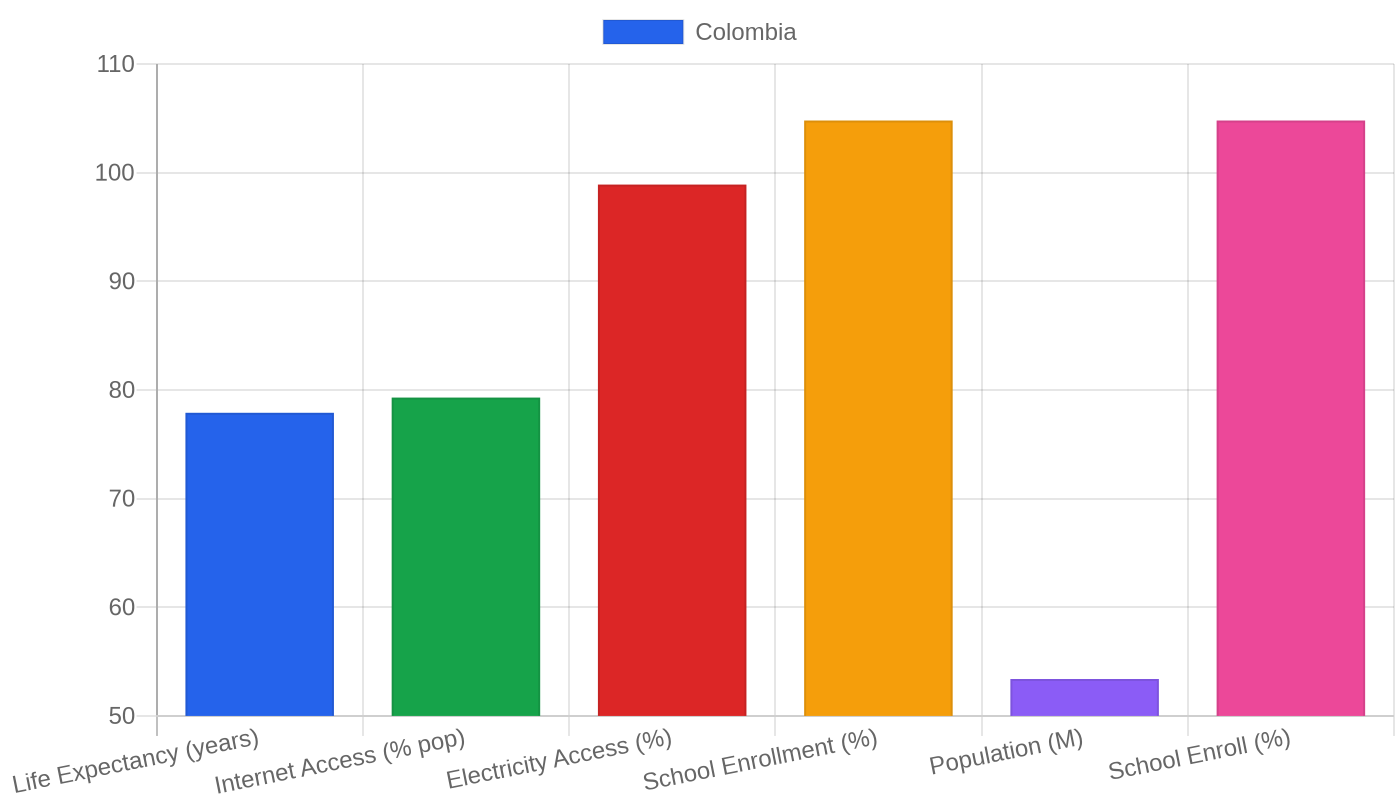
This growth occurs against a backdrop of inflation, where the CPI stands at 5.14222911946201%, suggesting that while prices are rising, they are not spiraling out of control; however, this level remains above ideal targets for many emerging markets, squeezing household budgets. The total GDP reaches $457,410,034,202.523, a substantial aggregate output driven by a population of 53,425,635.
When viewed through the lens of individual prosperity, the GDP per capita (PPP) sits at $22,640.4224606513, which offers a more accurate reflection of living standards than nominal figures alone. Yet, the GNI per capita remains at $7,900.0, revealing a disparity between what is produced within borders and what is actually retained or earned by residents.
Furthermore, the unemployment rate of 8.29% serves as a critical indicator of social stress, implying that nearly one in twelve workers is seeking employment, a statistic that demands policy attention to ensure inclusive growth. These numbers collectively paint a portrait of an economy that is growing but must work harder to translate aggregate gains into widespread welfare improvements.
Cost of Living: The Daily Economic Reality
For residents and expatriates alike, understanding the cost of living in Colombia requires looking beyond headline inflation to the tangible daily expenses that define quality of life. While specific housing indices are not provided in the current dataset, the broader inflation metric of 5.14% suggests that the cost of essentials—from food to utilities—is experiencing steady upward pressure.
This environment makes the strong presence of domestic consumer goods companies particularly relevant; brands such as Alpina Productos Alimenticios, Alquería, and Auteco dominate local shelves, indicating a robust internal supply chain that may offer competitive pricing compared to imported alternatives. The availability of these locally produced goods helps buffer consumers against global supply shocks, although it does not eliminate the impact of domestic inflation.
For those analyzing rent versus buy dynamics, the general economic climate suggests that capital allocation decisions are being made with caution, as high interest rates often accompany inflationary periods to combat rising prices. Consequently, disposable income is likely being carefully managed, with a significant portion directed toward basic necessities and essential services rather than discretionary luxury spending.
The interplay between the 8.29% unemployment rate and these costs means that financial security is precarious for many, making access to affordable housing and stable food prices a primary concern for the average Colombian household.
Investment & Business Climate: Giants of Industry
Colombia’s business landscape is characterized by a concentration of well-established players across industrials and consumer sectors, providing a clear view of where capital is currently flowing. The top companies list reveals a heavy emphasis on industrials and consumer services, with entities like Acerias Paz del Rio and AeroAndina anchoring the industrial base, while Avianca leads the consumer services segment.
This diversification suggests that investors can find exposure in both traditional infrastructure-heavy industries and service-oriented economies that drive daily consumption. Notably, the prominence of consumer goods manufacturers such as AKT motos, Aerolínea de Antioquia, and Aerosucre highlights a vibrant domestic market where brand loyalty and local production capabilities are key competitive advantages.
For foreign investors, these established entities represent either potential acquisition targets or strategic partners who understand the nuances of the local regulatory and cultural environment. The presence of Arcadia in the consumer services sector further illustrates the importance of media and entertainment in capturing audience attention and advertising revenue.
As the economy grows at 2.64%, these companies are likely leveraging their scale to maintain margins despite inflationary pressures, making them relatively stable anchors in a potentially volatile investment portfolio. However, the lack of detailed crime and safety indices complicates risk assessment for physical assets and logistics operations, requiring due diligence that goes beyond standard financial metrics.
Safety, Politics & Quality of Life: Governance and Stability
The political framework of Colombia provides a structured environment for economic activity, operating within a presidential participatory democratic republic as defined by the Constitution of 1991. This system enforces a strict separation of powers among the executive, legislative, and judicial branches, creating checks and balances that theoretically protect property rights and enforce contracts.
Such institutional stability is crucial for long-term planning, allowing businesses to operate with a degree of predictability regarding legal and regulatory changes. However, the absence of specific Crime Index and Safety Index data presents a blind spot for assessing the day-to-day quality of life for citizens and the operational security for businesses. Without these metrics, it is difficult to fully gauge the impact of security concerns on tourism, foreign direct investment, or internal migration patterns.
The political landscape, therefore, relies heavily on the perceived legitimacy and effectiveness of government institutions rather than just statistical safety scores. Citizens navigate a system designed for participation, yet the high unemployment rate of 8.29% may fuel social discontent if economic opportunities do not materialize quickly enough. Ultimately, the quality of life in Colombia is shaped by this tension between robust democratic structures and the practical realities of safety and economic inclusion.
What’s Happening Now: Policy Shifts and Market Dynamics
In the current economic cycle, Colombia is grappling with the delicate balance of maintaining growth while controlling inflation. The 5.14% CPI figure indicates that monetary policy is likely remaining vigilant, preventing a return to higher inflation without choking off the 2.64% GDP growth. Businesses are adapting to this environment by focusing on efficiency and local sourcing, as evidenced by the dominance of homegrown brands like Alpina and Alquería in the marketplace.
The labor market remains a focal point for policymakers, with the 8.29% unemployment rate serving as a benchmark for evaluating the success of recent job creation initiatives. Meanwhile, the large GDP of over $457 billion provides a substantial base for tax revenues, which the government can utilize to fund infrastructure or social programs aimed at reducing inequality. As we move through 2025, the interplay between these macroeconomic indicators will dictate the pace of reform and investment.
Companies like Avianca and Acerias Paz del Rio are likely adjusting their strategies to align with consumer spending habits influenced by inflation, ensuring they remain competitive in a tightening market. The focus now is on sustaining this moderate growth trajectory while addressing the structural unemployment that continues to challenge social cohesion.
The Bottom Line
Colombia represents a market of significant opportunity for those willing to navigate its complexities. Investors should watch closely how the government manages the dual challenge of inflation and unemployment, as these factors will determine the speed of consumer recovery. The strong domestic industrial base offers resilience, but the lack of granular safety data warrants careful risk management.
For long-term stakeholders, the country’s democratic stability and growing GDP provide a solid foundation for engagement.
Sources & Methodology
This article is authored by Economic Pulse Net for informational and research purposes. Economic Pulse Net sources its data from multilateral institutions, national statistics bureaus, and proprietary databases. All data is believed to be current as of the date of publication.
Published: October 16, 2026 | Category: Research — Colombia
Use these signals in your own platform
Economic Pulse publishes its live signal feed through a documented, read-only API. Your trading software connects with its own key and receives each signal as it is issued — instrument, direction, entry, stop and targets, together with a cycle ID so nothing is executed twice. The feed is independent of this website and cannot change it.
Signals are informational only and are not financial advice.