Economic Pulse Net | Sources: World Bank World Development Indicators, Government Sources | 2026
Key Takeaways
* Moderate but Steady Expansion: Colombia’s economy is projected to grow by approximately 2.64% in 2025, signaling resilience despite global headwinds and domestic structural challenges.
Inflationary Pressures Persist: With CPI inflation hovering around 5.14%, the central bank faces ongoing pressure to stabilize prices while maintaining growth momentum.
Labor Market Tightness: An unemployment rate of 8.29% indicates a constrained labor market, suggesting that job creation is not keeping pace with population growth or economic expansion.
Industrial Dominance: Key economic activity is concentrated in industrials and consumer goods sectors, led by major players like Avianca and Acerias Paz del Rio, highlighting a reliance on traditional manufacturing and services.
Democratic Stability Amid Uncertainty: Operating within a presidential participatory democratic republic since 1991, the political framework remains stable, though safety indices remain unreported, leaving quality-of-life assessments incomplete.
Economic Resilience Amidst Inflationary Headwinds
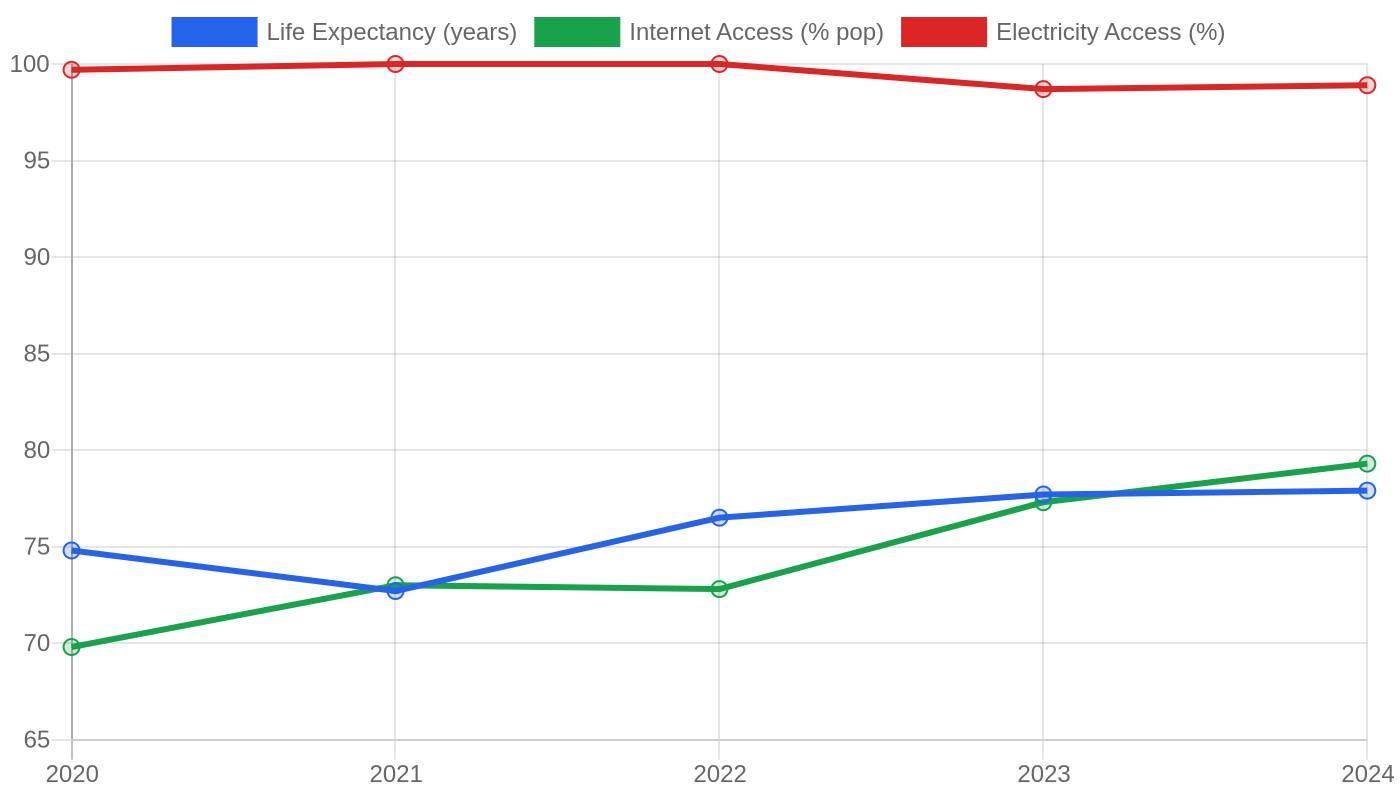
Colombia’s economic trajectory for 2025 presents a picture of cautious optimism tempered by persistent monetary challenges. According to World Bank data, the nation’s Gross Domestic Product (GDP) is forecasted to expand by 2.64201548985928%. While this figure may appear modest compared to emerging market peers experiencing rapid industrialization, it reflects a mature economy navigating complex internal and external pressures.
The total GDP stands at an impressive $457,410,034,202.523, underscoring the sheer scale of commercial activity within a population of 53,425,635. However, growth does not come without cost; the Consumer Price Index (CPI) has risen to 5.14222911946201%, a level that erodes purchasing power and complicates household budgeting. This inflation rate suggests that while the economy is growing, the cost of living is rising faster than wages for many citizens.
Furthermore, the unemployment rate of 8.29% reveals a significant gap between labor supply and demand, indicating that nearly one in twelve workers seeking employment cannot find it. These figures collectively paint a portrait of an economy that is expanding but struggling to distribute its benefits evenly across the workforce.
The GDP per capita, measured at Purchasing Power Parity (PPP), sits at $22,640.4224606513, which provides a more nuanced view of individual welfare than nominal figures alone, yet still highlights disparities in wealth distribution.
Cost of Living and Housing Dynamics
The interplay between inflation and daily expenses creates a challenging environment for residents and expatriates alike. With inflation tracking above 5%, the cost of essential goods and services is under constant upward pressure, affecting everything from food baskets to utility bills.
Although specific housing metrics such as rent-to-income ratios are not detailed in the current dataset, the broader inflationary context implies that real estate markets are likely adjusting to higher construction costs and financing rates. For the average citizen, the GNI per capita of $7,900 serves as a critical benchmark; it suggests that while macroeconomic indicators show growth, individual income levels remain relatively low compared to global averages.
This discrepancy often leads to a situation where basic necessities consume a larger portion of household budgets, limiting discretionary spending. Without precise data on regional housing variances, it is difficult to pinpoint exact affordability levels, but the general trend of rising prices necessitates careful financial planning for both locals and foreign investors.
The lack of granular cost-of-living data means that businesses must rely on broader inflation trends to estimate operational expenses, adding a layer of uncertainty to long-term investment strategies.
Investment & Business Climate: Industrial Pillars
Colombia’s business landscape is heavily anchored by a robust industrial sector and a growing consumer services industry. Major corporations dominate the corporate hierarchy, reflecting a market structure where established players hold significant sway over economic directions. Companies such as Acerias Paz del Rio and AeroAndina in the industrials sector demonstrate the country’s capacity for heavy manufacturing and logistics support.
Meanwhile, the consumer goods sector is bolstered by household names like Alpina Productos Alimenticios, Alquería, and AKT motos, indicating strong domestic demand for everyday products and personal mobility solutions. In the services realm, Avianca stands out as a critical infrastructure provider, linking Colombia to global markets and facilitating both tourism and trade.
Other entities like Aerolínea de Antioquia and Aerosucre further diversify the transportation network, enhancing connectivity within the region. Arcadia, operating in consumer services, highlights the growing importance of media and entertainment in the modern Colombian economy. For investors, these companies represent both stability and opportunity, as they navigate the dual challenges of inflation control and labor market constraints.
The concentration of top firms in industrials and consumer goods suggests that capital flows are likely prioritizing tangible assets and essential services over speculative ventures.
Safety, Politics & Quality of Life
Navigating the socio-political terrain of Colombia requires an understanding of its constitutional framework and current security realities. The government operates as a presidential participatory democratic republic, a system established by the Constitution of 1991 that emphasizes separation of powers among the executive, legislative, and judicial branches.
This structure aims to prevent authoritarian overreach and ensure checks and balances, providing a degree of political predictability for international observers. However, the absence of reported Crime and Safety Indices introduces a significant blind spot in assessing the true quality of life for residents. Without concrete data on crime rates or safety perceptions, it is impossible to fully gauge the risks associated with daily life or business operations in various regions.
This data gap forces analysts to rely on qualitative assessments rather than quantitative metrics when evaluating human security. Nevertheless, the enduring nature of the 1991 constitutional framework suggests a resilient political culture capable of adapting to social pressures. For expatriates and diplomats, the lack of specific safety scores necessitates heightened vigilance and reliance on local intelligence rather than broad statistical averages.
What’s Happening Now: Policy Shifts and Market Realities
The current economic narrative in Colombia is defined by the tension between growth targets and inflation management. As the 2025 projections take shape, policymakers are likely focusing on measures to curb the 5.14% inflation rate without stifling the 2.64% GDP growth. The persistent unemployment rate of 8.29% suggests that labor market reforms may be imminent, aiming to integrate more workers into the formal economy.
Businesses are responding to these shifts by optimizing supply chains and managing costs, given the volatile price environment. The performance of key industries, particularly in industrials and consumer goods, will serve as a barometer for consumer confidence in the coming months. If inflation continues to ease, the real value of the GNI per capita could improve, potentially boosting domestic consumption.
Conversely, if prices remain sticky, the central bank may need to maintain restrictive monetary policies, impacting borrowing costs for companies like Avianca and Alpina. The interplay between these factors will determine whether Colombia can achieve sustainable development or face stagnation.
The Bottom Line
Colombia represents a compelling case study in emerging market resilience, characterized by steady GDP growth and a diversified industrial base. Investors should monitor the inflation trajectory closely, as it directly impacts consumer spending power and corporate margins. While the political framework offers stability, the lack of safety data warrants caution for those considering direct engagement or relocation.
Ultimately, Colombia’s future hinges on its ability to reduce unemployment while containing price increases, making it a critical watchlist asset for those interested in Latin American economic dynamics.
Sources & Methodology
This article is authored by Economic Pulse Net for informational and research purposes. Economic Pulse Net sources its data from multilateral institutions, national statistics bureaus, and proprietary databases. All data is believed to be current as of the date of publication.
Published: September 28, 2026 | Category: Research — Colombia
Use these signals in your own platform
Economic Pulse publishes its live signal feed through a documented, read-only API. Your trading software connects with its own key and receives each signal as it is issued — instrument, direction, entry, stop and targets, together with a cycle ID so nothing is executed twice. The feed is independent of this website and cannot change it.
Signals are informational only and are not financial advice.