Economic Pulse Net | Sources: World Bank World Development Indicators, Government Sources | 2026
Key Takeaways
* Moderate but Steady Expansion: Colombia’s economy is projected to grow by approximately 2.64% in 2025, signaling a recovery phase driven by domestic consumption and resilient service sectors.
Inflationary Pressures Persist: With the Consumer Price Index (CPI) hovering around 5.14%, the central bank faces ongoing challenges in stabilizing prices while maintaining growth momentum.
Labor Market Friction: An unemployment rate of 8.29% highlights structural gaps in job creation, particularly as the nation navigates its transition toward more sustainable industrial models.
Consumer Goods Dominance: The corporate landscape is heavily weighted toward consumer goods and services, with major players like Alpina, Alquería, and Avianca anchoring the market.
Democratic Stability: Operating within a participatory democratic republic framework established in 1991, the country maintains institutional continuity despite evolving political dynamics.
Economic Outlook: Navigating the 2.6% Threshold
Colombia’s economic trajectory for 2025 presents a nuanced picture of cautious optimism tempered by persistent macroeconomic headwinds. According to World Bank data, the nation is expected to achieve a GDP growth rate of 2.64201548985928%. While this figure may appear modest compared to high-growth emerging markets, it represents a critical stabilization point for an economy that has faced volatility in recent years.
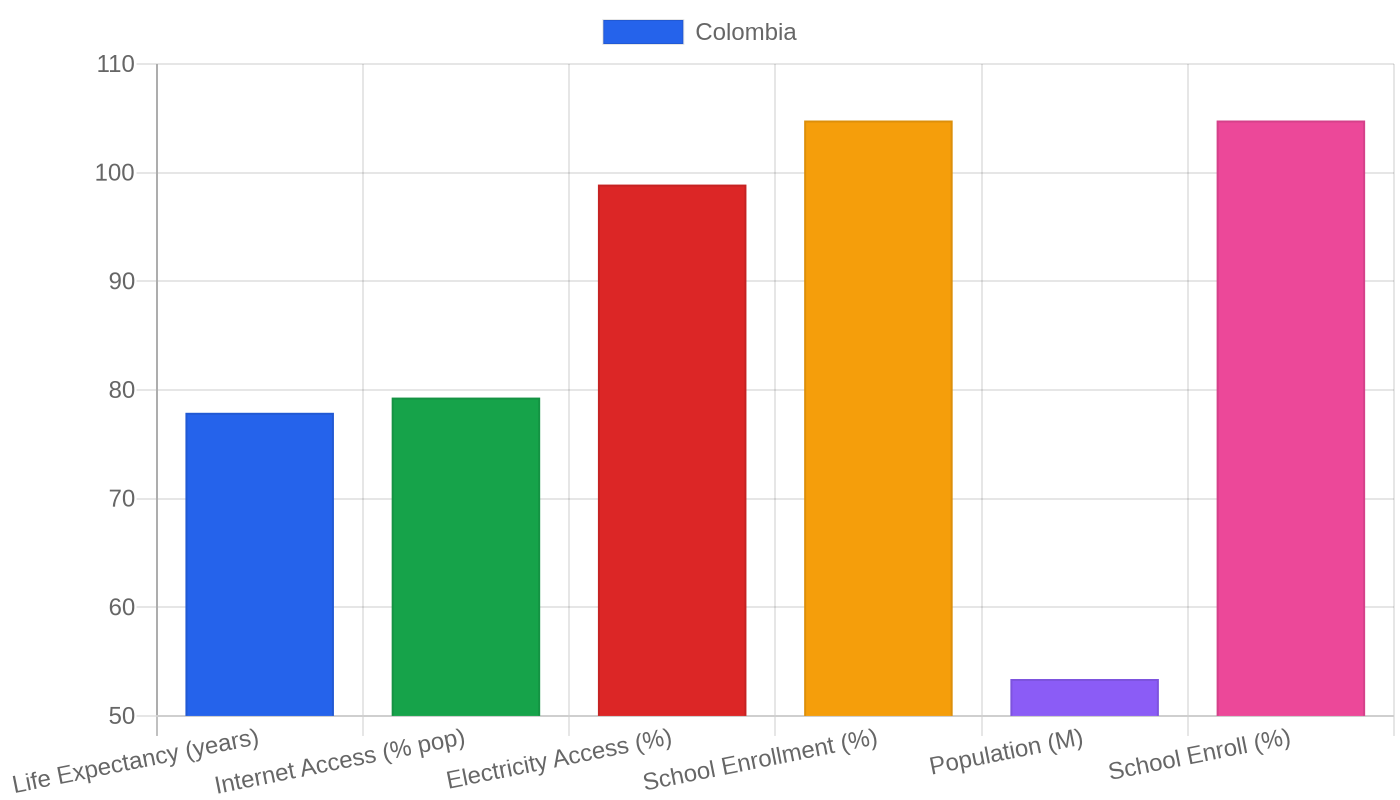
This growth is underpinned by a total GDP of $457,410,034,202.52 USD, reflecting a substantial aggregate output that supports a population of 53,425,635 citizens. However, the purchasing power dynamics tell a different story; the GDP per capita at Purchasing Power Parity (PPP) stands at $22,640.42, indicating that while national wealth is significant, individual disposable income remains constrained by broader economic forces.
For policymakers, this disparity between aggregate growth and per-capita reality underscores the need for inclusive policies that translate macro-level gains into tangible improvements for the average citizen.
Cost of Living: Balancing Affordability and Inflation
The daily economic experience in Colombia is increasingly defined by the tension between rising costs and stagnant wage growth. The current inflation rate, measured by the CPI at 5.14222911946201%, suggests that the cost of living is eroding real incomes, particularly for lower-and-middle-income households. While specific housing rent-to-buy ratios are not detailed in the provided dataset, the general inflationary environment implies that both rental and ownership costs are subject to upward pressure.
For expatriates and local residents alike, managing household budgets requires careful navigation of these price increases. The GNI per capita of $7,900.0 further contextualizes this challenge, revealing that national income levels must be carefully managed against the backdrop of a 5% inflation rate to prevent significant declines in living standards.
Without targeted subsidies or wage adjustments, the affordability of essential goods and services remains a pressing concern for families across urban and rural centers alike.
Investment & Business Climate: The Consumer Sector Anchor
Colombia’s investment landscape is currently characterized by the strength of its domestic consumer market, where established brands wield significant influence over industry trends. The corporate sector is dominated by companies such as Acerias Paz del Rio and AeroAndina in the industrials space, alongside consumer goods giants like Alpina Productos Alimenticios and Alquería. These entities reflect a business environment where food production and manufacturing remain vital pillars of economic activity.
In the services sector, Avianca and Arcadia highlight the importance of connectivity and media in driving commercial engagement. Meanwhile, automotive and logistics firms like AKT motos and Aerosucre indicate a growing demand for transportation infrastructure and personal mobility solutions.
Investors looking at Colombia should note that while heavy industrial diversification is evident, the immediate opportunities lie in supporting the consumption habits of a middle class that is sensitive to price fluctuations yet still engaged in the formal economy.
Safety, Politics & Quality of Life: Institutional Frameworks
Political stability in Colombia is anchored in the constitutional framework of a presidential participatory democratic republic, established in 1991. This system enforces a strict separation of powers among the executive, legislative, and judicial branches, providing a structured mechanism for governance and policy implementation.
While crime and safety indices are listed as N/A in the current data set, the institutional robustness suggests that legal protections and civic participation mechanisms remain active areas of focus. The absence of specific safety metrics does not negate the importance of security in quality of life assessments, but it does highlight that political discourse often centers on democratic engagement rather than just law enforcement statistics.
For residents and investors, the predictability offered by a clear constitutional order provides a baseline of operational certainty, even as social challenges related to safety and inequality continue to evolve.
What’s Happening Now: Policy Adjustments and Market Realities
Currently, the Colombian government is navigating the delicate balance of sustaining its 2.64% growth target while addressing the 5.14% inflation rate through monetary and fiscal tools. Recent economic indicators suggest that businesses are adapting to higher input costs, with consumer goods manufacturers like Alpina and Alquería likely adjusting pricing strategies to maintain margins.
The labor market, showing an 8.29% unemployment rate, indicates that job creation is not keeping pace with population growth, prompting potential policy shifts toward skills training and industrial diversification. As the year progresses, stakeholders are closely watching how the executive branch utilizes its constitutional powers to stimulate investment in key sectors like aviation and industrials.
The interplay between maintaining democratic participatory structures and delivering economic results will define the next phase of Colombia’s development, with all eyes on whether growth can accelerate beyond the current 2.64% threshold without exacerbating inflationary pressures.
The Bottom Line
Colombia offers a compelling case study for investors seeking exposure to Latin American markets with a strong consumer base and stable democratic institutions. The 2.64% growth projection and $457 billion GDP provide a solid foundation, though the 5.14% inflation rate demands careful risk management. Those interested in consumer goods, industrials, and services will find active market participants, but must navigate an unemployment rate of 8.29% that signals ongoing structural labor challenges.
Ultimately, Colombia is a country to watch for its resilience and institutional depth, rather than for explosive short-term gains.
Sources & Methodology
This article is authored by Economic Pulse Net for informational and research purposes. Economic Pulse Net sources its data from multilateral institutions, national statistics bureaus, and proprietary databases. All data is believed to be current as of the date of publication.
Published: October 25, 2026 | Category: Research — Colombia
Use these signals in your own platform
Economic Pulse publishes its live signal feed through a documented, read-only API. Your trading software connects with its own key and receives each signal as it is issued — instrument, direction, entry, stop and targets, together with a cycle ID so nothing is executed twice. The feed is independent of this website and cannot change it.
Signals are informational only and are not financial advice.