Economic Pulse Net | Sources: World Bank World Development Indicators, Government Sources | 2026
Key Takeaways
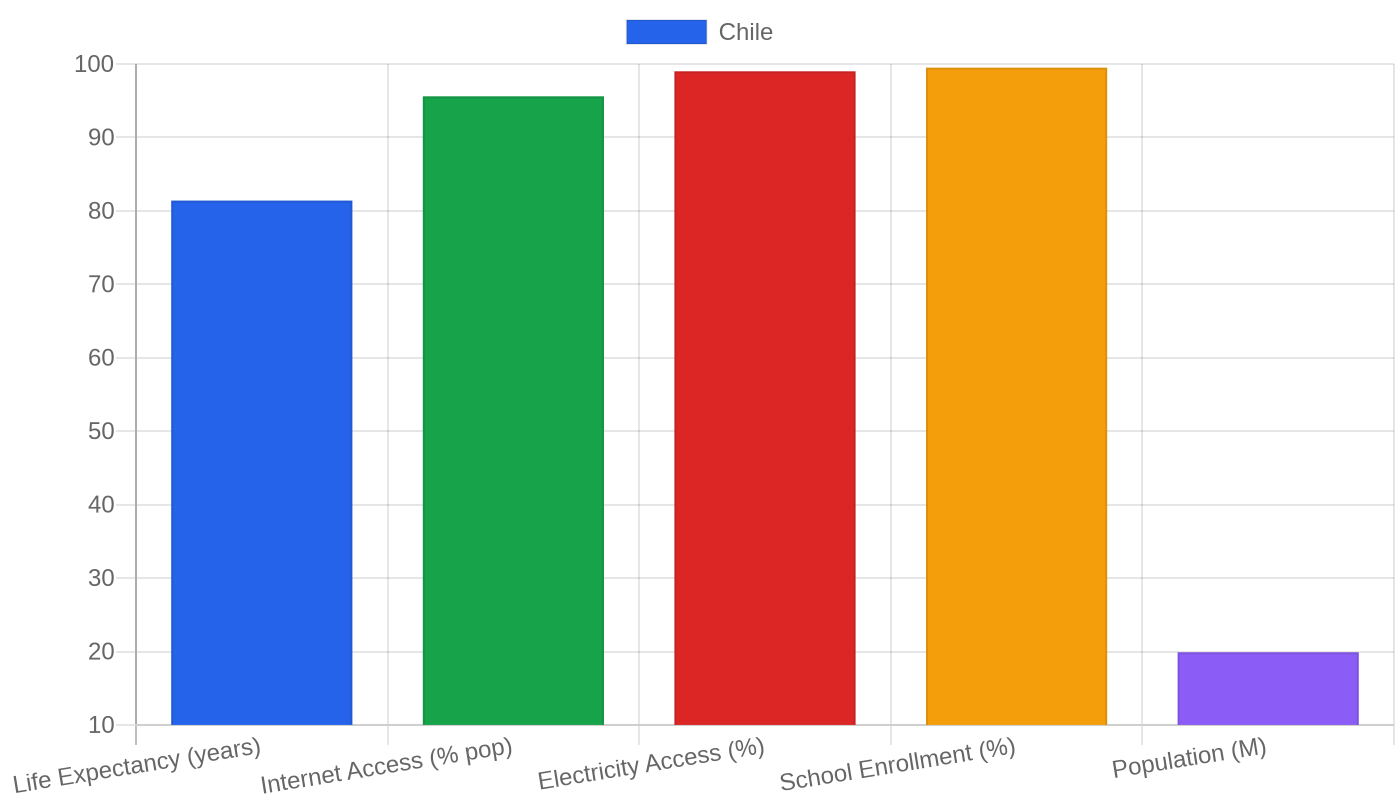
– Chile’s economy, valued at roughly $357 billion according to the World Bank, remains a regional heavyweight despite recent political turbulence.
– The nation’s industrial backbone is anchored by global mining giant Antofagasta PLC and conglomerate AntarChile, signaling continued reliance on natural resources.
– A notable cluster of homegrown technology firms, including ACE Team and AmnesiaGames, points to a nascent but real digital economy beyond copper.
– The political landscape remains defined by the legacy of the 1980 Pinochet-era constitution, a document that continues to shape governance debates decades later.
– For investors, the country offers a paradox: deep corporate sophistication alongside unresolved constitutional questions that could redefine the rules of the game.
The Copper Pulse: Reading Chile’s Economic Vital Signs
When economists talk about Chile, they often speak in superlatives — the region’s most stable democracy, its most open economy, its most reliable mining jurisdiction. The World Bank pegs the country’s GDP at approximately $357 billion, a figure that places it firmly in the upper tier of Latin American economies. But the headline numbers tell only part of the story.
Chile’s economic identity has long been tied to the red metal beneath its soil, and the fortunes of global copper prices have historically moved the needle on everything from government revenue to household consumption.
Antofagasta PLC, one of the world’s largest copper producers, remains a bellwether for the nation’s economic health, its London-listed shares watched closely by investors who understand that Chile’s prosperity is inextricably linked to Chinese industrial demand and global electrification trends.
Yet the economy is not a one-trick pony. The presence of AntarChile, a sprawling conglomerate with interests spanning forestry, fishing, and energy, reveals a more diversified corporate landscape than casual observers might assume. Agrosuper, a major player in consumer goods, underscores the importance of agriculture and food exports — salmon, wine, and fresh fruit — to the national balance sheet.
These industries provide a buffer against commodity price swings and employ hundreds of thousands of workers across the country’s central valley and southern fjords. The services sector, too, has grown steadily, with consumer services companies like Aerocardal and AeroEjecutiva catering to a business class that has expanded alongside the country’s integration into global supply chains.
However, the absence of current inflation and unemployment figures from the latest World Bank dataset is itself telling. Chile has historically boasted single-digit inflation and unemployment rates that would be the envy of its neighbors, but the post-pandemic period brought new pressures. Global supply chain disruptions and domestic political uncertainty have tested the resilience of the Chilean model.
The country’s dependence on imported energy — it produces minimal oil and gas domestically — leaves it vulnerable to external price shocks, a vulnerability that has periodically reignited inflation and prompted the central bank to tighten monetary policy. For now, the economy appears to be navigating these headwinds with characteristic Chilean pragmatism, but the margin for error has narrowed.
The Housing Calculus: Where Urban Dreams Meet Geographic Reality
Any discussion of living costs in Chile must begin with Santiago, a city of seven million people nestled in a valley ringed by the Andes. Housing prices in the capital have risen steadily over the past decade, driven by a combination of foreign investment, internal migration from rural areas, and a persistent shortage of affordable units in desirable neighborhoods.
The gap between renting and buying is particularly stark for young professionals: a mortgage in districts like Providencia or Las Condes requires a down payment that would take a decade or more to save from an average salary, pushing many into long-term rental arrangements or forcing them to commute from peripheral communes where land is cheaper but public transit options are thinner.
Outside the capital, the calculus shifts dramatically. Regional cities like Concepción, Valparaíso, and La Serena offer significantly lower housing costs, and the government has periodically introduced subsidy programs aimed at encouraging homeownership among middle- and lower-income families.
Yet these programs have often struggled to keep pace with demand, and the informal housing market — campamentos, or shantytowns — has grown in recent years, a visible reminder that the country’s economic success has not been evenly distributed.
The cost of daily essentials, meanwhile, tends to track global food and energy prices, with Chilean consumers paying relatively high rates for electricity and gasoline compared to regional peers, a reflection of the country’s limited domestic energy resources and its reliance on imported fuels.
For expatriates and returning Chileans, the cost of living in Santiago compares favorably to major Western cities but is notably higher than in neighboring Peru or Colombia. A mid-range restaurant meal, a monthly gym membership, and a modest apartment in a decent neighborhood will consume a significant chunk of a professional salary. The trade-off is quality of life: clean air in the better districts, world-class skiing within an hour’s drive, and a culinary scene that has earned international acclaim.
The housing market, like the economy itself, is a study in contrasts — world-class amenities for those who can afford them, and a quiet crisis of affordability for those who cannot.
The Business Landscape: Conglomerates, Coders, and the Search for the Next Engine
Chile’s corporate sector is a tale of two economies. On one hand, the country boasts some of the most sophisticated and internationally competitive firms in Latin America. Antofagasta PLC is a global mining powerhouse with operations that span the Atacama Desert, one of the driest places on Earth.
AES Andes, a subsidiary of the global energy giant, is a major player in the country’s electricity grid, increasingly pivoting toward renewable sources like solar and wind to capitalize on the Atacama’s extraordinary solar radiation. These companies operate to international standards, employ thousands of highly skilled workers, and generate export revenues that anchor the national economy.
On the other hand, a quieter revolution is underway in the technology sector. ACE Team and AmnesiaGames, both listed among the country’s top companies, represent a homegrown gaming industry that has found international audiences. These studios are part of a broader ecosystem of startups and digital enterprises that have emerged in Santiago’s trendy Bellas Artes neighborhood and the tech hubs sprouting around universities like Pontificia Universidad Católica.
The Chilean government has actively courted this sector through programs like Start-Up Chile, which offers equity-free funding to attract entrepreneurs from around the world. The bet is that a knowledge-based economy can eventually reduce the country’s dependence on copper and agriculture, though that transition remains in its early stages.
The business environment, however, is not without its challenges. The constitutional question looms large over investment decisions, with the business community watching closely to see whether the 1980 charter — drafted by Jaime Guzmán under the Pinochet dictatorship and subsequently amended — will be replaced by a new document that could alter property rights, labor laws, and the state’s role in the economy.
The uncertainty has weighed on business confidence, and some observers argue it has dampened foreign direct investment in recent years. Yet the fundamentals remain strong: a well-educated workforce, transparent regulatory institutions, and a legal system that generally respects contracts. For companies willing to navigate the political uncertainty, Chile still offers one of the most attractive risk-adjusted opportunities in the region.
The Political Crucible: A Constitution’s Long Shadow
The political landscape in Chile cannot be understood without grappling with the 1980 constitution, a document born in the darkest hours of the Pinochet dictatorship and which continues to cast a long shadow over the country’s governance.
Drafted by Jaime Guzmán, a conservative lawyer and senator who was assassinated in 1991, the constitution was approved via a national plebiscite in September 1980 — a vote that international observers widely regarded as “highly irregular” given the absence of political freedoms under the military regime.
It entered into force in March 1981, enshrining a series of provisions designed to protect private property, limit state intervention in the economy, and create a political system that favored conservative forces.
The return to democracy in 1990 did not immediately resolve the constitutional question. After Pinochet’s defeat in the 1988 plebiscite, the constitution was amended to ease provisions for future amendments, a pragmatic acknowledgment that the document would need to evolve.
In September 2005, President Ricardo Lagos signed into law several constitutional reforms that removed some of the most egregious authoritarian vestiges, including the provision that allowed the military to appoint senators without popular election. These reforms were significant, but they did not fundamentally alter the charter’s structure or its philosophical underpinnings.
The debate over whether to replace the constitution entirely — or simply continue amending it — has simmered for decades, periodically boiling over into mass protest.
The social unrest of October 2019, triggered by a modest increase in metro fares, exploded into a nationwide movement demanding a new constitution, better public services, and a more equitable distribution of the country’s wealth. The political establishment responded by agreeing to a constitutional convention, a body elected to draft a replacement charter.
The process has been fraught, with debates over indigenous rights, environmental protections, and the scope of private property rights exposing deep ideological divisions. The outcome remains uncertain, and the business community watches nervously, aware that a new constitution could fundamentally reshape the rules of the game. For now, the country operates under a legal framework that is simultaneously democratic and authoritarian in origin — a tension that defines Chilean politics.
What’s Happening Now: The Republic at a Crossroads
The most pressing question facing Chile right now is whether the country can write a new constitution that commands broad legitimacy without scaring off the investment that fuels its economy. The constitutional convention, elected in 2021 with a progressive majority, has been working through a draft charter that would recognize indigenous rights, enshrine environmental protections, and expand social rights.
The business community has expressed concerns about provisions that could increase state intervention in the economy and expand labor protections, while social movements argue the draft does not go far enough to address entrenched inequality. The stakes could not be higher: a new constitution approved by popular vote would be a historic achievement, but a rejection would leave the country in constitutional limbo, prolonging the uncertainty that has weighed on investment.
Meanwhile, the economy continues to operate, albeit with visible strains. The mining sector, which accounts for roughly half of the country’s exports, has benefited from elevated copper prices driven by global demand for electric vehicles and renewable energy infrastructure. Antofagasta PLC has announced expansion plans, betting that the energy transition will sustain demand for decades to come.
The technology sector, still small by global standards, has continued to grow, with Chilean studios winning international awards and attracting attention from global publishers. And the country’s agricultural exporters have navigated logistical challenges to maintain their position in global markets for wine, salmon, and fruit.
The political calendar, however, dominates the national conversation. The constitutional plebiscite represents a fork in the road, and both proponents and opponents are mobilizing for what promises to be a hard-fought campaign. The outcome will not only determine the country’s legal framework but also signal to the world whether Chile can reconcile its democratic aspirations with its institutional inheritance.
In the meantime, the central bank watches inflation data, the finance ministry monitors the fiscal balance, and ordinary Chileans — from copper miners in the north to software developers in Santiago — continue their daily routines, acutely aware that they are living through a moment of profound national transformation.
The Bottom Line
Chile is a country of extraordinary economic achievement and unresolved political questions. The World Bank’s data paints a picture of a substantial, diversified economy with world-class companies and a skilled workforce, but the constitutional crisis threatens to overshadow these fundamentals.
Investors with a long-term horizon should watch Chile closely — the country has repeatedly demonstrated its capacity for pragmatic reform, and a new constitution could ultimately provide the stability that the business community craves. But the near-term path is uncertain, and those who enter now must be prepared for volatility.
For observers of Latin American politics, Chile remains the region’s most instructive case study — a nation that built one of the world’s most successful emerging markets and now must decide what comes next.
Sources & Methodology
This article is authored by Economic Pulse Net for informational and research purposes. Economic Pulse Net sources its data from multilateral institutions, national statistics bureaus, and proprietary databases. All data is believed to be current as of the date of publication.
Published: August 07, 2026 | Category: Research — Chile
Use these signals in your own platform
Economic Pulse publishes its live signal feed through a documented, read-only API. Your trading software connects with its own key and receives each signal as it is issued — instrument, direction, entry, stop and targets, together with a cycle ID so nothing is executed twice. The feed is independent of this website and cannot change it.
Signals are informational only and are not financial advice.