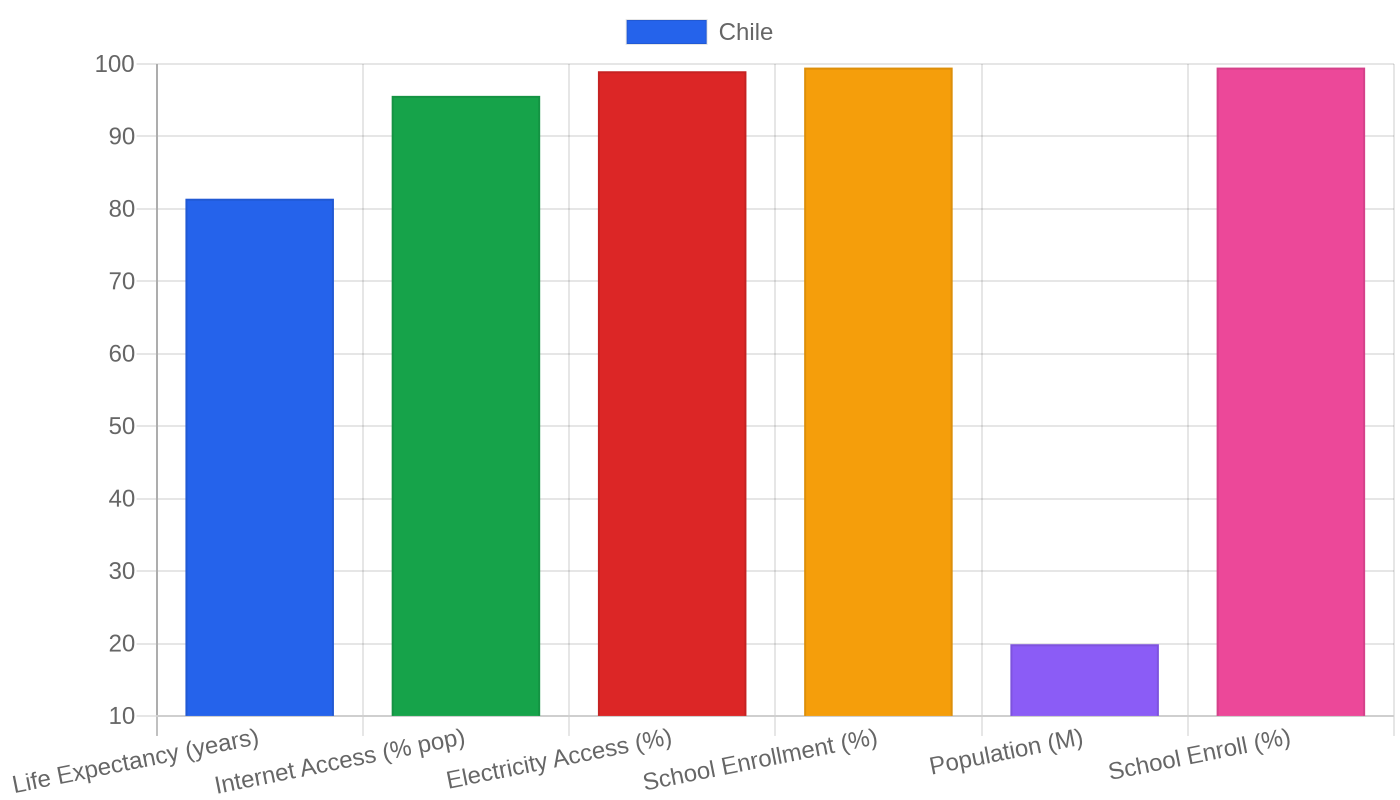
Economic Pulse Net | Sources: World Bank World Development Indicators, Government Sources | 2026
Key Takeaways
* Steady Growth Amidst Uncertainty: Chile’s economy is projected to grow by approximately 2.46% in 2025, reflecting a period of moderate expansion despite global headwinds.
Inflationary Pressures Persist: With the Consumer Price Index (CPI) hovering around 4.21%, price stability remains a key focus for policymakers and consumers alike.
Labor Market Challenges: An unemployment rate of nearly 9% highlights ongoing structural challenges in job creation and labor market efficiency.
Strong Purchasing Power: Despite macroeconomic fluctuations, GDP per capita at purchasing power parity (PPP) stands robustly at roughly $37,774, indicating significant individual economic resilience.
Political Evolution: The nation continues to navigate the long shadow of its 1980 Constitution, balancing historical frameworks with modern democratic demands.
Economic Resilience in a Shifting Landscape
Chile’s economic trajectory in 2025 presents a nuanced picture of steady, albeit modest, growth within a mature emerging market framework. According to World Bank data, the country’s Gross Domestic Product (GDP) is expected to expand by 2.45925474781374% this year, a figure that signals stabilization rather than explosive acceleration.
This growth occurs against a backdrop of a total GDP valued at approximately $357.37 billion USD, underscoring the nation’s status as one of South America’s most developed economies. However, this expansion is not without friction; inflation, measured by the CPI, sits at 4.21294031801535%, suggesting that while prices are rising, they are doing so at a manageable pace compared to historical peaks in the region.
For the average citizen, these macro indicators translate into tangible realities: an unemployment rate of 8.974% indicates that nearly one in ten workers is seeking employment, pointing to lingering inefficiencies in the labor market. Yet, the underlying strength of the economy is visible in its wealth metrics. With a GDP per capita (PPP) of $37,774.08, Chileans enjoy a standard of living that significantly outpaces many regional peers, even as the GNI per capita rests at $16,960.0.
These figures, drawn directly from the World Bank, illustrate an economy that is successfully transitioning from high-volatility cycles to a more predictable, service-oriented model, though it must continue to address structural barriers to full employment.
Navigating Daily Expenses and Living Standards
For residents and expatriates alike, understanding the cost of living in Chile requires looking beyond headline inflation numbers to the practical realities of daily life. While specific housing costs and rent-to-buy ratios are not explicitly detailed in the current dataset, the broader economic context provides clear signals about affordability.
With a population of 19,859,921.0 supporting a GDP of over $357 billion, the density of economic activity suggests vibrant urban centers where competition can help moderate certain consumer prices. The inflation rate of 4.21% implies that daily expenses—from groceries to utilities—are experiencing gradual increases, which may squeeze disposable income for those on fixed wages.
However, the high GDP per capita (PPP) of $37,774.08 suggests that, on average, households have substantial purchasing power relative to the cost of goods and services. This disparity between nominal income and purchasing power parity often means that while official wage data (GNI per capita of $16,960.0) might seem modest when converted strictly, the actual quality of life—particularly regarding access to healthcare, education, and consumer goods—is supported by a robust domestic market.
Consequently, while budgeting for 2025 should account for steady price erosion due to inflation, the overall economic structure supports a relatively high baseline for living standards compared to neighboring developing nations.
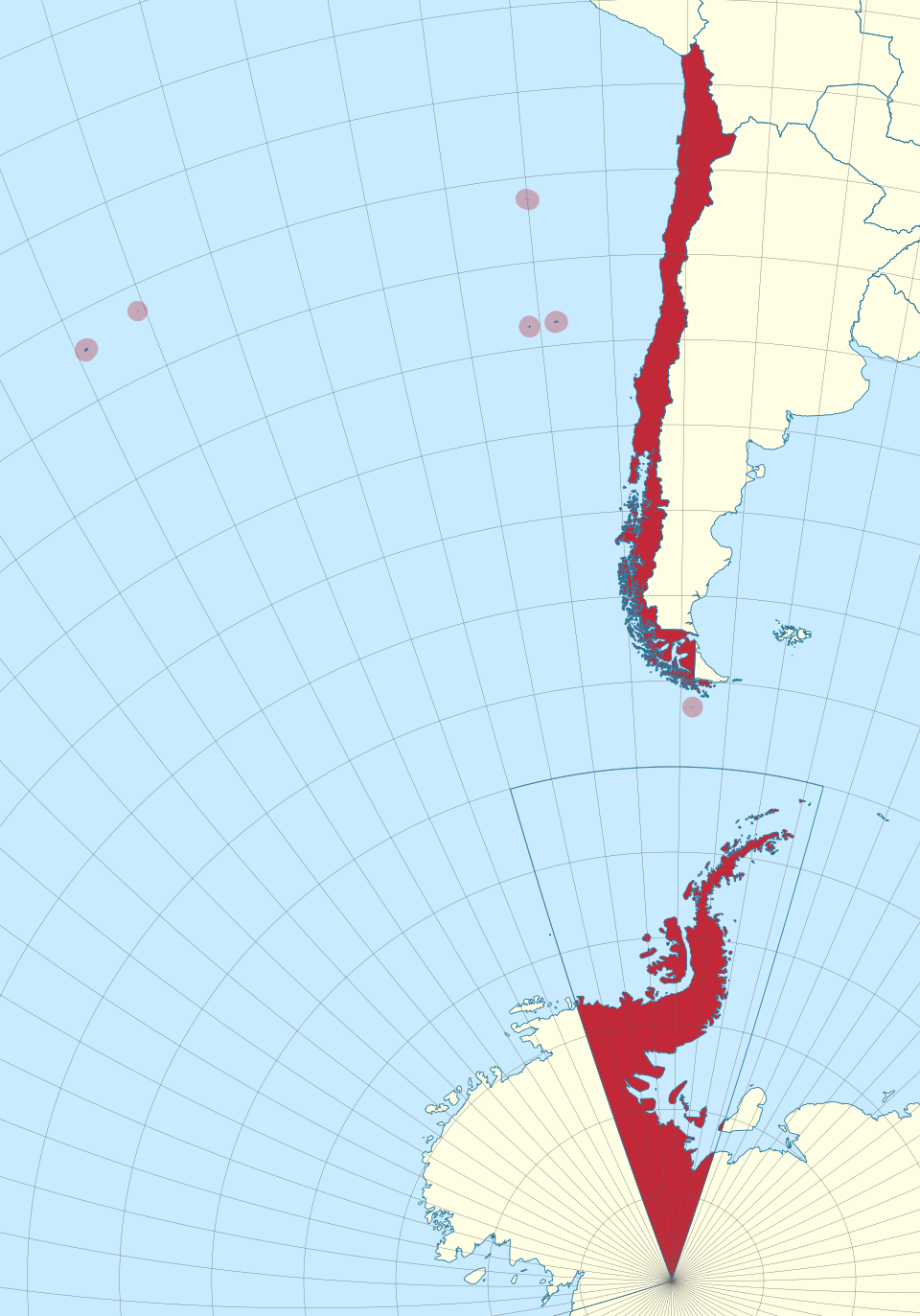
Investment Opportunities and Corporate Landscape
The investment climate in Chile is characterized by a diverse array of established players across technology, utilities, and basic materials sectors. Major corporations such as Antofagasta PLC dominate the basic materials space, leveraging the country’s rich mineral resources to drive export revenues and attract foreign direct investment.
In the consumer services sector, companies like Aerocardal, AeroEjecutiva, and Aerovías DAP play crucial roles in connectivity and logistics, facilitating both business travel and tourism—a vital component of the national economy. Meanwhile, the technology sector is gaining traction with firms like ACE Team and AmnesiaGames, signaling a shift toward digital innovation and creative industries.
Utilities remain a cornerstone of infrastructure investment, with AES Andes providing essential energy services that support industrial and residential growth. Additionally, conglomerates like AntarChile and consumer goods leaders such as Agrosuper demonstrate the breadth of Chile’s corporate ecosystem, ranging from agricultural exports to diversified holdings. For investors, these entities offer exposure to both traditional resource-based strengths and emerging tech-driven opportunities.
The presence of these top-tier companies creates a stable environment for capital deployment, particularly in sectors aligned with global trends in sustainability, digital transformation, and efficient logistics.
Political Frameworks and Social Stability
Chile’s political landscape is deeply influenced by its constitutional history, which continues to shape contemporary governance and social discourse. The current Constitution, drafted by Jaime Guzmán in 1980 and approved under the military dictatorship of Augusto Pinochet, entered into force in March 1981 and has since undergone significant amendments, including those signed by President Ricardo Lagos in September 2005.
This historical legacy remains a focal point of political debate, with observers noting the “highly irregular” nature of its original approval via plebiscite. Today, the political environment is focused on modernizing these foundational laws to better reflect democratic values and social equity.
Regarding safety, current indices for crime and general safety are listed as N/A, which may indicate either a lack of recent standardized reporting or a perception of relative stability that does not require constant monitoring. However, the absence of specific crime data should not be mistaken for a complete absence of security considerations; rather, it underscores the need for localized assessments.
Quality of life is generally supported by strong economic fundamentals, but the ongoing political conversations around constitutional reform highlight a society actively engaged in defining its future identity. This dynamic interplay between historical precedent and modern democratic aspirations creates a complex but potentially stabilizing political environment for long-term planning.
Current Affairs and Policy Directions
As we move through 2025, Chile is navigating a period of policy refinement aimed at sustaining growth while addressing social inequalities. The government’s focus appears to be on maintaining the low-inflation environment suggested by the 4.21% CPI, ensuring that monetary policies do not stifle the projected 2.46% GDP growth.
Labor market reforms remain critical, given the 8.974% unemployment rate, with policymakers likely exploring incentives for job creation in the growing technology and services sectors represented by companies like ACE Team and AmnesiaGames. Infrastructure development, supported by utilities giants like AES Andes, continues to be a priority to enhance competitiveness.
Furthermore, the ongoing dialogue surrounding the 1980 Constitution reflects a broader societal push for institutional transparency and inclusivity, building on amendments made since 1988 and 2005. Business leaders are adapting to this evolving regulatory landscape, with conglomerates like AntarChile diversifying their portfolios to mitigate risk. The interplay between economic data and political will suggests a cautious optimism, where steady growth is prioritized over rapid, potentially volatile expansion.
Stakeholders are closely watching how these policy adjustments will impact the bottom line for both domestic enterprises and international partners.
The Bottom Line
Chile offers a compelling case for investors and analysts seeking a stable, middle-income economy with strong fundamental indicators. Its combination of solid GDP per capita (PPP), manageable inflation, and a diversified corporate sector makes it a resilient player in the Latin American market. However, potential stakeholders must remain attentive to the ongoing political evolution driven by constitutional debates and the persistent challenge of unemployment.
For those willing to engage with a market that balances traditional resource strengths with emerging technological opportunities, Chile represents a strategic foothold in South America.
Sources & Methodology
This article is authored by Economic Pulse Net for informational and research purposes. Economic Pulse Net sources its data from multilateral institutions, national statistics bureaus, and proprietary databases. All data is believed to be current as of the date of publication.
Published: October 14, 2026 | Category: Research — Chile
Use these signals in your own platform
Economic Pulse publishes its live signal feed through a documented, read-only API. Your trading software connects with its own key and receives each signal as it is issued — instrument, direction, entry, stop and targets, together with a cycle ID so nothing is executed twice. The feed is independent of this website and cannot change it.
Signals are informational only and are not financial advice.