Economic Pulse Net | Sources: World Bank World Development Indicators, Government Sources | 2026
Key Takeaways
– Political Return, Economic Questions: Luiz Inácio Lula da Silva’s return to the presidency marks a sharp pivot from the previous administration, but the economic data remains opaque, with the World Bank currently listing no definitive figures for GDP growth, inflation, or unemployment, leaving analysts to rely on structural observations rather than hard numbers.
– A Nation of Corporate Heavyweights: Brazil’s private sector is dominated by household names like AmBev (the world’s largest brewer) and Amaggi Group (a global agribusiness behemoth), underscoring that the country’s real economic muscle lies in consumer goods and agriculture, not just commodities extraction.
– Infrastructure and Utilities as Quiet Engines: The presence of firms like Alupar (utilities) and Andrade Gutierrez (conglomerates) in the top company rankings suggests that energy transmission and large-scale construction remain foundational to the nation’s growth story.
– A Democratic Anchor in a Turbulent Region: The 1993 referendum confirmed Brazil’s status as a democratic federative republic with a presidential system, a political structure that provides a degree of stability even as social and economic pressures mount.
– Data Vacuum, Narrative Richness: The absence of fresh World Bank metrics does not mean Brazil is in stasis; it means the story is being written in boardrooms, on construction sites, and in the halls of power in Brasília, not just in spreadsheets.
The Economic Engine: Where Growth Hides in Plain Sight
The most striking feature of Brazil’s current economic profile is not a number, but a silence. The World Bank’s latest data release offers no GDP growth figure, no inflation rate, and no unemployment statistic for the country. For a nation of Brazil’s size—historically the largest economy in Latin America—this absence is unusual. However, the GNI per capita figure of $10,550.0 (World Bank) tells a story of a middle-income country that has struggled to break into the high-income bracket.
This is a nation that has long been described as “the country of the future”—and, the joke goes, it always will be. Yet beneath the surface of missing macro-data, the structure of the economy is visible through its corporate champions. The presence of AmBev in the consumer goods sector speaks to a massive domestic market and a sophisticated export apparatus for beverages. The Amaggi Group’s dominance in agribusiness highlights Brazil’s role as a critical global food supplier.
Meanwhile, the inclusion of Aperam South America in basic materials and Aracruz Celulose (now part of Suzano) in pulp and paper reveals a deep integration into global supply chains for steel and renewable packaging materials. The absence of hard data forces us to look at the real economy—the one that ships soybeans, brews beer, and strings power lines across the Amazon—rather than the abstract one of quarterly GDP releases.
The reality is that Brazil’s economic engine is running, but its instrument panel is currently unlit. For investors and policymakers, this is a moment to watch the fundamentals: a vast consumer base, abundant natural resources, and a corporate sector that has learned to compete globally even when the state’s fiscal accounts are under strain.
The Cost of Living: A Tale of Two Brazils
Without specific CPI or housing cost data from the World Bank, we must look at the structural realities of the Brazilian economy to understand the cost of living. Brazil has historically been a country of stark inequality, and the cost of living is a reflection of that divide.
In major metropolitan centers like São Paulo and Rio de Janeiro, the cost of urban living—rent, transportation, and food—has traditionally been high relative to regional peers, driven by a concentrated population and a complex tax system that inflates consumer prices. The presence of massive consumer goods companies like AmBev and Agrale suggests that domestically produced goods are plentiful, but the tax burden on these goods is notoriously heavy, making everyday items more expensive than they should be.
For the middle class, the dream of homeownership in major cities has become increasingly difficult, with mortgage rates historically high due to a volatile inflationary environment. However, the absence of current data means we must infer that the situation remains challenging.
The Brazilian economy has long been characterized by a “Custo Brasil” (Cost Brazil)—a term used to describe the high cost of doing business and living in the country due to infrastructure bottlenecks, bureaucratic red tape, and a complex tax code. For the average citizen, this translates into a paradox: a country rich in resources and food production, yet where a significant portion of the population struggles to make ends meet.
The rental market in urban centers is tight, and the gap between the haves and have-nots remains a defining feature of the social landscape. Until the official statistics catch up with reality, the cost of living in Brazil remains a story of resilience against a backdrop of structural inefficiency.
Investment & Business Climate: The Titans of Industry
For investors looking at Brazil, the message from the corporate roster is clear: this is a market for heavyweights, not the faint-hearted. The top companies list reads like a who’s who of Latin American capitalism. AmBev, a subsidiary of Anheuser-Busch InBev, is a global beverage behemoth that dominates the Brazilian market and has a massive footprint across the Americas.
The Amaggi Group, founded by the late billionaire André Maggi, is a vertically integrated agribusiness giant that controls everything from soybean production to shipping. On the industrial side, Andrade Gutierrez is one of the largest engineering and construction conglomerates in the region, deeply involved in infrastructure projects that are the lifeblood of a developing economy.
The utilities sector, represented by Alupar, is critical for a country that relies heavily on hydroelectric power; Alupar is a key player in energy transmission, a sector that is essential for connecting the Amazon’s power generation to the industrial south. For a foreign investor, the opportunities are immense but the challenges are equally daunting. The business environment is notoriously complex, with a labyrinthine tax code and a labor market that is heavily regulated.
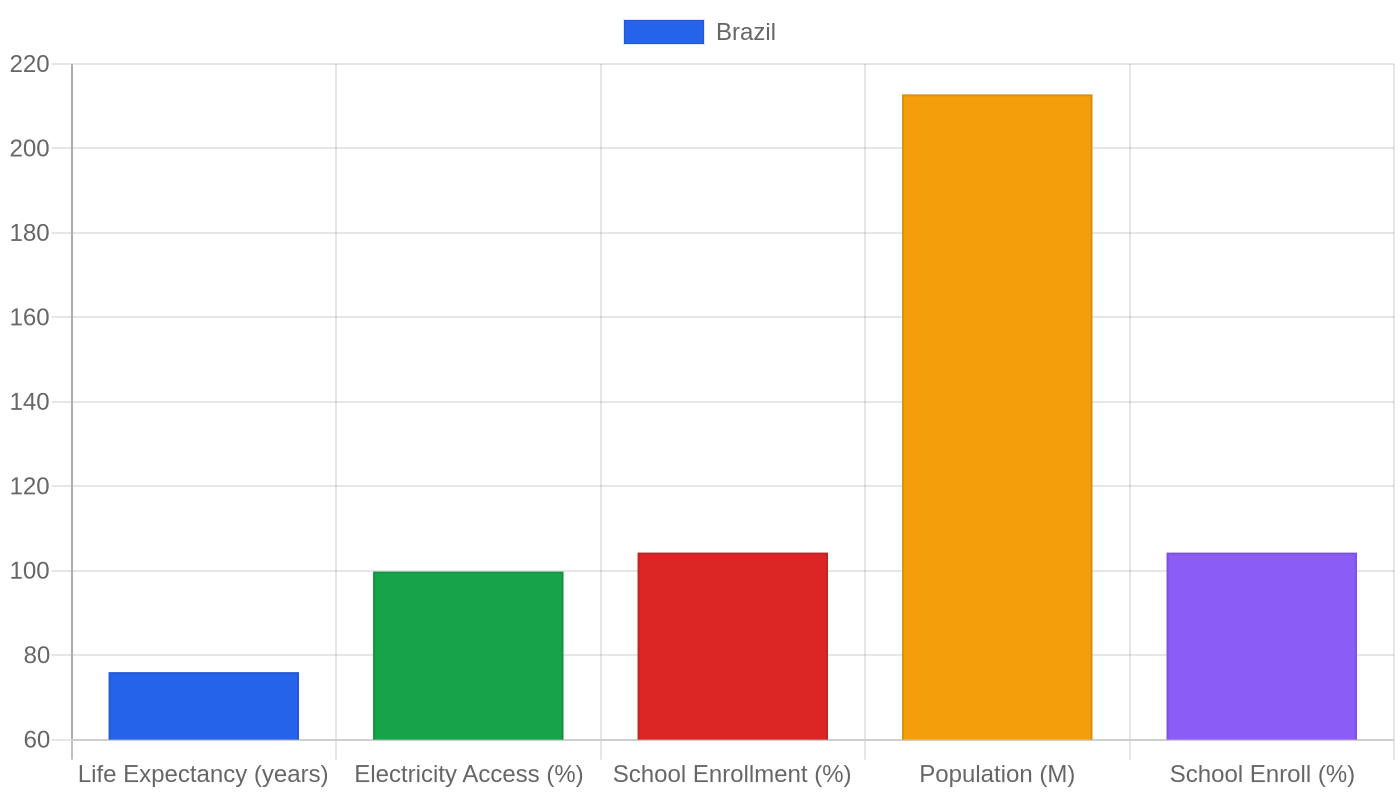
However, the sheer size of the domestic market—over 200 million consumers—makes it an unavoidable destination for global companies. The current political landscape, with Lula da Silva at the helm, suggests a return to a more interventionist industrial policy, which could be a boon for local manufacturers like Agrale (a maker of trucks and tractors) but a source of concern for international firms that fear protectionism.
The key takeaway is that Brazil is not a market for passive investment; it requires active management, local partnerships, and a long-term vision.
Safety, Politics & Quality of Life: Democracy Under Pressure
Brazil’s political system is a democratic federative republic, a structure reaffirmed by a 1993 referendum, with a presidential system where the head of state and government is elected for a four-year term with the possibility of one consecutive re-election. The current president, Luiz Inácio Lula da Silva, is a towering figure in Brazilian politics, a former union leader who has now served multiple terms and represents a significant shift to the left after the previous administration.
This political transition is not without friction. The country remains deeply polarized, and the quality of life is affected by this tension. While the World Bank data does not provide a Crime Index or Safety Index, it is well-documented that Brazil faces significant public security challenges, particularly in its largest cities.
The combination of inequality, urban density, and, in some regions, organized crime, creates an environment where safety is a primary concern for residents and a key consideration for expatriates and investors. The political landscape is robust in its democratic institutions—the judiciary, the legislature, and the presidency all function with a degree of independence that is not always found in the region.
However, the quality of life is often diminished by the stress of urban violence and the daily struggle with public services that are overstretched. The Lula administration has promised to address these issues, but the fiscal space to do so is limited. For the average Brazilian, the political drama in Brasília is not just a spectator sport; it has a direct impact on their daily security, their job prospects, and their hope for the future.
The nation’s democratic resilience is a point of pride, but the social contract remains under strain.
What’s Happening Now: Lula’s Tightrope Walk
Right now, Brazil is in a delicate moment of recalibration. President Lula da Silva is navigating a complex political and economic environment, attempting to balance the social welfare programs that define his political legacy with the fiscal responsibility demanded by the markets. The World Bank’s lack of updated macro-data suggests that we are in a period of transition, where the official statistics have not yet caught up with the new administration’s policies.
Lula’s government has signaled a return to a more active state role in the economy, with an emphasis on re-industrialization and infrastructure investment—a move that would benefit companies like Andrade Gutierrez and Agrale. However, this comes against a backdrop of global economic uncertainty and a domestic environment where inflation has historically eroded purchasing power.
The agribusiness sector, represented by the Amaggi Group, is watching closely to see how Lula balances environmental protection with the need for agricultural expansion, a tension that has global implications for food prices and climate policy. The telecommunications and technology sectors, buoyed by companies like Algar and AstralSat, are hoping for regulatory stability to continue their growth. Meanwhile, the political opposition remains vocal, and the country is bracing for the next electoral cycle.
The immediate future is one of negotiation and watchful waiting: Lula must deliver on his promises of growth and equity, or risk losing the political capital that brought him back to power. For now, the world is watching to see if Brazil can finally overcome its historical inertia and become the economic power its resources suggest it should be.
The Bottom Line
Brazil is not a country for those seeking clean data and straightforward narratives. It is a country of immense potential, frustrating contradictions, and high-stakes politics. Investors and businesses should watch Brazil because its sheer size makes it impossible to ignore, and its corporate champions—from AmBev to Amaggi—prove that Brazilian companies can compete on the world stage. The Lula administration represents a new chapter, but the book is still being written.
For those with a long-term perspective and a tolerance for volatility, Brazil offers a unique opportunity to participate in the rise of a global powerhouse that has, so far, always remained just on the cusp of greatness. Watch this space, but bring patience.
Sources & Methodology
This article is authored by Economic Pulse Net for informational and research purposes. Economic Pulse Net sources its data from multilateral institutions, national statistics bureaus, and proprietary databases. All data is believed to be current as of the date of publication.
Published: August 03, 2026 | Category: Research — Brazil
Use these signals in your own platform
Economic Pulse publishes its live signal feed through a documented, read-only API. Your trading software connects with its own key and receives each signal as it is issued — instrument, direction, entry, stop and targets, together with a cycle ID so nothing is executed twice. The feed is independent of this website and cannot change it.
Signals are informational only and are not financial advice.