Economic Pulse Net | Sources: World Bank World Development Indicators, Government Sources | 2026
Key Takeaways
– Brazil’s economy is growing at a modest 2.29% annual rate, a figure that signals resilience but falls short of the dynamism needed to transform South America’s largest economy.
– Unemployment has fallen to 5.97%, a level that would be the envy of most developed nations, yet it masks deeper structural questions about informality and wage stagnation.
– The political landscape remains anchored by President Luiz Inácio Lula da Silva, whose return to power has redefined Brazil’s relationship with both markets and social policy.
– Brazil’s corporate landscape is a study in diversity, spanning agribusiness giants like Amaggi Group to industrial innovators like Airship do Brasil, reflecting an economy in transition.
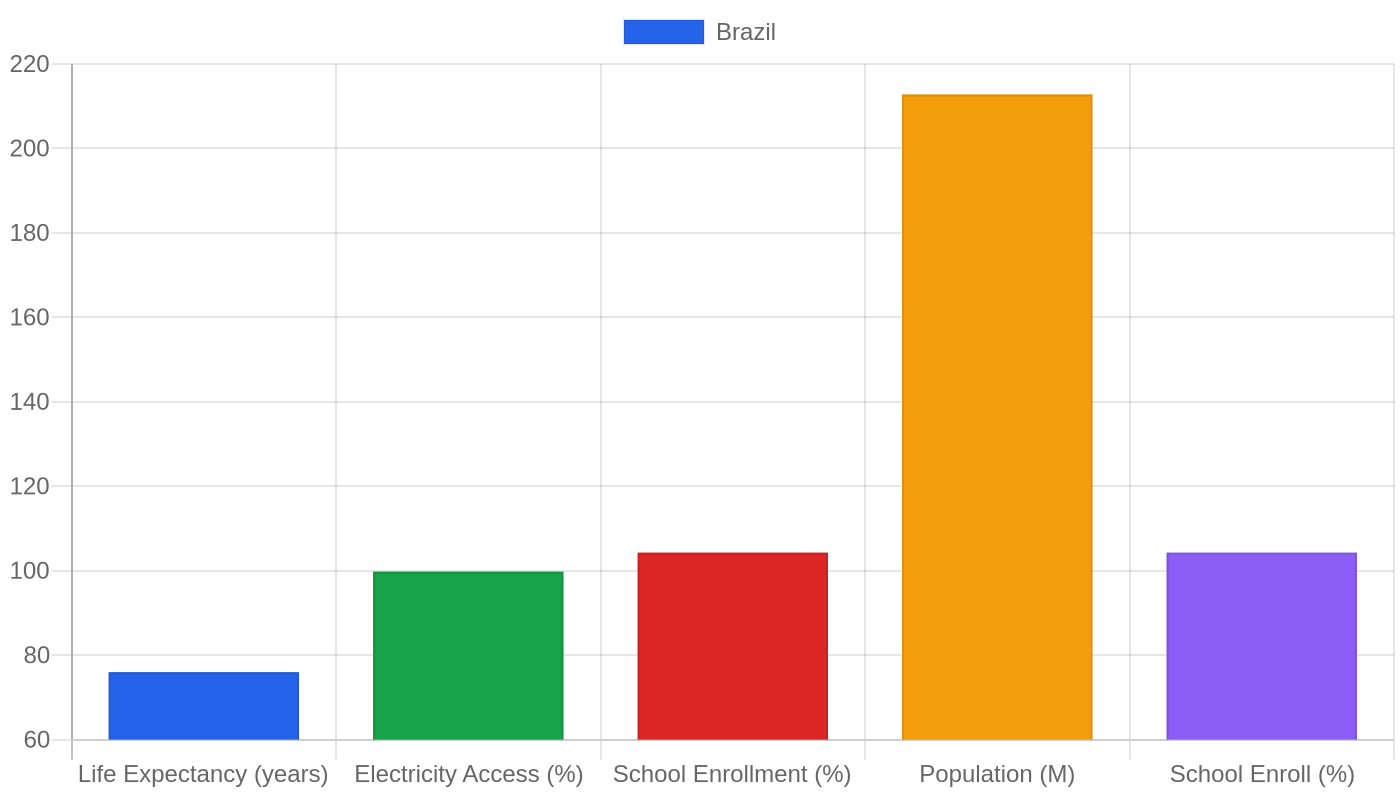
– With a GNI per capita of $10,550 and a population exceeding 212 million, Brazil remains a market of continental scale, but one that demands careful navigation.
The Growth Paradox — Modest Gains, Massive Potential
The World Bank’s latest data paints a picture of a Brazilian economy that is stable but not spectacular. GDP growth of 2.29% in 2025 tells a story of an economy that has weathered global headwinds but has yet to recapture the breakout momentum that analysts once predicted for the Brics pioneer.
This is not the Brazil of the commodity super-cycle, when double-digit growth seemed possible; this is a maturing economy grappling with structural bottlenecks, from infrastructure deficits to a complex tax code that burdens entrepreneurs and multinationals alike.
Yet the unemployment figure of 5.97% demands attention. In a country that spent years wrestling with double-digit joblessness, this represents a genuine achievement. The World Bank’s data suggests a labour market that has absorbed workers even as the broader economy grows at a moderate clip. The challenge, however, lies beneath the surface. Brazil’s informal sector remains vast, and many of the jobs being created lack the productivity gains that would drive sustained wage growth.
For the average Brazilian, the difference between having a job and having a good job remains the central economic question.
The GNI per capita of $10,550 places Brazil firmly in the upper-middle-income bracket, but it also highlights the persistent inequality that defines the nation. Brazil is not a poor country; it is an unequal one. The wealth generated by agribusiness, mining, and manufacturing does not distribute evenly across the 212 million people who call Brazil home.
The World Bank’s numbers tell us where Brazil stands, but the lived experience of Brazilians — from the favelas of São Paulo to the soybean fields of Mato Grosso — tells a more complicated story.
The composition of Brazil’s economy remains a tale of two sectors. On one hand, the agribusiness complex, anchored by companies like Amaggi Group, has turned Brazil into a global breadbasket, feeding millions across the world. On the other, the industrial and services sectors show signs of cautious expansion, though they face persistent challenges from high interest rates and a business environment that rewards patience over risk-taking.
The 2.29% growth rate, while modest, masks the underlying dynamism of a country that remains a cornerstone of the global food supply chain.
The Price of Living — Brazil’s Urban Reality
For the millions of Brazilians navigating daily life in cities like São Paulo, Rio de Janeiro, and Belo Horizonte, the cost of living remains a constant source of pressure. Housing, in particular, presents a stark challenge. In prime urban areas, rental prices have climbed steadily, pushing homeownership further out of reach for younger Brazilians and working-class families.
The choice between renting in the city and buying in the periphery is not merely an economic calculation; it is a decision that shapes access to jobs, education, and healthcare.
The gap between Brazil’s wealthy neighbourhoods and its working-class districts remains one of the most visible markers of inequality in any major economy. While comprehensive inflation data is not available in the current World Bank dataset, the lived experience of Brazilians suggests that food prices, transportation costs, and utility bills consume a significant share of household budgets.
For a nation with a GNI per capita of $10,550, the purchasing power of the average citizen is stretched thin when basic necessities demand so much.
The rental market, particularly in the southern and southeastern regions, has become a battleground between investors seeking yields and residents seeking stability. This dynamic is not unique to Brazil, but it takes on a particular intensity in a country where the formal housing market has historically failed to keep pace with urbanisation.
The result is a sprawling landscape of informal settlements alongside gleaming new developments — a physical manifestation of the economic dualism that defines Brazilian society.
The Business Frontier — Where Capital Meets Opportunity
Brazil’s corporate landscape offers a window into the country’s economic future. The presence of AmBev, one of the world’s largest beverage companies, speaks to Brazil’s consumer market potential. The inclusion of Agrale, a manufacturer of vehicles and agricultural machinery, highlights the industrial depth that persists despite decades of deindustrialisation concerns.
And the presence of Alupar, a utility company, underscores the critical role of energy infrastructure in powering Brazil’s growth.
For investors, Brazil offers a paradox. The country’s sheer scale — 212 million consumers, abundant natural resources, and a diversified economy — makes it impossible to ignore. Yet the operational realities can be daunting. The telecommunications sector, represented by Algar, operates in a market that has consolidated significantly but still offers opportunities in underserved regions.
The basic materials sector, anchored by companies like Aperam South America and Aracruz Celulose, benefits from Brazil’s competitive advantages in forestry and mining but remains exposed to global commodity cycles.
The business environment in Brazil demands what analysts often call “local knowledge” — an understanding of the regulatory landscape, the tax system, and the political currents that shape economic policy. The conglomerate Andrade Gutierrez, with its roots in construction and infrastructure, exemplifies the kind of diversified approach that has historically succeeded in Brazil.
Meanwhile, newer entrants like Airship do Brasil, operating in the industrials space, suggest that innovation is finding a foothold even in a challenging environment.
Politics, Safety, and the Quality of Life Question
Brazil’s political system, defined by the World Bank data as a democratic federative republic with a presidential system, remains the framework within which all economic activity occurs. President Luiz Inácio Lula da Silva, now in his current term, represents a return to a style of governance that prioritises social welfare alongside economic development. The 1993 referendum that confirmed the presidential system continues to shape the country’s political trajectory, for better or worse.
The quality of life in Brazil is inseparable from questions of public safety. While specific crime indices are not available in the current dataset, it is well understood that urban violence remains a persistent concern that affects everything from property values to foreign investment decisions. Brazilians have developed a resilience in the face of these challenges, but the psychological toll of insecurity cannot be underestimated.
For the middle class, Brazil offers a lifestyle that is both alluring and demanding. The cultural richness, the natural beauty, and the warmth of the people are genuine assets. But the strains of inequality, the frustrations of bureaucracy, and the anxiety about safety create a constant undercurrent of stress. The political landscape, with its sharp divisions between Lula’s supporters and his detractors, adds another layer of complexity to daily life.
The Moment Now — Brazil at a Crossroads
As 2026 unfolds, Brazil stands at a genuine inflection point. The World Bank’s growth figure of 2.29% is not merely a statistic; it is a reflection of the choices being made in Brasília about fiscal policy, investment priorities, and the balance between environmental protection and economic development.
President Lula’s administration is navigating a delicate path, attempting to honour campaign promises of social investment while reassuring markets that Brazil remains a responsible steward of its finances.
The low unemployment rate of 5.97% provides the government with political capital, but it also creates expectations that cannot be easily met. Workers who have found jobs now want better jobs. Families who have achieved stability now want upward mobility. The pressure on the government to deliver tangible improvements in public services, infrastructure, and education is immense.
The business community is watching closely. The presence of major companies across every sector of the economy suggests confidence in Brazil’s long-term trajectory, but short-term decisions are being made with caution. The global economic environment remains uncertain, and Brazil is not immune to external shocks. The coming months will test whether the country can translate its modest growth into more substantial progress.
The Bottom Line
Brazil is not a country for those seeking quick returns or simple narratives. It is a market of profound complexity, where opportunity and obstacle exist in equal measure. The World Bank data confirms that Brazil remains a major economic power — the 2.29% growth, the 5.97% unemployment, the $10,550 GNI per capita all point to a nation of substance. But the real story is about whether Brazil can move beyond stability to transformation.
For investors with long time horizons, for companies willing to navigate the regulatory labyrinth, and for observers who appreciate the drama of a nation perpetually striving to fulfil its vast potential, Brazil remains one of the most compelling stories in the global economy. The world should watch, not because Brazil is about to become something entirely new, but because the struggle itself — between growth and equity, between ambition and reality — is the defining narrative of our times.
Sources & Methodology
This article is authored by Economic Pulse Net for informational and research purposes. Economic Pulse Net sources its data from multilateral institutions, national statistics bureaus, and proprietary databases. All data is believed to be current as of the date of publication.
Published: August 03, 2026 | Category: Research — Brazil
Use these signals in your own platform
Economic Pulse publishes its live signal feed through a documented, read-only API. Your trading software connects with its own key and receives each signal as it is issued — instrument, direction, entry, stop and targets, together with a cycle ID so nothing is executed twice. The feed is independent of this website and cannot change it.
Signals are informational only and are not financial advice.