Economic Pulse Net | Sources: World Bank World Development Indicators, Government Sources | 2026
Key Takeaways
* Brazil’s economy is projected to grow by approximately 2.3% in 2025, demonstrating resilience despite global headwinds.
Inflation remains contained near the central bank’s target, with CPI hovering around 5%, while unemployment sits at a manageable 5.97%.
As the world’s fourth most populous nation, Brazil leverages its vast domestic market and diverse industrial base, from agribusiness to telecommunications.
The political landscape remains stable under President Luiz Inácio Lula da Silva, operating within a federal presidential system established by the 1988 Constitution.
Major corporate players like AmBev and Algar drive significant economic activity across consumer goods, utilities, and infrastructure sectors.
Economic Resilience Amidst Global Uncertainty
Brazil’s macroeconomic indicators for 2025 suggest a period of moderate but steady expansion, anchored by a GDP growth rate of 2.2857464902475%. This growth trajectory places Brazil’s total economic output at an impressive $2.28 trillion USD, underscoring its status as one of the world’s largest economies.
However, the true strength of the Brazilian economy lies in its purchasing power; with a GDP per capita (PPP) of $23,433, the average citizen enjoys a standard of living that significantly outpaces nominal income figures. This disparity highlights the importance of considering local price levels when assessing economic health. Meanwhile, inflation has been brought under relative control, with the Consumer Price Index (CPI) recorded at 5.01675279604836%.
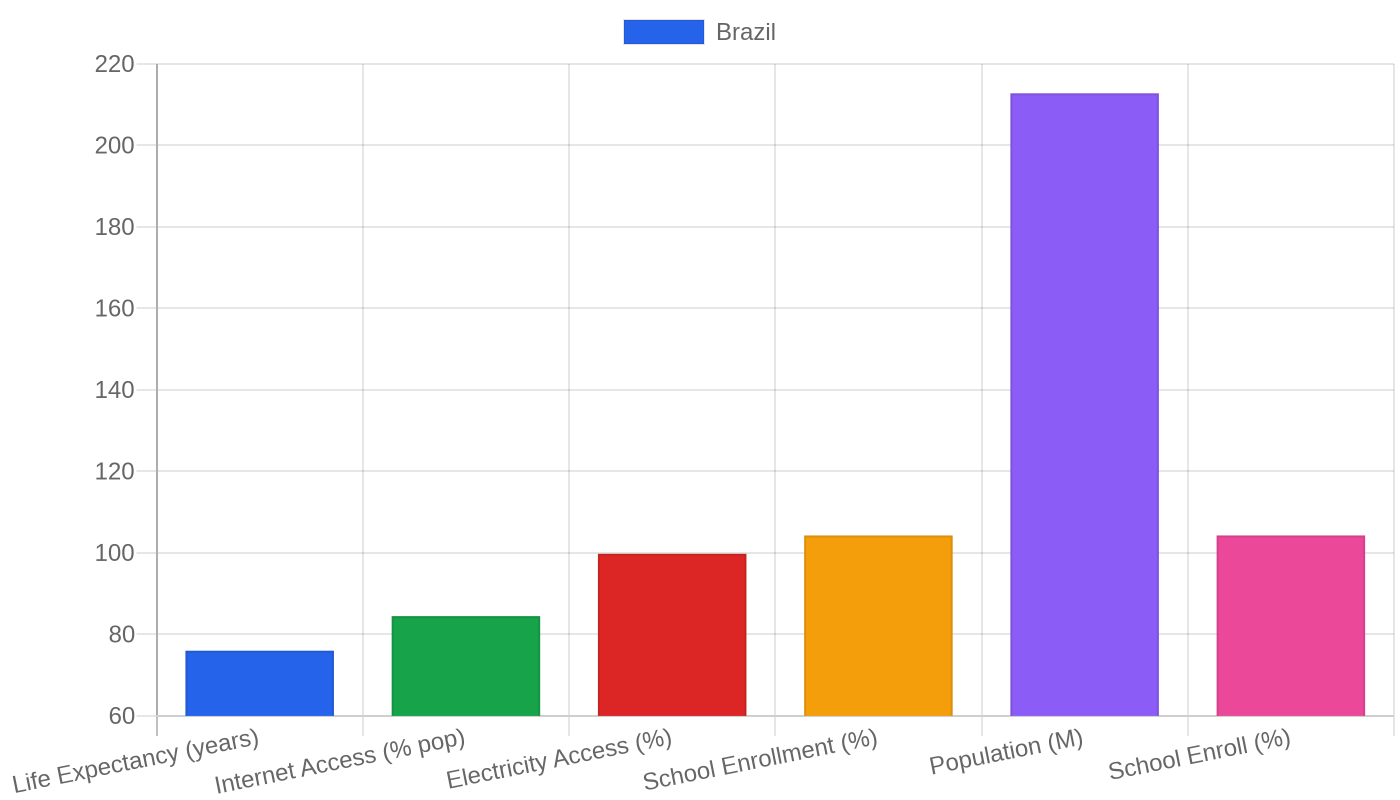
While this figure indicates prices are rising, it reflects a managed environment where monetary policy appears effective. Labor markets are also showing signs of stability, with the unemployment rate holding at 5.97%. For a country with a population exceeding 212 million, maintaining such low joblessness is a significant achievement, suggesting that the labor force is largely integrated into the formal economy.
These numbers collectively paint a picture of an economy that is not booming explosively but is growing sustainably, providing a solid foundation for long-term development.
Navigating the Cost of Living
For residents and expatriates alike, understanding the cost of living in Brazil requires looking beyond headline inflation numbers. With CPI at roughly 5%, daily expenses are subject to gradual increases, yet the PPP-adjusted GDP per capita suggests that real purchasing power remains robust for many segments of the population. Housing costs, which vary dramatically between metropolitan hubs like São Paulo and rural interior regions, are influenced by both local supply dynamics and national economic trends.
Rent versus buy decisions are increasingly complex, as mortgage rates often correlate with broader interest rate policies aimed at curbing inflation. Daily necessities, from food to transportation, reflect the country’s agricultural abundance, often keeping grocery bills lower than in more industrialized nations. However, services in urban centers can be pricey, driven by high demand and regulatory costs.
Overall, the cost structure supports a middle class that is active in the economy, contributing to the vibrant consumer sector seen in companies like AmBev.
Investment Opportunities and Corporate Landscape
Brazil’s business climate is characterized by a diverse array of industries, ranging from heavy industry to digital services. The corporate landscape is dominated by key players who span multiple sectors, offering investors a mix of stability and growth potential. In the consumer goods space, giants like AmBev continue to dominate beverage markets, while Agrale provides essential equipment and goods.
The industrial sector sees contributions from entities like Airship do Brasil and Andrade Gutierrez, highlighting the country’s ongoing infrastructure needs. Meanwhile, the utility and telecommunications sectors are being reshaped by companies such as Algar and Alupar, which are critical for modernizing Brazil’s energy grid and connectivity. Basic materials remain a cornerstone, with Aperam South America and Aracruz Celulose playing pivotal roles in steel and paper production respectively.
Even emerging tech-focused firms like AstralSat indicate a shift toward innovation in consumer services. This diversity means that investment strategies can be tailored to specific sectors, whether one seeks exposure to traditional commodities or modern digital infrastructure.
Political Stability and Safety Considerations
The political framework of Brazil is defined by its democratic federative republic status, a system confirmed by historical referendums and enshrined in law. President Luiz Inácio Lula da Silva currently leads the nation, serving as both head of state and head of government. His administration operates within a presidential system where the president appoints ministers to form a cabinet, ensuring a centralized executive branch capable of swift decision-making.
Re-election is permitted for a second successive term, adding a layer of predictability to short-term policy directions. Regarding safety, specific crime and safety indices are currently listed as N/A, making precise quantitative assessments difficult. However, the general quality of life is supported by strong social structures and a vibrant cultural scene.
The absence of granular safety data does not negate the country’s appeal, but it does require investors and travelers to exercise standard caution and stay informed about local conditions. Political stability remains a key asset, as consistent governance helps maintain investor confidence over time.
Current Affairs and Policy Shifts
Right now, Brazil is navigating a critical phase of economic management under President Lula’s leadership. The focus is on balancing growth with fiscal responsibility, aiming to keep inflation near the 5% mark while supporting employment. Recent policy discussions likely center on how to further integrate the informal workforce into the formal economy, given the already low 5.97% unemployment rate.
Infrastructure projects spearheaded by companies like Alupar and Airship do Brasil are probably accelerating, driven by government incentives to boost productivity. There is also heightened attention on the agribusiness sector, with firms like Amaggi Group playing a crucial role in export revenues. Regulatory reforms in telecommunications and utilities may be underway to attract foreign capital, leveraging the success of existing players like Algar.
These developments suggest a government that is proactive in addressing structural bottlenecks while maintaining macroeconomic stability.
The Bottom Line
Brazil presents a compelling case for those seeking exposure to a large, diversified emerging market. Its steady GDP growth and controlled inflation provide a safe harbor compared to more volatile peers. Investors should watch the corporate sector closely, particularly in utilities and agribusiness, where major companies are driving innovation. Ultimately, Brazil’s size, political stability, and resilient consumer base make it a country worth monitoring for long-term opportunities.
Sources & Methodology
This article is authored by Economic Pulse Net for informational and research purposes. Economic Pulse Net sources its data from multilateral institutions, national statistics bureaus, and proprietary databases. All data is believed to be current as of the date of publication.
Published: October 17, 2026 | Category: Research — Brazil
Use these signals in your own platform
Economic Pulse publishes its live signal feed through a documented, read-only API. Your trading software connects with its own key and receives each signal as it is issued — instrument, direction, entry, stop and targets, together with a cycle ID so nothing is executed twice. The feed is independent of this website and cannot change it.
Signals are informational only and are not financial advice.