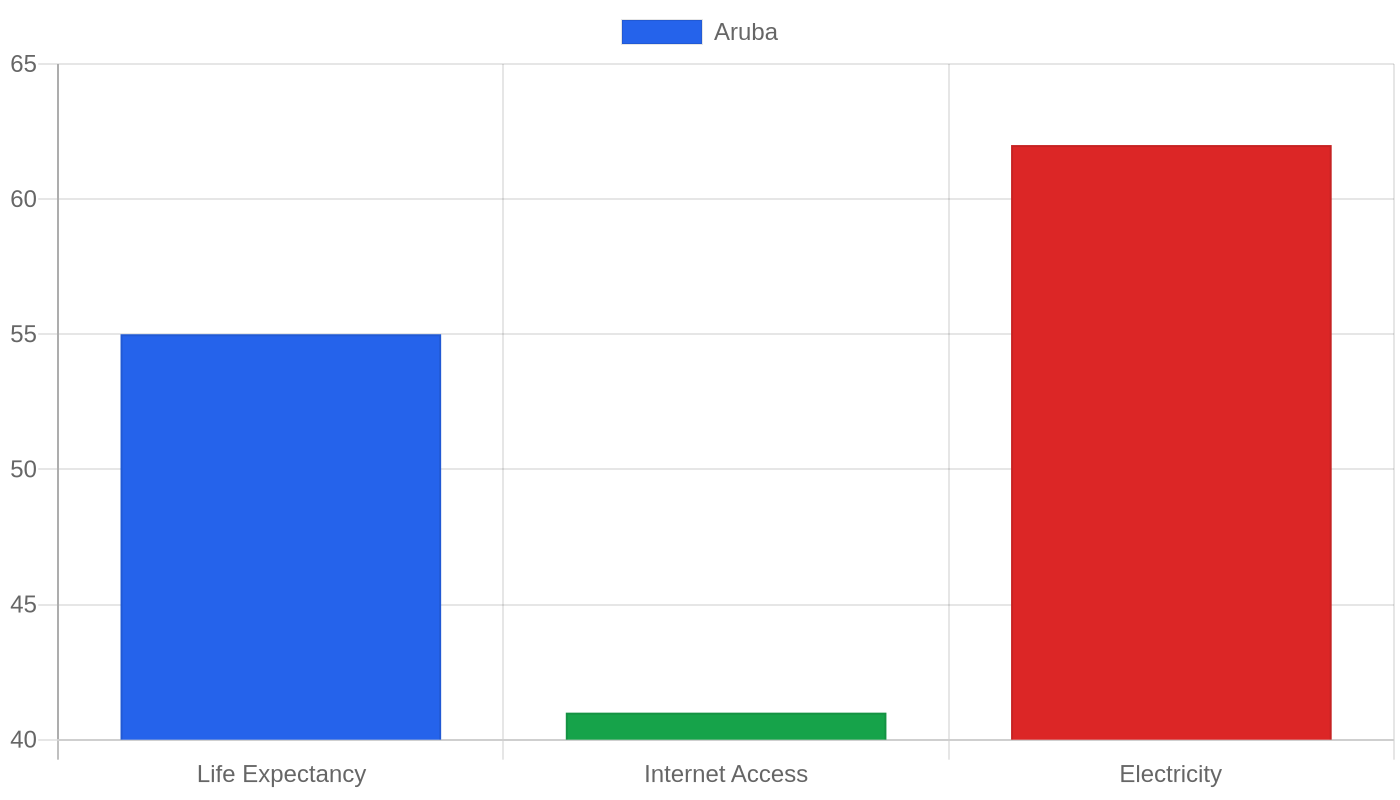
Economic Pulse Net | Sources: World Bank World Development Indicators, Government Sources | 2026
Key Takeaways
– Aruba operates as a constituent country of the Kingdom of the Netherlands, managing its internal affairs through a 21-member Parliament and an eight-member Cabinet, while the Dutch government retains control over foreign policy and defence.
– The island’s political system features a governor appointed by the Dutch monarch for a six-year term, creating a unique hybrid of Caribbean governance and European constitutional oversight.
– With limited landmass and a tourism-dependent economy, Aruba’s economic fate remains closely tied to global travel patterns and the broader Caribbean regional outlook.
– The World Bank’s latest data shows no recorded figures for GDP growth, inflation, or unemployment, underscoring the challenges of tracking economic performance in small island states.
– For investors and policymakers, Aruba represents a case study in how small territories navigate autonomy within a larger kingdom structure.
The Economic Engine — A Tourism-Led Model Under the Caribbean Sun
The economic story of Aruba is, at its core, a narrative about the power of place. The World Bank’s most recent data does not provide specific figures for GDP growth, inflation, or unemployment, which is itself a telling detail about the realities of monitoring small island economies.
When international institutions lack up-to-date metrics, it reflects both the challenges of data collection in territories with populations that number in the hundreds of thousands and the outsized volatility that comes with dependence on a single dominant industry. For Aruba, that industry has long been tourism, with the island’s white-sand beaches, year-round trade winds, and location outside the hurricane belt making it a perennial favourite for North American and European travellers.
The absence of hard numbers from the World Bank should not be mistaken for economic stagnation. Rather, it points to a broader truth about Caribbean micro-states: their economic indicators can swing dramatically from year to year based on factors largely beyond their control. A single hurricane season, a shift in European travel preferences, or a global health scare can move the needle more than a decade of domestic policy.
Aruba’s economic fundamentals, while not quantified in the latest data, rest on a well-established tourism infrastructure, a stable political environment within the Dutch Kingdom framework, and a reputation for safety and reliability that many of its Caribbean neighbours envy.
What the available data does tell us is that Aruba’s economic model is one of managed dependency. The island’s status as a constituent country of the Kingdom of the Netherlands provides access to Dutch institutional support and a legal framework that protects property rights and enforces contracts. For businesses and investors, this means operating in an environment that feels more European than typically Caribbean, with transparent governance and a predictable regulatory climate.
The trade-off, of course, is that the island’s economic destiny remains tethered to decisions made in The Hague on matters ranging from defence to foreign affairs, limiting the scope for independent economic diplomacy.
The Cost of Paradise — Housing and Daily Life on a Small Island
Living in Aruba comes with a price tag that reflects the realities of island geography. As a small territory with finite land and a population concentrated along its southwestern coast, the cost of living carries the familiar premiums of island economies: nearly everything must be imported, from food to fuel to construction materials. While specific housing cost data is not available in the current World Bank figures, the structural dynamics are clear.
Land is scarce, zoning is tight, and the competition for property is intensified by both residential demand and the tourism sector’s appetite for beachfront development.
For residents, the rent-versus-buy calculation is heavily influenced by the island’s dual identity as both a home and a holiday destination. Properties that might otherwise be available for long-term residents are often diverted into the short-term vacation rental market, a pattern seen across the Caribbean and one that tends to push housing costs upward. Daily expenses, from groceries to utilities, carry the weight of import dependence, with prices that typically run above regional averages.
The cost of living in Aruba, while not quantified in the current data, is generally understood to be higher than in many of its Caribbean neighbours, a premium paid for the island’s stability, safety, and Dutch-linked infrastructure.
Business and Investment — A Stable Platform in a Volatile Region
For investors scanning the Caribbean, Aruba offers a distinctive proposition. The island’s top companies are predominantly concentrated in tourism, hospitality, and related services, reflecting the economy’s core strengths. The political framework, with its 21-member Parliament and eight-member Cabinet, provides a level of governmental stability that is not universal in the region.
Elections occur on a predictable four-year cycle, and the presence of Dutch constitutional oversight adds an extra layer of institutional security for those considering longer-term commitments.
The business environment is shaped by Aruba’s membership in the Kingdom of the Netherlands, which brings with it a legal system rooted in Dutch law and commercial practices that align more closely with European standards than with those of many neighbouring jurisdictions. For companies in the tourism and hospitality sectors, the island’s well-developed infrastructure and international airport make it a relatively easy market to enter.
The sectors to watch are those adjacent to the core tourism economy — sustainable energy, water management, and high-end real estate — all of which benefit from the island’s need to balance growth with environmental preservation.
Safety, Politics, and the Quality of Life Equation
The crime and safety indices for Aruba are not available in the current data, but the island’s reputation for safety is one of its most valuable assets. In a region where crime rates can be a significant deterrent to both tourism and investment, Aruba has long positioned itself as a secure and welcoming destination.
The political landscape is defined by the island’s unique status: along with the Netherlands, Curaçao, and Sint Maarten, Aruba is a constituent country of the Kingdom of the Netherlands, with internal autonomy over its domestic affairs.
This arrangement means that Arubans manage their own healthcare, education, and economic policy, while the Dutch government handles foreign affairs and defence. The governor of Aruba, appointed for a six-year term by the monarch, serves as the representative of the Crown and plays a ceremonial but constitutionally significant role. For residents, this creates a quality of life that combines Caribbean warmth with European institutional reliability.
The island’s political stability, its Dutch-linked social services, and its relative safety all contribute to a standard of living that punches above what the raw economic data might suggest.
What’s Happening Now — Navigating Autonomy in a Changing World
The most pressing conversations in Aruba today centre on how the island navigates its autonomy within the Kingdom of the Netherlands while confronting the global forces reshaping tourism and trade. The World Bank’s lack of current economic data reflects a broader challenge: small island states are often the last to receive updated statistics and the first to feel the impact of global economic shifts.
Aruba’s political leadership is engaged in an ongoing dialogue with The Hague about the terms of its autonomy, a relationship that requires constant negotiation between local priorities and kingdom-wide interests.
The island’s 21-member Parliament and eight-member Cabinet are grappling with the perennial questions of small-state governance: how to diversify an economy built on tourism, how to manage the environmental pressures of development, and how to maintain a distinct Aruban identity within a larger constitutional framework. The four-year electoral cycle keeps these debates fresh, with each election offering voters a chance to recalibrate the island’s direction.
For observers, the key dynamic to watch is how Aruba balances its desire for greater self-determination with the practical benefits of Dutch support — a tension that will define the island’s trajectory in the years ahead.
The Bottom Line
Aruba is a country that rewards patient observation. For investors, it offers a stable, well-governed platform in a region where such qualities are not guaranteed. For policymakers, it represents a fascinating case study in how small territories manage autonomy within larger political structures. And for anyone interested in the future of the Caribbean, Aruba’s ability to balance tourism-driven growth with environmental stewardship and cultural preservation will be a story worth following.
The data may be sparse, but the island’s significance is not — Aruba is a place where the big questions of small-state economics are playing out in real time.
Sources & Methodology
This article is authored by Economic Pulse Net for informational and research purposes. Economic Pulse Net sources its data from multilateral institutions, national statistics bureaus, and proprietary databases. All data is believed to be current as of the date of publication.
Published: August 02, 2026 | Category: Research — Aruba
Use these signals in your own platform
Economic Pulse publishes its live signal feed through a documented, read-only API. Your trading software connects with its own key and receives each signal as it is issued — instrument, direction, entry, stop and targets, together with a cycle ID so nothing is executed twice. The feed is independent of this website and cannot change it.
Signals are informational only and are not financial advice.