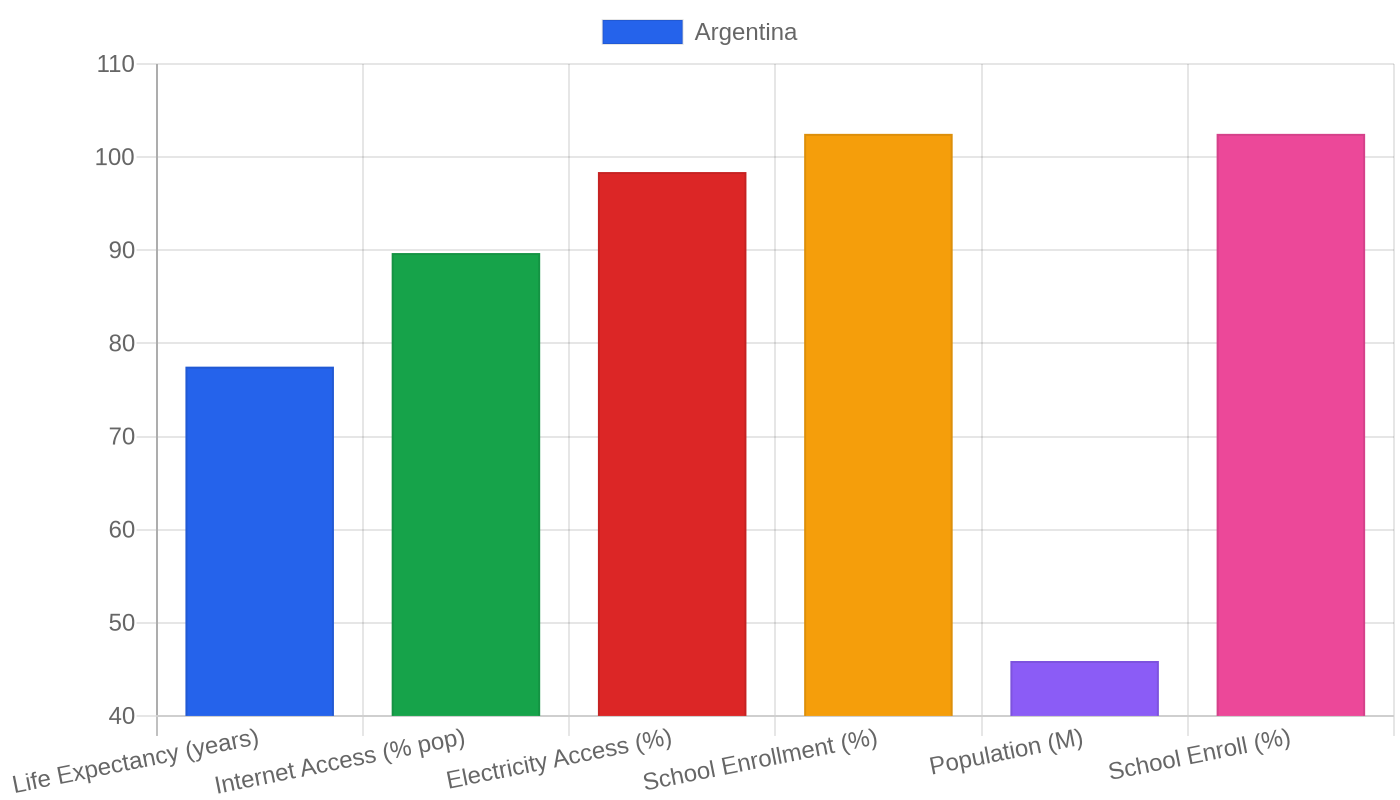
Economic Pulse Net | Sources: World Bank World Development Indicators, Government Sources | 2026
Key Takeaways
– Argentina’s economy grew by 4.37% in 2025 according to the World Bank, yet this expansion is almost entirely overshadowed by an astronomical inflation rate of nearly 220%, the highest in the world among major economies.
– Unemployment sits at a remarkably low 7.1%, but this figure masks a labour market distorted by chronic inflation, informal employment, and a shrinking middle class.
– The nation’s democracy, restored after decades of military rule and the 2001–02 crisis, remains tested by deep-seated political instability and economic trauma.
– Argentina’s GNI per capita of $14,650 suggests an upper-middle-income country, but the cost-of-living crisis has eroded purchasing power to levels that feel far poorer for ordinary citizens.
– Major domestic companies span industrials, consumer services, and basic materials, but the business climate remains constrained by currency controls, state intervention, and unpredictable policy swings.
The Paradox of Growth: GDP Expansion Amidst Inflationary Fire
Argentina’s headline GDP growth figure of 4.37% for 2025, reported by the World Bank, would be cause for celebration in almost any other emerging economy. Here, it arrives with a bitter asterisk. The nation’s inflation rate of 219.9% — a number that has become almost numbingly familiar to Argentines — means that nominal growth is being devoured in real terms. When prices nearly triple every year, a 4.37% expansion in output is a pittance.
Consumers see their pesos lose value by the hour, while businesses struggle to set prices that remain relevant by the end of the week.
The World Bank data places Argentina’s total GDP at roughly $683 billion, with a per capita PPP figure of $32,586. On paper, this suggests a relatively prosperous nation, comparable to some Eastern European economies. Yet the lived reality is starkly different.
The GNI per capita of $14,650 tells a more honest story: the gap between purchasing power parity and actual income reflects the deep distortions caused by capital controls, black market exchange rates, and a dual-currency economy where dollars are hoarded like gold.
Unemployment at 7.1% is low by historical standards, but this statistic requires careful reading. In an economy where inflation erodes formal wages, many Argentines are forced into multiple informal jobs just to keep pace with rising costs. The labour market is a survivalist arena, not a sign of robust health. Key industries — from agriculture to manufacturing — operate under the constant shadow of government intervention, export taxes, and unpredictable regulatory shifts.
The agricultural sector, Argentina’s traditional powerhouse, continues to produce, but farmers face crushing export duties that fund the state’s bloated budget while strangling their own margins.
The Price of Everything: Housing, Daily Life, and the Vanishing Peso
The cost of living in Argentina has become a national obsession, and for good reason. With inflation running at nearly 220%, the price of basic goods — bread, milk, cooking oil — can change from one week to the next. Supermarket shelves are stocked, but the psychological toll of watching one’s savings evaporate is immense. Rentals in Buenos Aires, once a bargain for foreign visitors, have become prohibitive for locals earning in pesos.
The traditional aspiration of homeownership has receded for a generation of young Argentines, who now view property as an unattainable luxury rather than a milestone.
Renting versus buying has become a false dichotomy for most. Those with access to US dollars — through family remittances, black market dealings, or savings from better times — can secure property or vehicles at relative bargains. For the peso-earning majority, rent consumes an ever-growing share of household income. Utility bills, transportation costs, and healthcare expenses have all risen in lockstep with inflation.
The middle class, once the pride of Argentine society, is being squeezed into a lower economic bracket, forced to make choices between quality of life and basic survival.
Regional comparisons are difficult without data, but anecdotal evidence from neighbouring economies suggests Argentina’s cost-of-living crisis is uniquely severe. While Chile and Uruguay also face inflation, neither approaches Argentina’s triple-digit nightmare. The gap between the official exchange rate and the “blue dollar” parallel market creates a two-tier economy where those with access to foreign currency live in a different financial universe from those trapped in pesos.
Business Under Siege: Corporate Argentina in the Age of Uncertainty
Argentina’s top companies, as listed in available data, offer a revealing snapshot of the economy’s strengths and vulnerabilities. Aero Boero and AeroDreams represent the industrials sector, while Aerolíneas Argentinas, the state-owned flag carrier, stands as a symbol of both national pride and chronic inefficiency. Aluar, a major player in basic materials, reflects Argentina’s natural resource wealth.
Yet these companies operate in an environment where the government frequently changes tax rules, imposes price controls, and restricts access to foreign currency for importing essential inputs.
The business climate is defined by unpredictability. Entrepreneurs and investors must navigate a labyrinth of regulations, multiple exchange rates, and a judiciary that is sometimes independent, sometimes not. The energy sector, particularly Vaca Muerta’s shale oil and gas reserves, offers genuine promise, but development has been hampered by infrastructure bottlenecks and political interference.
Agriculture remains the backbone, but export taxes and the threat of further government grabs keep farmers in a state of perpetual wariness.
For foreign investors, the risk-reward calculation is extreme. Argentina offers cheap assets, a well-educated workforce, and abundant natural resources. But the history of debt defaults, capital controls, and policy reversals — from Peronist nationalism to market-friendly reforms and back again — makes long-term commitment a gamble.
The current government’s approach to economic management remains a subject of intense debate, with no clear consensus on whether the country is edging toward orthodoxy or deeper interventionism.
Democracy’s Long Shadow: Politics, Safety, and the Quality of Life
Argentina’s political landscape, as documented in the data, tells a story of hard-won stability built on a foundation of repeated trauma. Between 1930 and 1976, the armed forces overthrew six governments. The country alternated between brief periods of democracy and extended stretches of military rule, including the brutal dictatorship of 1976–1983. Since the transition that began in 1983, democracy has held, surviving the catastrophic economic collapse of 2001–02. But the scars remain.
The political system today is fractured and polarised. The Peronist movement, in its various incarnations, has dominated much of the post-1983 era, but its grip has weakened. The current administration faces deep public anger over inflation, crime, and declining public services. Trust in institutions — the presidency, the congress, the judiciary — is low. Protests are frequent, and the streets of Buenos Aires often echo with the sound of banging pots and pans, a traditional Argentine expression of discontent.
Crime and safety indices are not available in the provided data, but it is well understood that Argentina’s major cities face challenges with petty theft, robbery, and, in some areas, more violent crime. The quality of life is a mixed picture: Argentina still boasts excellent public universities, a vibrant cultural scene, and some of the world’s best food and wine. But the economic crisis has frayed the social fabric, and many Argentines express a deep sense of exhaustion and pessimism about the future.
The Present Crisis: What’s Happening in Argentina Right Now
This is the moment of maximum tension in Argentina’s long-running economic drama. The 219.9% inflation rate is not a static figure; it is accelerating, and the government’s policy responses have been a patchwork of emergency measures, price freezes, and currency devaluations that have failed to break the cycle. The Central Bank continues to print money to finance the fiscal deficit, a strategy that only fuels further inflation.
Negotiations with the International Monetary Fund remain a perennial feature of the news cycle, with each agreement bringing temporary relief but no structural solution.
On the political front, the government is fighting to maintain credibility ahead of the next electoral cycle. The opposition, meanwhile, has offered competing visions — from dollarisation to austerity to more state intervention — but has yet to present a unified alternative. The business community is watching closely, hoping for signs of a coherent economic plan but bracing for more of the same. Recent weeks have seen renewed protests over wages and prices, and the social temperature is rising.
The energy sector offers a rare bright spot. Vaca Muerta’s production continues to ramp up, and Argentina is on track to become a net energy exporter in the near future. This could provide a crucial source of foreign currency to ease the balance of payments crisis. But the benefits will take time to materialise, and in the meantime, Argentines are living through one of the most severe inflationary episodes in modern global history.
The question on everyone’s mind is whether the country can hold together long enough for the energy boom to arrive.
The Bottom Line
Argentina is a country of extraordinary potential and chronic dysfunction. For investors with a high tolerance for risk and a long time horizon, the distressed asset play could yield enormous returns — but only if the political and economic landscape stabilises. For policymakers and economists, Argentina serves as a case study in the dangers of fiscal incontinence and the difficulty of taming hyperinflation once it takes hold.
For the ordinary Argentine, this is a test of endurance, resilience, and faith that the nation’s democratic institutions can eventually deliver a better life. Watch Argentina not for what it is today, but for what it could become — if it can finally break the cycle of crisis.
Sources & Methodology
This article is authored by Economic Pulse Net for informational and research purposes. Economic Pulse Net sources its data from multilateral institutions, national statistics bureaus, and proprietary databases. All data is believed to be current as of the date of publication.
Published: July 20, 2026 | Category: Research — Argentina
Use these signals in your own platform
Economic Pulse publishes its live signal feed through a documented, read-only API. Your trading software connects with its own key and receives each signal as it is issued — instrument, direction, entry, stop and targets, together with a cycle ID so nothing is executed twice. The feed is independent of this website and cannot change it.
Signals are informational only and are not financial advice.