Economic Pulse Net | Sources: World Bank World Development Indicators, Government Sources | 2026
Key Takeaways
– A Resilient Democracy: After decades of military coups and political upheaval throughout the 20th century, Argentina has maintained uninterrupted democratic governance since 1983, surviving even the catastrophic 2001–02 economic crisis.
– A Nation of Industrial Might: Argentina’s corporate landscape is anchored by major industrial players in aerospace, aluminum, and basic materials, signaling a manufacturing base that persists despite macroeconomic turbulence.
– A Story of Institutional Survival: The political system has demonstrated remarkable endurance, navigating six military overthrows between 1930 and 1976 to emerge as one of Latin America’s most established democracies.
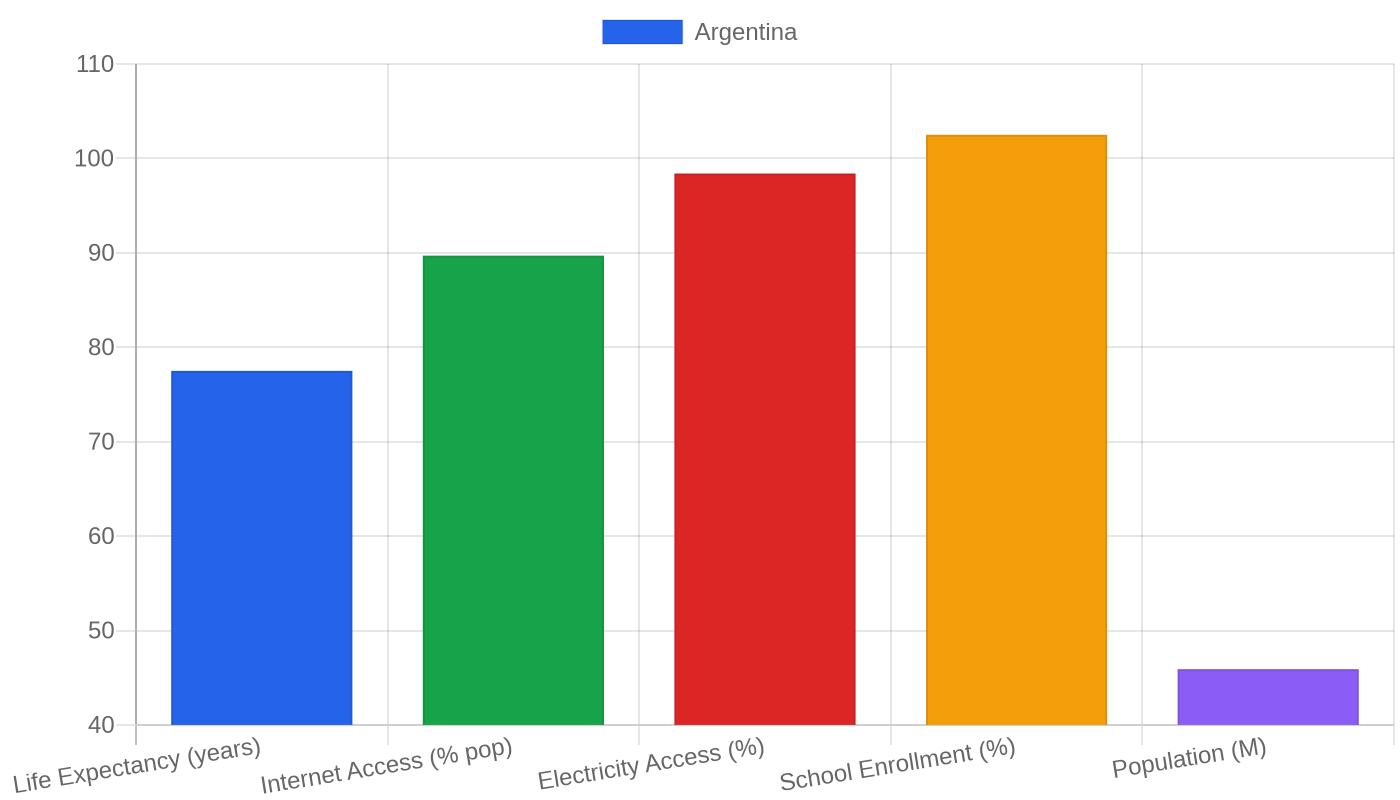
– A Large Domestic Market: With a population exceeding 45.8 million, Argentina represents one of the region’s most substantial consumer bases, offering significant scale for both domestic enterprises and international investors.
– A Country in Transition: The nation finds itself at a critical juncture, balancing its industrial heritage with the urgent need for economic modernization and fiscal discipline.
The Economic Tightrope — Industry, Inflation, and the Search for Stability
Argentina’s economic narrative is one of extraordinary potential perpetually wrestling with structural challenges. The latest World Bank data presents a complex picture, with key indicators currently unavailable, yet the composition of the nation’s top companies tells a revealing story about where Argentina’s productive energies lie.
The industrial sector dominates the corporate landscape, with companies like Aluar in basic materials and Aerolineas Argentinas in consumer services representing the backbone of the national economy. The presence of aerospace manufacturers such as Aero Boero and AeroDreams alongside agricultural machinery producer Agrinar suggests a diversified industrial base that extends well beyond the country’s traditional agricultural strengths.
The absence of current GDP growth figures from the World Bank speaks to the broader uncertainty that has characterized Argentina’s recent economic trajectory. For decades, the country has grappled with persistent inflationary pressures and currency volatility that have complicated long-term planning for both businesses and households.
The unemployment picture remains equally opaque in the current data, but the structure of the economy — heavily weighted toward industrial production and services — suggests a labor market that is particularly sensitive to swings in domestic demand and international commodity prices.
What makes Argentina’s economic situation particularly noteworthy is the juxtaposition of its industrial sophistication against its macroeconomic fragility. This is not a nation lacking productive capacity; rather, it is a nation struggling to create the monetary and fiscal conditions that would allow that capacity to flourish.
The World Bank’s demographic data, showing a population of over 45.8 million, underscores the scale of the domestic market — a market that, if stabilized, could provide the foundation for sustained growth and development.
The Cost of Living Puzzle — Navigating Daily Life in a Volatile Economy
For the average Argentine household, the cost of living represents an exercise in constant adaptation. While specific housing cost data from the World Bank is not currently available, the broader economic context suggests that Argentine families face unique challenges in managing their daily expenses. The country’s history of inflation means that prices can shift dramatically in short periods, forcing households to make purchasing decisions with an urgency that would be unfamiliar in more stable economies.
The housing market in Argentina’s major urban centers reflects the broader economic volatility, with property transactions often complicated by currency fluctuations and financing constraints. For many Argentines, the choice between renting and buying is not simply a financial calculation but a strategic decision about how to protect savings from the erosion of inflation.
Real estate has traditionally served as a hedge against currency devaluation, making homeownership an attractive option for those with access to capital, even as rental markets remain active for the broader population.
The daily cost of groceries, transportation, and utilities in Argentina must be understood through the lens of the country’s economic history. Families have developed sophisticated coping mechanisms — from bulk purchasing to seeking out price-controlled goods — that have become ingrained in the national culture. This adaptability, while born of necessity, speaks to a resilience that has allowed Argentine society to maintain its quality of life despite persistent economic headwinds.
Business and Investment Landscape — Industrial Giants and Emerging Opportunities
Argentina’s corporate sector presents a study in contrasts, dominated by established industrial players while also nurturing a vibrant services and media ecosystem. The presence of major companies across industrials, basic materials, and consumer services indicates an economy with genuine depth and diversity.
Aluar’s position in the aluminum sector highlights Argentina’s capabilities in energy-intensive manufacturing, while the aerospace companies suggest a technological sophistication that could serve as a foundation for future growth in higher-value industries.
The media landscape, represented by outlets like Ámbito Financiero and América 24, points to a robust information economy and a society engaged with current events and financial matters. This media infrastructure is crucial not only for democratic discourse but also for the functioning of markets and the dissemination of business information.
For international investors, Argentina offers the allure of a large domestic market, natural resource wealth, and a skilled workforce — but these advantages must be weighed against the country’s history of economic instability and policy unpredictability.
The business environment in Argentina demands patience and a long-term perspective. Companies that have succeeded in this market, as evidenced by those appearing on the top companies list, have typically demonstrated an ability to navigate regulatory complexity and economic cycles. The industrial base that has developed over decades represents a significant competitive asset — one that could prove enormously valuable if the country can achieve greater macroeconomic stability and policy consistency.
Democracy, Security, and the Argentine Quality of Life
Argentina’s political journey in the 20th century was marked by profound instability, with the armed forces overthrowing six governments between 1930 and 1976. The country cycled through periods of democracy and military rule, experiencing full democratic governance only during the periods of 1912–1930, 1946–1955, and 1973–1976.
This turbulent history makes the democratic consolidation that began in 1983 all the more remarkable — a transition that has proven durable even in the face of severe economic challenges.
The endurance of Argentine democracy through the 2001–02 crisis represents perhaps the strongest testament to the country’s political maturation. That crisis, which brought economic collapse and social upheaval, might in earlier eras have triggered another military intervention. Instead, Argentina’s democratic institutions held, demonstrating a resilience that has fundamentally changed the country’s political character.
The current crime and safety indices from the World Bank are not available, but the broader social context suggests a country that, while facing challenges common to many Latin American nations, has developed robust civic institutions and a vibrant civil society.
Quality of life in Argentina extends beyond economic metrics to encompass a rich cultural heritage, strong social bonds, and a distinctive national identity. The same population that has weathered economic storms has also produced world-class literature, film, music, and sport.
This cultural vitality, combined with the country’s natural beauty and sophisticated urban centers, contributes to a quality of life that many Argentines value deeply — even as they express frustration with economic management and political dysfunction.
The Current Moment — Reform, Reaction, and the Road Ahead
Argentina today stands at a crossroads that feels both familiar and unprecedented. The democratic institutions established in 1983 continue to function, but they are being tested by economic pressures that have proven resistant to conventional solutions. The country’s ongoing struggle with inflation and fiscal imbalance has created a sense of urgency among policymakers and citizens alike, with competing visions for how to restore stability without sacrificing social protections.
The current political landscape reflects the broader tensions within Argentine society. The government faces the challenge of implementing reforms that can address structural economic weaknesses while maintaining the support of a population that has endured significant hardship. The business community watches closely, seeking signals about the direction of policy and the prospects for investment and growth.
Meanwhile, ordinary Argentines navigate their daily lives with the pragmatism that has become a national hallmark, adapting to conditions that remain challenging but far removed from the chaos of earlier crises.
What makes this moment particularly significant is the confluence of challenges and opportunities. Argentina possesses resources, human capital, and industrial capacity that many developing nations would envy. The question is whether the country can finally achieve the combination of sound monetary policy, fiscal responsibility, and institutional stability that has proven so elusive.
The path forward will require difficult choices and sustained commitment — but the alternative, a return to the cycles of crisis that have marked much of the country’s modern history, is not a future most Argentines wish to contemplate.
The Bottom Line
Argentina is a country that demands attention from anyone interested in the dynamics of emerging markets, democratic resilience, or the challenges of economic development. For investors, the potential rewards are substantial, but so too are the risks. For policymakers and scholars, Argentina offers a case study in both the fragility and the durability of democratic institutions.
And for the casual observer, it presents a compelling narrative of a nation that has endured extraordinary trials while maintaining its cultural richness and national identity. The world should watch Argentina not because its future is certain, but because the outcome of its current experiment will offer lessons with relevance far beyond its borders.
Sources & Methodology
This article is authored by Economic Pulse Net for informational and research purposes. Economic Pulse Net sources its data from multilateral institutions, national statistics bureaus, and proprietary databases. All data is believed to be current as of the date of publication.
Published: August 11, 2026 | Category: Research — Argentina
Use these signals in your own platform
Economic Pulse publishes its live signal feed through a documented, read-only API. Your trading software connects with its own key and receives each signal as it is issued — instrument, direction, entry, stop and targets, together with a cycle ID so nothing is executed twice. The feed is independent of this website and cannot change it.
Signals are informational only and are not financial advice.