Economic Pulse Net | Sources: World Bank World Development Indicators, Government Sources | 2026
🇦🇷 Argentina 2026 — High Growth Amidst Hyperinflationary Headwinds
Key Takeaways
* Rapid Economic Expansion: Argentina is projected to see significant GDP growth of 4.37% in 2025, signaling a potential rebound despite historical volatility.
Persistent Price Pressures: The country continues to battle severe inflation, with the Consumer Price Index (CPI) soaring to nearly 220%, eroding purchasing power for residents.
Stable Labor Market: Unemployment remains relatively controlled at 7.15%, suggesting that the current economic restructuring has not yet triggered mass job losses.
Mixed Wealth Indicators: While GDP per capita based on Purchasing Power Parity (PPP) stands at $32,587, the nominal GNI per capita is significantly lower at $14,650, highlighting a disparity between local cost-of-living adjustments and global income metrics.
Reshaping the Macro-Economic Landscape
Argentina’s economy is currently navigating a complex period of recovery characterized by robust growth figures juxtaposed against persistent price instability. According to World Bank data, the nation’s GDP is expected to grow by 4.367% in 2025, a figure that underscores a dynamic shift in economic activity after years of stagnation. This expansion is supported by a total GDP valuation of approximately $683 billion USD, reflecting the sheer scale of the country’s commercial output.
However, this growth occurs within an environment of extreme monetary pressure; the CPI inflation rate has reached 219.88%, a level that fundamentally alters how businesses plan for the future and how consumers manage their budgets. Despite these headwinds, the labor market shows resilience, with unemployment holding steady at 7.145%. This suggests that while prices are volatile, the demand for labor remains sufficient to keep joblessness in check.
For investors and policymakers alike, the divergence between high nominal growth and high inflation presents a critical challenge: sustaining real value creation rather than just nominal expansion. The gap between the PPP-adjusted GDP per capita of $32,587 and the GNI per capita of $14,650 further illustrates the unique economic reality where local purchasing power differs vastly from international income standards.
Understanding this duality is essential for assessing the true health of the Argentine consumer base.
Navigating Daily Expenses and Housing Costs
For residents and expatriates, the daily experience in Argentina is defined by the stark contrast between official statistics and lived reality. With inflation rates nearing 220%, the cost of living fluctuates rapidly, making long-term budgeting difficult for households dependent on fixed incomes.
While specific housing indices are not provided in the current dataset, the broader inflationary context implies that rent and property costs are subject to significant upward pressure or indexation mechanisms to keep pace with rising prices. The disparity between the high GDP per capita (PPP) and the lower GNI per capita suggests that while some sectors may enjoy higher real wages, the average citizen faces considerable strain in affording basic goods and services.
In such an environment, the ability to buy versus rent often depends heavily on access to foreign currency or indexed contracts, which protect against the rapid erosion of local currency value. Daily expenses, from groceries to utilities, are likely tracked closely by consumers as they adapt to a new normal where price stability is elusive.
Consequently, financial planning in Argentina requires a high degree of agility and a keen awareness of real-time market shifts rather than reliance on static annual projections.
Investment Opportunities and Corporate Dynamics
The business landscape in Argentina is anchored by a diverse array of industries, ranging from aviation to basic materials, offering varied entry points for domestic and foreign capital. Major entities such as Aerolíneas Argentinas and Aero Boero dominate the consumer services and industrial sectors, respectively, indicating a strong focus on transportation and logistics infrastructure.
In the materials sector, companies like Aluar play a crucial role, leveraging Argentina’s resource endowments to produce aluminum and other essential commodities. Meanwhile, firms like Agrinar highlight the importance of industrial processing within the agricultural supply chain, adding value to raw exports.
The presence of media and entertainment conglomerates such as América 24 and Aleph Producciones demonstrates a vibrant service-oriented sub-sector that caters to both local consumption and digital engagement. For investors, the key lies in identifying which of these major players can maintain margins amidst high inflation. The industrial and consumer goods sectors, represented by companies like Al Este and Ámbito Financiero, suggest opportunities in both tangible products and financial information services.
As the economy stabilizes, these established corporations are well-positioned to benefit from increased domestic spending if disposable income recovers.
Political Stability and Social Safety
Argentina’s political history serves as a backdrop to its current economic trajectory, marked by a hard-won commitment to democratic governance. Following periods of military rule and democratic reversals between 1930 and 1976, the country reestablished full-scale democracy in 1983, a system that has endured through subsequent crises, including the tumultuous 2001–02 period. This institutional resilience provides a baseline of political predictability that is crucial for long-term investment planning.
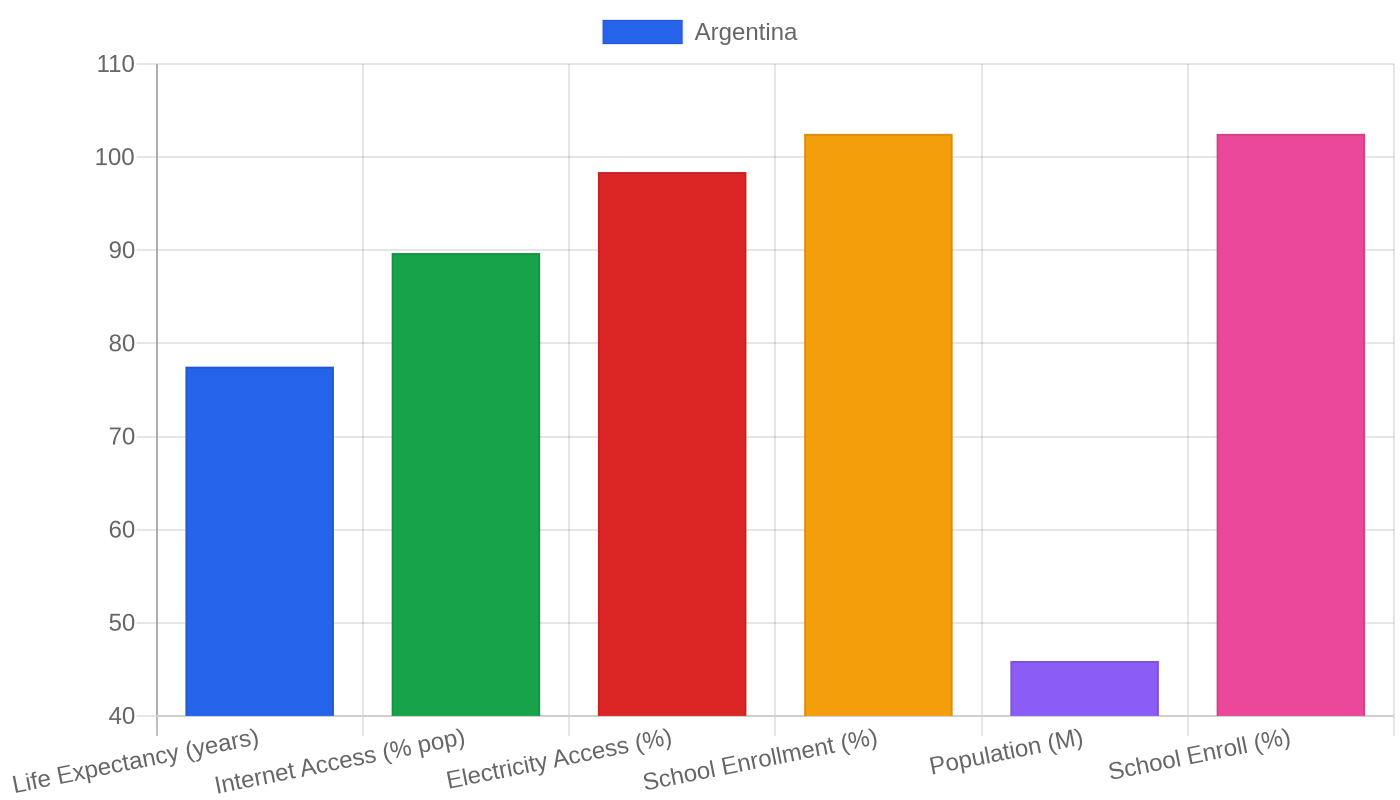
However, social indicators remain mixed; with crime and safety indices listed as N/A, precise assessments of public security are currently unavailable, leaving a blind spot in the quality of life analysis. The population of over 45 million people represents a significant consumer market, but their welfare is directly impacted by the interplay of political decisions and economic outcomes.
While the democratic framework offers stability, the legacy of past turmoil means that policy shifts can still generate significant social friction. Therefore, observers must monitor not just economic data, but also the social contract between the state and its citizens, as political legitimacy often hinges on the government’s ability to deliver tangible improvements in living standards.
Current Affairs and Policy Shifts
Right now, Argentina is at a critical juncture where reform efforts are colliding with immediate economic realities. The government is likely focused on curbing the 219.88% inflation rate while trying to sustain the 4.37% GDP growth projected for 2025. This balancing act involves difficult trade-offs, as measures to stabilize prices may initially suppress economic activity before fostering long-term confidence.
Recent developments suggest a continued emphasis on structural adjustments to address the root causes of fiscal imbalances and currency volatility. Business leaders are watching closely to see how policies impact the operational costs for major companies like Aluar and Aerolíneas Argentinas. The stability of the 7.145% unemployment rate is being tested as industries adapt to new regulatory environments.
Furthermore, the enduring nature of democracy since 1983 provides a stable platform for implementing these reforms, even if public sentiment fluctuates. As we move forward, the key indicator will be whether the initial shock of adjustment translates into sustained growth and reduced inflation without compromising social cohesion.
The Bottom Line
Argentina presents a high-risk, high-reward scenario for economic observers and investors. The combination of strong GDP growth and manageable unemployment offers a compelling narrative of recovery, but the extreme inflation rate demands caution. Those interested in industrial and service-sector investments should monitor the performance of leading companies like Aluar and Aerolíneas Argentinas as barometers of broader economic health.
Ultimately, the country’s democratic resilience and large consumer base make it a vital player in Latin America, provided that inflationary pressures can be effectively managed in the coming years.
Sources & Methodology
This article is authored by Economic Pulse Net for informational and research purposes. Economic Pulse Net sources its data from multilateral institutions, national statistics bureaus, and proprietary databases. All data is believed to be current as of the date of publication.
Published: October 03, 2026 | Category: Research — Argentina
Use these signals in your own platform
Economic Pulse publishes its live signal feed through a documented, read-only API. Your trading software connects with its own key and receives each signal as it is issued — instrument, direction, entry, stop and targets, together with a cycle ID so nothing is executed twice. The feed is independent of this website and cannot change it.
Signals are informational only and are not financial advice.