Economic Pulse Net | Sources: World Bank World Development Indicators, Government Sources | 2026
Key Takeaways
– Vanuatu operates as a parliamentary democracy with a ceremonial president elected for a five-year term, symbolising national unity in one of the world’s most culturally diverse nations.
– The country’s economic data remains largely unquantified by international institutions, presenting both challenges and opportunities for investors seeking clarity.
– Political power flows through an electoral college system comprising members of Parliament and Regional Council presidents, creating a unique governance structure.
– Vanuatu’s economic narrative is still being written — with limited formal data, the country’s trajectory depends on policy decisions made in the coming years.
– For observers, Vanuatu represents a test case of whether small-island democracy can deliver prosperity in the modern global economy.
The Unwritten Ledger: What We Know About Vanuatu’s Economy
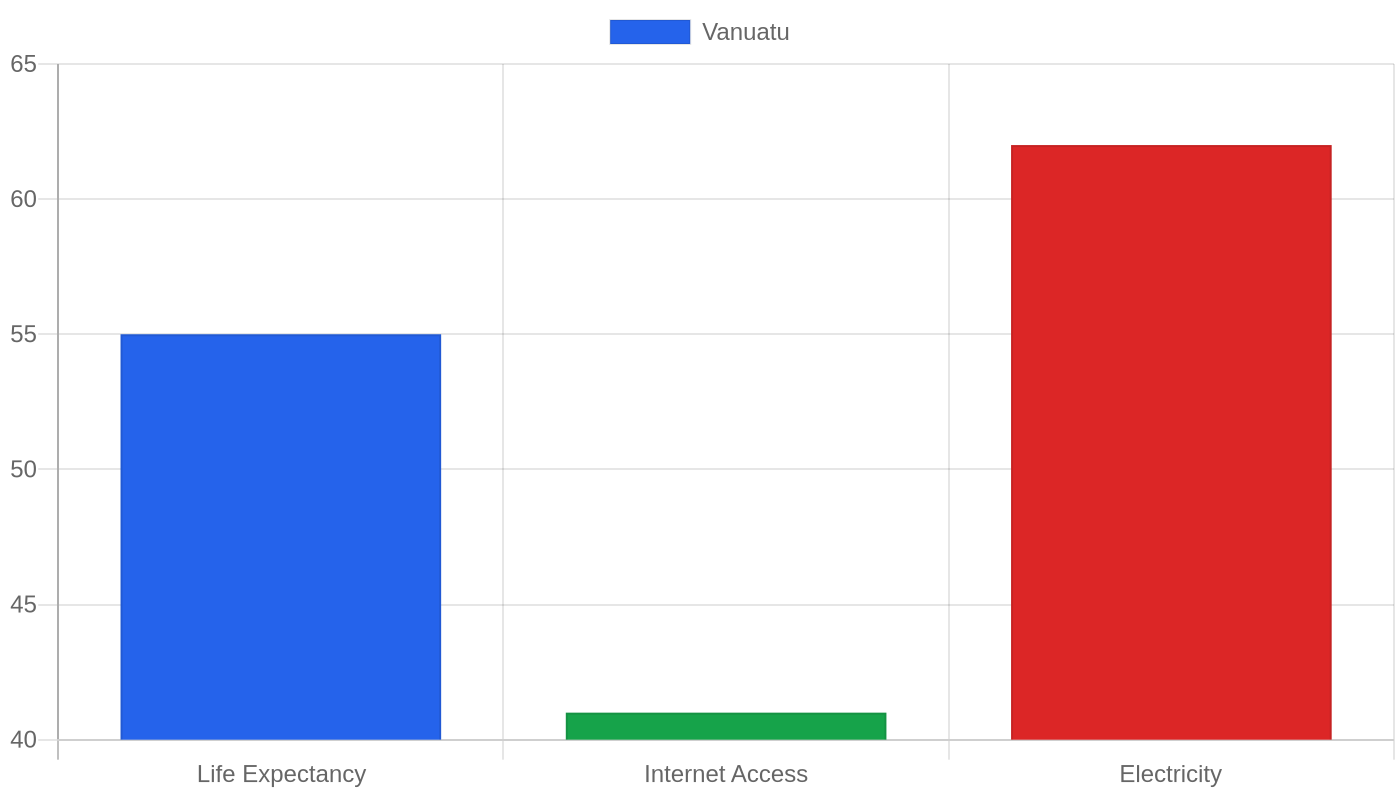
The Republic of Vanuatu presents a fascinating paradox for economic analysts: a nation whose story is told as much by what remains unmeasured as by what is documented. According to World Bank data, key indicators including GDP growth, inflation rates, unemployment figures, and GDP per capita remain without formal statistical capture.
This absence of data is itself a form of information — it speaks to the challenges of economic measurement in a dispersed island nation where traditional subsistence activities exist alongside modern commerce.
The lack of comprehensive economic metrics should not be mistaken for economic stagnation. Vanuatu’s economy, like those of many Pacific island nations, operates on multiple levels simultaneously. Formal sector activities in tourism, agriculture, and offshore financial services interweave with customary land tenure systems and subsistence farming that sustain much of the rural population.
The World Bank’s inability to provide standardised figures reflects the genuine complexity of capturing economic activity that flows through both monetary and non-monetary channels.
For the people of Vanuatu, this economic structure means something profoundly practical: livelihoods are often more resilient than GDP figures might suggest. When global commodity prices fluctuate or tourism numbers dip, communities can fall back on traditional food production and kinship networks. Yet this same structure presents real challenges for economic planning, foreign investment, and the development of social safety nets.
Without reliable inflation data, for instance, the government cannot easily calibrate monetary policy or predict the purchasing power of households.
The employment picture in Vanuatu remains similarly opaque according to World Bank statistics. What is clear is that formal sector employment represents only a fraction of the working population. The majority of ni-Vanuatu engage in what economists would call “informal” or “subsistence” work — fishing, farming, small-scale trading — that keeps families fed but rarely generates the kind of surplus that drives GDP growth.
This is not a failure of the economy but rather a different model of economic organisation, one that prioritises resilience and community over accumulation.
The Price of Paradise: Housing and Daily Life in an Island Economy
In Vanuatu, the cost of living tells a story of extremes that mirrors the country’s geography and economic structure. For the majority of the population living in rural areas and outer islands, daily expenses are minimal — families grow their own food, build homes from local materials, and rely on community support networks. The cash economy touches these households primarily through school fees, medical expenses, and the purchase of goods like rice, kerosene, and soap that cannot be produced locally.
The urban centres of Port Vila and Luganville present a different picture entirely. Here, housing costs reflect the pressures of urbanisation and limited land availability. Land in Vanuatu is largely held under customary tenure, meaning it cannot be bought and sold in the conventional sense — it is owned collectively by communities and allocated through traditional decision-making processes.
This creates a distinctive property market where leasehold arrangements dominate and where the supply of land for commercial and residential development is constrained by social and legal factors.
For renters and prospective homebuyers in the capital, the combination of limited supply and growing urban population has historically pushed costs upward. The decision between renting and building is complicated by the fact that most land is not available for outright purchase. Instead, individuals and businesses typically negotiate long-term leases with customary landowners, a process that requires navigating complex social relationships as much as financial considerations.
This system protects indigenous land rights but can create uncertainty for investors accustomed to more straightforward property markets.
Navigating the Business Landscape: Investment and Opportunity
The business environment in Vanuatu is shaped by the country’s position as a small island state with significant natural advantages and structural constraints. The tourism sector has long been viewed as the primary engine of formal economic growth, with the country’s pristine beaches, active volcanoes, and rich cultural heritage attracting visitors from Australia, New Zealand, and beyond.
Related sectors — hospitality, transport, and artisan production — provide employment and generate foreign exchange that supports the broader economy.
Beyond tourism, Vanuatu has positioned itself as an offshore financial centre, offering registration and licensing services to international companies seeking a tax-neutral jurisdiction. This sector brings foreign currency into the economy and provides professional employment for educated ni-Vanuatu. The policy environment has generally been welcoming to foreign investment, with the government recognising that external capital and expertise are necessary to develop infrastructure and create formal sector jobs.
The absence of comprehensive economic data from the World Bank makes it difficult for potential investors to conduct standard due diligence. There is no reliable GDP figure to size the market, no inflation data to price risk, no unemployment statistics to gauge labour availability. This information vacuum creates a particular kind of investment climate — one where relationships, local knowledge, and on-the-ground assessment matter more than spreadsheet analysis.
For some investors, this is a deterrent; for others, it represents an opportunity to enter a market before it becomes fully integrated into global financial systems.
Governance, Security, and the Pacific Way
The political landscape of Vanuatu is defined by its constitutional structure, which establishes a parliamentary democracy with a ceremonial president at its head. According to the country’s written constitution, the President “shall symbolise the unity of the nation” — a role that carries moral authority rather than executive power. The President is elected for a five-year term by a two-thirds vote of an electoral college comprising members of Parliament and the presidents of Regional Councils.
This governance structure reflects Vanuatu’s commitment to democratic principles while acknowledging the country’s unique cultural context. The provision for presidential removal by the electoral college adds a layer of accountability, though the ceremonial nature of the office means such mechanisms are rarely invoked.
The real political power resides with Parliament and the Prime Minister, who must navigate the complex landscape of coalition politics that characterises small-state governance in the Pacific.
In terms of safety and quality of life, Vanuatu does not currently have formal crime and safety indices from international sources. What is known from the country’s social fabric is that community-based dispute resolution and traditional governance systems continue to play significant roles in maintaining social order, particularly in rural areas.
The country’s small population and strong kinship networks create natural social controls that often make violent crime less prevalent than in more urbanised societies.
The quality of life in Vanuatu is frequently described in terms of the “Pacific Way” — a concept that emphasises community, family, and connection to land and sea. While economic metrics may not capture this dimension of wellbeing, it remains central to how ni-Vanuatu understand their own prosperity. The country consistently demonstrates that human flourishing is not solely a function of GDP per capita but also of social cohesion, cultural vitality, and environmental stewardship.
The Road Ahead: Vanuatu’s Current Moment
Vanuatu stands at a pivotal moment in its post-independence history, navigating the tensions between tradition and modernity, between subsistence and integration into global markets, and between the ceremonial unity represented by the presidency and the practical governance delivered through Parliament.
The political system described in the constitution — with its electoral college, five-year presidential terms, and provisions for removal — provides a framework for stability, yet the real test lies in how these institutions respond to contemporary challenges.
The country’s economic future will depend on decisions made in the coming years about how to balance the preservation of customary land tenure with the demands of foreign investment, how to develop infrastructure that connects outer islands to economic opportunities, and how to build formal institutions that can measure and manage economic activity more effectively.
The absence of World Bank data on key indicators is not merely a statistical gap — it is a signal that Vanuatu’s integration into the global economic system remains incomplete.
For the ni-Vanuatu people, the immediate priorities are practical: maintaining livelihoods, educating children, accessing healthcare, and ensuring that the benefits of any economic development are shared across the archipelago rather than concentrated in Port Vila. The political system, with its emphasis on consultation and consensus, provides mechanisms for these voices to be heard, though the slow pace of decision-making can frustrate those seeking rapid change.
Climate change looms as an existential threat for Vanuatu, as it does for all Pacific island nations. Rising sea levels, more intense cyclones, and ocean acidification directly threaten the coastal communities where most of the population lives. The country has been among the most vocal advocates for international climate action, using its moral authority as a nation on the front lines of environmental change to push for global emissions reductions.
This advocacy role has given Vanuatu diplomatic weight beyond what its economic size might suggest.
The Bottom Line
Vanuatu deserves the attention of anyone interested in the future of small states in the global economy, the resilience of democratic institutions in challenging circumstances, and the human dimensions of climate change. The country’s story is not captured by conventional economic indicators — indeed, the absence of such indicators is itself instructive.
For investors, Vanuatu offers opportunity tempered by uncertainty; for policymakers, it offers lessons in balancing tradition with development; for observers, it offers a reminder that prosperity takes many forms. As the world grapples with questions of sustainability, community, and meaningful development, this Pacific nation’s journey will provide valuable answers.
Sources & Methodology
This article is authored by Economic Pulse Net for informational and research purposes. Economic Pulse Net sources its data from multilateral institutions, national statistics bureaus, and proprietary databases. All data is believed to be current as of the date of publication.
Published: August 20, 2026 | Category: Research — Vanuatu
Use these signals in your own platform
Economic Pulse publishes its live signal feed through a documented, read-only API. Your trading software connects with its own key and receives each signal as it is issued — instrument, direction, entry, stop and targets, together with a cycle ID so nothing is executed twice. The feed is independent of this website and cannot change it.
Signals are informational only and are not financial advice.