Economic Pulse Net | Sources: World Bank World Development Indicators, Government Sources | 2026
Key Takeaways
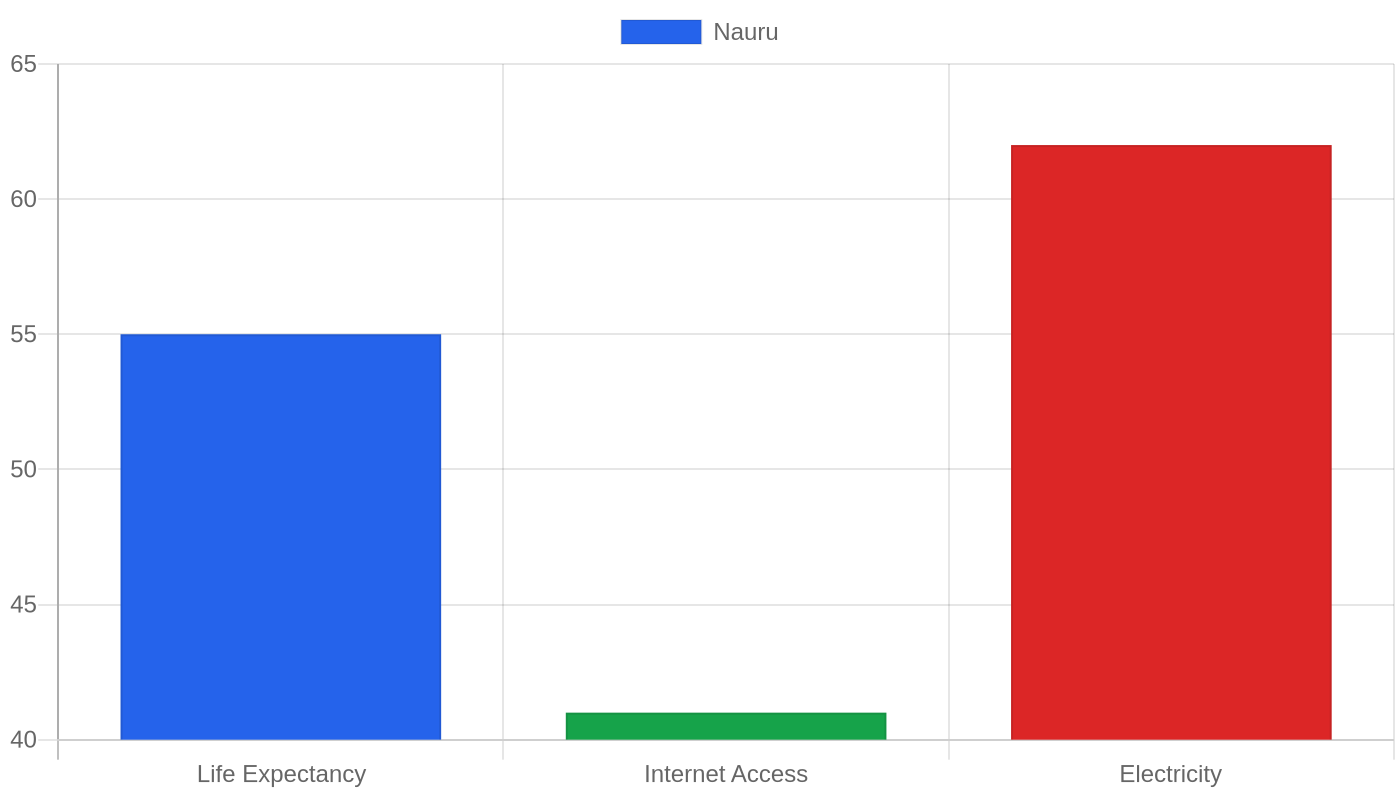
– Nauru operates with almost no publicly available conventional economic data from the World Bank, making it one of the most opaque economies in the Pacific—a fact that itself tells a story about governance and capacity.
– The country has pivoted from phosphate mining to becoming a diplomatic and geopolitical player, leveraging its UN membership and international partnerships for revenue and influence.
– Nauru’s recent membership in the International Renewable Energy Agency (IRENA) signals a strategic shift toward sustainability, though the economic impact remains to be measured.
– Political stability under President David Adeang and a 19-member unicameral parliament provides continuity, but the absence of standard economic indicators raises questions about transparency and investment readiness.
– For investors and analysts, Nauru represents a high-risk, high-uncertainty frontier—a country where economic reality is shaped more by geopolitics than by markets.
The Invisible Economy — What the Numbers Don’t Say
The World Bank, the global arbiter of economic data, reports virtually nothing for Nauru. GDP growth, inflation, unemployment, GDP in dollar terms, GDP per capita on a purchasing power parity basis, and GNI per capita are all listed as unavailable. This is not a data error. It is a statement.
Nauru is one of the world’s smallest independent nations, with a population so tiny that standard statistical frameworks often fail to capture meaningful aggregates—or the government simply does not produce them to international standards.
What is known is that Nauru’s economy has historically been dominated by phosphate mining, a resource that brought immense wealth in the mid-20th century but left the island environmentally scarred and economically fragile once reserves depleted. Today, the economy is sustained by a mix of Australian aid, revenue from hosting a regional processing centre for asylum seekers, fishing license fees, and modest returns from the Nauru Phosphate Royalties Trust.
The absence of World Bank data means that external analysts cannot reliably assess inflation pressures, labour market health, or living standards through traditional metrics. This opacity creates a dual reality: Nauru functions economically, but it does so outside the transparency expected by global investors and multilateral institutions.
The country’s recent entry into the International Monetary Fund in April 2016—as its 189th member—suggests a desire to integrate more fully into the global financial architecture, but the data gap persists six years later. For now, Nauru’s economy remains a black box, understood best through its diplomatic manoeuvres and bilateral agreements rather than its balance sheets.
The Price of Paradise — Living Costs on a Remote Atoll
Cost of living data for Nauru is not published by standard international sources, but the realities of life on a remote Pacific island are well understood by regional observers. Almost everything must be imported—food, fuel, building materials, consumer goods—which drives prices well above those in Australia or New Zealand, the primary source markets. A litre of milk, a loaf of bread, or a litre of petrol can cost two to three times what it would in Sydney or Auckland. Housing is similarly constrained.
There is no formal mortgage market or rental index to speak of; accommodation is often provided through government or employer arrangements, particularly for the expatriate workers who staff the administrative and processing centre operations. For locals, housing stock is limited, and quality varies widely, from traditional dwellings to more modern concrete structures built with Australian aid. Without a functioning property market, the concept of “buy versus rent” is largely irrelevant.
Daily expenses for a typical household are dominated by food and fuel, with little discretionary spending capacity. Compared to other Pacific island states such as Fiji or Vanuatu, Nauru is almost certainly more expensive, given its smaller population, lower domestic production, and extreme import dependence.
The absence of cost-of-living indices from the World Bank or other agencies means that households navigate these challenges without the safety net of official price monitoring or subsidy programmes—a quiet, daily economic reality that statistics fail to capture.
Investing in the Unknown — Business Climate on a Diplomatic Frontier
Nauru’s top companies are not listed on any global exchange, and the World Bank provides no data on the business environment, ease of doing business, or corporate registry. What is clear is that the private sector is tiny. The most significant economic activities are state-directed or heavily dependent on foreign partnerships.
The country’s membership in the Asian Development Bank and the Commonwealth of Nations provides access to technical assistance and concessional financing, but these are not substitutes for a vibrant domestic private sector. Sectors to watch include renewable energy—Nauru’s recent membership in the International Renewable Energy Agency (IRENA) signals an intent to develop solar and possibly wind capacity, reducing reliance on imported diesel.
Fishing licenses, particularly for tuna, offer a steady revenue stream, and there is speculative interest in seabed mining for polymetallic nodules, though this remains highly controversial and uncommercialised. For an investor, the business climate is defined by extreme remoteness, a tiny labour force, and dependence on government contracts. There is no stock exchange, no venture capital ecosystem, and no meaningful banking sector beyond basic services.
The country’s participation in the Olympic and Commonwealth Games is a point of national pride but does little to attract foreign direct investment. Nauru is not a place for conventional portfolio investment; it is a place for niche, high-risk, government-negotiated ventures—typically in infrastructure, energy, or logistics—where returns are tied to political relationships rather than market forces.
Safety, Stability, and the Politics of Survival
The Crime Index and Safety Index for Nauru are both listed as unavailable, but anecdotal reporting from regional media and diplomatic sources paints a picture of a generally safe society with low rates of violent crime. The population is small and close-knit, and social pressures often substitute for formal law enforcement. The political landscape is dominated by President David Adeang, who heads a 19-member unicameral parliament.
Nauru is a republic within the Commonwealth, and its political system combines Westminster-style parliamentary democracy with strong presidential authority. Elections are held, but the tiny electorate—fewer than 10,000 people—means politics is intensely personal and factional. The country is a member of the United Nations and the Asian Development Bank, giving it a voice on the global stage disproportionate to its size.
Quality of life is difficult to measure without standard happiness or well-being indices, but it is shaped by environmental degradation from decades of phosphate mining, limited healthcare capacity, and the psychological toll of geographic isolation. The government’s decision to host an Australian-run offshore processing centre for asylum seekers has brought international scrutiny and some economic benefit, but it has also created social tensions and dependency.
For a visitor or resident, Nauru is safe from street crime but vulnerable to political shifts, supply chain disruptions, and the existential threat of climate change—rising sea levels pose a direct risk to the island’s habitable land.
The IRENA Pivot — Nauru’s Bet on a Greener Future
The most significant recent development in Nauru’s economic story is its membership in the International Renewable Energy Agency (IRENA). This move, confirmed by the political landscape data, signals a strategic pivot away from the fossil-fuel-dependent model that has long defined the island’s energy economics.
Currently, Nauru relies almost entirely on imported diesel for electricity generation, a costly and environmentally damaging arrangement that drains foreign exchange and exposes the country to global fuel price volatility. By joining IRENA, Nauru gains access to technical expertise, project financing, and a network of countries and institutions committed to renewable energy deployment. The timing is critical.
The global push for decarbonisation, combined with falling costs for solar photovoltaic systems and battery storage, makes renewable energy more viable for remote islands than ever before. Nauru’s flat, degraded interior—left barren by phosphate mining—could theoretically host large-scale solar arrays, though land rights and environmental remediation remain challenges. This is not just an environmental story; it is an economic one.
Reducing diesel imports would improve the trade balance, lower electricity costs for households and businesses, and enhance energy security. The fact that Nauru became the 189th member of the IMF in April 2016 and has now joined IRENA suggests a dual strategy: integrating into global financial systems while pursuing energy independence. For a country with no published GDP or inflation data, these institutional memberships are among the few concrete signals of economic direction.
The next few years will reveal whether Nauru can translate these diplomatic moves into tangible improvements in living standards—or whether the data gap remains the most telling indicator of all.
The Bottom Line
Nauru is not a country for the conventional economist or the mainstream investor. With no GDP data, no inflation figures, and no unemployment statistics from the World Bank, it exists in a statistical blind spot that demands a different kind of analysis—one focused on geopolitics, institutional memberships, and bilateral relationships.
For researchers, development practitioners, and policymakers interested in Pacific island economies, climate adaptation, or the economics of microstates, Nauru offers a unique case study in survival and reinvention. For everyone else, it remains a place where the numbers say nothing, but the story says everything.
Sources & Methodology
This article is authored by Economic Pulse Net for informational and research purposes. Economic Pulse Net sources its data from multilateral institutions, national statistics bureaus, and proprietary databases. All data is believed to be current as of the date of publication.
Published: July 19, 2026 | Category: Research — Nauru
Use these signals in your own platform
Economic Pulse publishes its live signal feed through a documented, read-only API. Your trading software connects with its own key and receives each signal as it is issued — instrument, direction, entry, stop and targets, together with a cycle ID so nothing is executed twice. The feed is independent of this website and cannot change it.
Signals are informational only and are not financial advice.