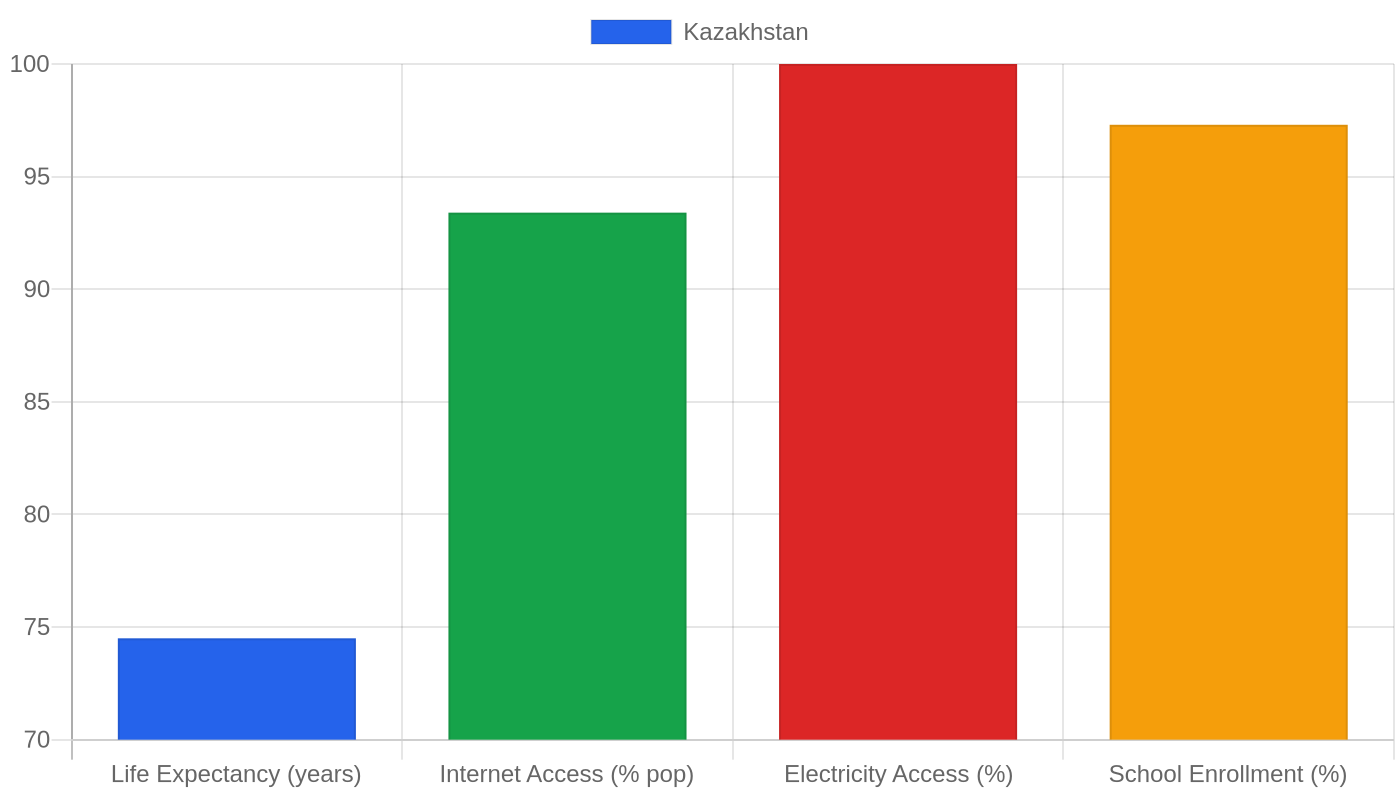
Economic Pulse Net | Sources: World Bank World Development Indicators, Government Sources | 2026
Key Takeaways
– Kazakhstan’s political transition from Nursultan Nazarbayev to Kassym-Jomart Tokayev marks the first leadership change in nearly three decades, reshaping the country’s governance landscape.
– The economy remains heavily anchored in basic materials and utilities, with major players like Kazakhmys and Bogatyr Access Komir dominating the corporate landscape.
– Consumer services and financial sectors show surprising strength, led by Air Astana and Halyk Bank, suggesting diversification beneath the resource-heavy surface.
– Crime and safety data remain unavailable, but the political structure points to a centralized, presidential system with limited democratic checks.
– The country’s official identity as a “democratic, secular, constitutional unitary republic” stands in tension with its long-serving leadership history and current power dynamics.
The Steppe Economy — Resources, Resilience, and the Search for Balance
Kazakhstan’s economic story is written in the language of commodities. The World Bank’s data reveals a nation whose industrial backbone is built on basic materials — companies like KazakhGold, Kazakhmys, and Bogatyr Access Komir dominate the corporate register. These are not minor players; they represent the extractive industries that have powered Kazakhstan since independence in 1991.
The economy’s pulse beats to the rhythm of global mineral prices, with copper, gold, and coal forming the bedrock of national wealth.
Yet the corporate landscape tells a more nuanced tale. The presence of Air Astana, Berkut Air, and Euro-Asia Air in the top companies list signals a consumer services sector that has grown beyond mere transport. These airlines connect a vast territory — Kazakhstan is the ninth-largest country by land area — and their prominence suggests a domestic market large enough to sustain serious aviation businesses.
The financial sector, represented by Halyk Bank, Eurasian Bank, and BTA Bank, indicates a banking system that has survived the turbulence of the post-Soviet era and emerged with substantial market power.
The World Bank data shows GDP growth, inflation, and unemployment figures as unavailable — a frustrating gap for analysts. But the absence of numbers does not mean the absence of story. Kazakhstan’s economy has historically ridden the commodity cycle: boom times when copper and oil prices soar, austerity when they fall. The country’s position as a major energy producer, sandwiched between Russia and China, gives it strategic importance that transcends its GDP figures.
The utilities sector, anchored by Ekibastuz GRES-2 Power Station, underscores the infrastructure demands of a modernizing state.
Housing and the Cost of Living — The Price of the Frontier
Kazakhstan’s cost of living data remains unpublished in the available information, but the country’s geography offers clues. The capital, Astana (now Nur-Sultan), was built from scratch on the northern steppe — a city of gleaming towers and brutal winters. Housing costs in such a planned capital tend to be higher than the national average, driven by government demand and the concentration of wealth.
Almaty, the former capital and commercial heart, likely commands even steeper prices, as it remains the country’s economic engine.
Rent versus buy decisions in Kazakhstan reflect the broader economic uncertainty. Without specific cost data from the World Bank or other sources, one can observe the pattern common to resource-rich developing economies: urban housing markets that boom during commodity upswings and stall during downturns. The presence of major banks like Halyk and Eurasian Bank suggests mortgage markets exist, but their accessibility to ordinary citizens remains an open question.
Daily expenses — food, transport, utilities — likely vary dramatically between the gleaming capitals and the rural steppe, where traditional livelihoods persist alongside modern extraction industries.
Business and Investment — The Corporate Giants of the Kazakh Economy
The list of Kazakhstan’s top companies reads like a map of the country’s economic priorities. Basic materials firms — Kazakhmys, KazakhGold, Bogatyr Access Komir — represent the extractive wealth that has drawn foreign investment for decades. These are not small operations; Kazakhmys alone is one of the world’s largest copper producers. The utilities sector, with Ekibastuz GRES-2 Power Station, speaks to the infrastructure needs of a country that spans two continents.
But the financial sector’s strength is perhaps the most telling indicator of economic maturity. Halyk Bank, Eurasian Bank, and BTA Bank form a banking trio that suggests Kazakhstan has moved beyond simple resource extraction toward a more sophisticated financial economy. Banks need deposits, loans, and a functioning business environment to thrive — their presence among the top companies indicates a domestic market with real depth.
Air Astana’s position as the leading consumer services company points to a growing middle class that travels, both for business and leisure.
Investors watching Kazakhstan should note the concentration of corporate power. The same names appear repeatedly across sectors, suggesting an economy where a handful of conglomerates and state-linked entities dominate. This creates both opportunity and risk: the companies are large enough to be stable, but the lack of competition may stifle innovation. The political landscape, with its strong presidential system, means that business success often depends on government relationships.
Politics, Safety, and Life on the Steppe
Kazakhstan’s political system is officially a “democratic, secular, constitutional unitary republic,” according to the source data. The reality is more complex. Nursultan Nazarbayev led the country from 1991 to 2019 — nearly three decades of continuous rule. His successor, Kassym-Jomart Tokayev, inherited a system built around presidential power, including the ability to veto legislation and serve as commander-in-chief of the armed forces.
The prime minister chairs the cabinet, with three deputies and sixteen ministers, but real authority flows from the presidency.
The political structure raises questions about democratic depth. A unitary republic with a powerful presidency and a single long-serving leader does not fit the typical model of competitive democracy. Yet Kazakhstan has avoided the violent instability seen in some post-Soviet states. The absence of crime and safety indices in the available data makes it impossible to quantify public security, but the country’s stability over three decades suggests a functioning, if imperfect, social contract.
Quality of life in Kazakhstan likely reflects the vast inequalities common to resource-rich nations. Astana and Almaty offer modern amenities, international restaurants, and cultural institutions. The rural steppe offers a harder existence, tied to traditional herding and mining communities.
Without happiness or well-being data from the World Bank or other sources, one can only note that Kazakhstan’s position — between Europe and Asia, between authoritarian and democratic models, between resource wealth and economic diversification — makes it a country of profound contradictions.
Current Affairs — The Tokayev Era Begins
The most significant development in Kazakhstan’s recent history is the political transition from Nazarbayev to Tokayev. This is not merely a change of faces; it represents the first leadership succession in the country’s independent history. Tokayev, a former prime minister and diplomat, brings a different style than his predecessor. Where Nazarbayev was the founding father, Tokayev is the manager — less charismatic, potentially more technocratic.
The political landscape shows a government structure designed for strong central control. The president’s veto power over parliament and role as commander-in-chief give Tokayev substantial authority. The cabinet, with sixteen ministers and three deputy prime ministers, suggests a bureaucracy large enough to manage a continental-sized country but also prone to the inefficiencies of centralized decision-making.
The official description of Kazakhstan as “democratic” and “secular” is worth noting — it signals the state’s official commitment to these principles, even if practice sometimes falls short.
Current economic policy under Tokayev likely focuses on the perennial challenge of diversification. Kazakhstan has talked about reducing dependence on commodities for decades; the question is whether the new leadership can achieve what the old could not. The major companies remain the same — Kazakhmys, Halyk Bank, Air Astana — suggesting that structural change, if it comes, will be gradual.
The financial sector’s strength offers a potential path: a developed banking system can finance new industries, support small businesses, and reduce reliance on extractive exports.
The Bottom Line
Kazakhstan is a country to watch for anyone interested in the future of Central Asia, commodity markets, or post-Soviet political transitions. Its vast territory, resource wealth, and strategic location between Russia and China give it geopolitical significance far beyond its economic weight. Investors should monitor the Tokayev era for signs of genuine reform versus continuity of the Nazarbayev system.
The country’s corporate giants offer exposure to copper, gold, coal, and banking — but the real story lies in whether Kazakhstan can build a more diversified, inclusive economy before the next commodity cycle turns.
Sources & Methodology
This article is authored by Economic Pulse Net for informational and research purposes. Economic Pulse Net sources its data from multilateral institutions, national statistics bureaus, and proprietary databases. All data is believed to be current as of the date of publication.
Published: July 19, 2026 | Category: Research — Kazakhstan
Use these signals in your own platform
Economic Pulse publishes its live signal feed through a documented, read-only API. Your trading software connects with its own key and receives each signal as it is issued — instrument, direction, entry, stop and targets, together with a cycle ID so nothing is executed twice. The feed is independent of this website and cannot change it.
Signals are informational only and are not financial advice.