Economic Pulse Net | Sources: World Bank World Development Indicators, Government Sources | 2026
Key Takeaways
– Nauru, a 21-square-kilometer island nation in the Pacific, is navigating one of the world’s most unique economic transitions — from phosphate mining giant to emerging renewable energy hub.
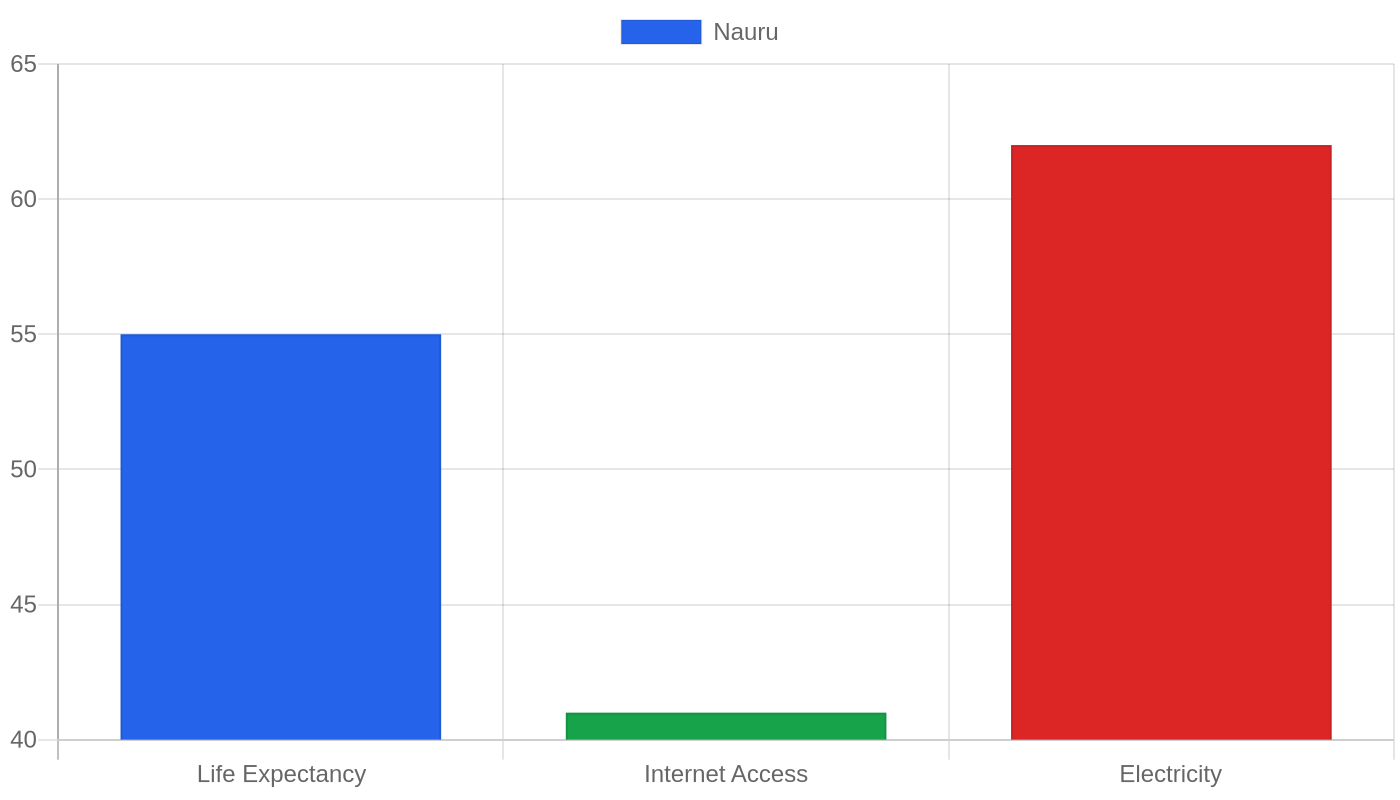
– The country has no publicly available GDP, inflation, or unemployment figures in the latest World Bank dataset, underscoring the profound data opacity that challenges investors and policymakers alike.
– Political stability is anchored by President David Adeang and a 19-member unicameral parliament, with the nation actively diversifying its international partnerships.
– Nauru’s recent accession to the International Renewable Energy Agency (IRENA) signals a strategic pivot toward sustainable development and energy independence.
– As a member of the UN, Commonwealth, and Asian Development Bank, Nauru is leveraging multilateral platforms to attract development finance and technical assistance.
The Phosphate Paradox — An Economy in Search of Its Next Chapter
Nauru’s economic story is one of boom, bust, and reinvention. For much of the 20th century, this tiny island was synonymous with phosphate — the mineral wealth that made it one of the richest nations per capita on Earth. But those deposits are now largely depleted, and the World Bank’s latest dataset offers no GDP growth figure, no inflation reading, and no employment numbers.
That absence is itself a story: Nauru has become something of a statistical ghost in the Pacific economic landscape, its true productive capacity hidden beneath layers of data gaps and reporting lags.
What we do know is that the economy has pivoted dramatically. With phosphate revenues a shadow of their former glory, Nauru has increasingly relied on a narrow set of income streams: fishing license fees from foreign fleets, regional development assistance, and, notably, revenue from hosting Australia’s offshore processing center for asylum seekers — a facility that has become a significant, if contentious, pillar of the national budget.
The World Bank’s silence on conventional indicators like GDP per capita and GNI per capita suggests a nation in a statistical limbo, where formal economic measurement has yet to catch up with the reality of a service-based, aid-dependent economy.
Inflation data is similarly absent, but the structural pressures are evident. As an island nation importing nearly all of its food, fuel, and manufactured goods, Nauru is acutely vulnerable to global supply chain shocks and commodity price swings. The absence of a reported inflation rate does not mean price pressures don’t exist — it means the mechanisms to track them are not yet robust enough to produce reliable public data.
For a country with limited domestic production, every imported barrel of oil and every shipped container of rice carries an implicit inflationary tax that disproportionately affects lower-income households.
The High Cost of Paradise — Housing and Daily Life on a Remote Atoll
Living in Nauru is not cheap, and the lack of formal cost-of-living data from the World Bank does little to mask the reality faced by residents. The island’s extreme geographic isolation means that virtually everything — from building materials to fresh produce — must be shipped thousands of miles across the Pacific, with freight costs passed directly to consumers. Housing is a particular challenge.
The legacy of phosphate mining has left much of the island’s interior uninhabitable, concentrating development along a narrow coastal belt and creating intense land scarcity.
There is no meaningful rental market to speak of in the conventional sense; land tenure is largely communal, governed by traditional systems that can make property transactions slow and complex. For expatriate workers — many of whom are employed in the offshore processing center or in government-funded infrastructure projects — accommodation is typically provided by employers or secured through informal arrangements at premium prices.
The cost of utilities, particularly electricity, is a persistent burden, as the island has historically relied on imported diesel for power generation. This is precisely why the recent pivot to renewable energy via IRENA membership is not merely an environmental gesture — it is an economic survival strategy with the potential to lower the cost of living for every household on the island.
A Thin Market, A Narrow Base — Investment and Business Climate
The Nauruan business environment is defined by scale — or the lack of it. With a population so small that the World Bank does not even report a figure in its latest dataset, the domestic market is minuscule, and opportunities for traditional consumer-facing businesses are severely limited.
The top companies operating in Nauru are not household names in global finance; they are predominantly state-owned enterprises, utilities, and a handful of trading and logistics firms that serve the island’s import-dependent economy.
For foreign investors, the calculus is straightforward: Nauru offers proximity to rich Pacific tuna fisheries, a strategic geopolitical location, and — increasingly — a government open to multilateral partnerships. The Asian Development Bank has been a consistent presence, funding infrastructure and technical assistance projects.
But the absence of a formal stock exchange, limited banking infrastructure, and the sheer logistical complexity of operating on a remote atoll will deter all but the most patient or strategically motivated capital. The brightest spot in the investment landscape is energy: with IRENA membership now secured, Nauru is positioning itself to attract concessional financing for solar and battery storage projects that could dramatically reduce the island’s dependence on imported diesel.
Stability in a Small State — Politics, Safety, and Daily Life
In a region where political instability is not uncommon, Nauru presents a picture of relative calm. President David Adeang leads a 19-member unicameral parliament, a compact legislative body that reflects the nation’s small population. The political system is functional, if occasionally fractious, with elections held regularly and power transferring peacefully.
Nauru’s active participation in the United Nations, the Commonwealth of Nations, and the Asian Development Bank demonstrates a consistent commitment to multilateral engagement that punches well above its weight for a nation of this size.
Crime and safety indices are not reported in the available data, which is unsurprising for a small island community where social bonds remain strong and serious crime is rare. However, the quality of life is shaped by more than just safety statistics. The physical legacy of phosphate mining — a landscape of jagged coral pinnacles and abandoned machinery — limits recreational space and contributes to a sense of environmental degradation that weighs on community morale.
Yet Nauruans are resilient, and the government’s recent push into renewable energy and international partnerships suggests a forward-looking mindset. The nation’s participation in the Commonwealth and Olympic Games also provides important cultural touchstones, connecting this remote population to the broader global community in ways that transcend economics.
The IRENA Pivot — What’s Happening in Nauru Right Now
The most consequential development in Nauru’s recent history is its accession to the International Renewable Energy Agency (IRENA), a move that signals a decisive shift in national strategy. For decades, Nauru’s economy has been held hostage by imported diesel — a dependency that exposed the island to volatile global fuel prices and drained foreign exchange reserves.
By joining IRENA, the government has formally committed to a path toward energy transition, opening the door to technical expertise, concessional financing, and partnerships with renewable energy developers.
This is not merely a symbolic gesture. The Adeang administration is actively seeking to transform Nauru’s energy architecture, with solar photovoltaic systems and battery storage identified as priority investments. The economic logic is compelling: every kilowatt of solar energy generated on-island is a kilowatt that does not need to be paid for in foreign currency. For a nation with a narrow export base and heavy import dependence, the balance-of-payments benefits of renewable energy are profound.
The IRENA membership also aligns Nauru with the broader Pacific Islands Forum agenda on climate resilience, positioning the country to access climate finance mechanisms that were previously out of reach.
Meanwhile, Nauru continues to navigate its complex relationship with regional powers, maintaining its membership in the Commonwealth and its partnership with the Asian Development Bank while exploring new avenues for economic diversification. The fishing industry remains a vital source of revenue, and there is growing interest in expanding the nation’s role as a regional hub for transshipment and logistics.
The data gaps remain — the World Bank’s silence on GDP, inflation, and employment persists — but the direction of travel is clear: Nauru is no longer content to be defined by its phosphate past. It is building toward a future powered by the sun, financed by multilateral partnerships, and anchored in the Pacific’s strategic landscape.
The Bottom Line
Nauru is a nation that defies conventional economic analysis — the numbers simply do not exist to tell the traditional story. But for investors, development financiers, and policymakers focused on Pacific resilience, this is precisely the moment to pay attention. The IRENA accession, the stable political environment under President Adeang, and the urgent need for energy transition create a rare opening for targeted, impactful investment.
This is not a market for mass-market consumer goods or large-scale manufacturing; it is a frontier for infrastructure, renewable energy, and strategic partnerships. For those willing to look beyond the data gaps, Nauru offers a compelling narrative of a small nation determined to write its next chapter on its own terms.
Sources & Methodology
This article is authored by Economic Pulse Net for informational and research purposes. Economic Pulse Net sources its data from multilateral institutions, national statistics bureaus, and proprietary databases. All data is believed to be current as of the date of publication.
Published: August 21, 2026 | Category: Research — Nauru
Use these signals in your own platform
Economic Pulse publishes its live signal feed through a documented, read-only API. Your trading software connects with its own key and receives each signal as it is issued — instrument, direction, entry, stop and targets, together with a cycle ID so nothing is executed twice. The feed is independent of this website and cannot change it.
Signals are informational only and are not financial advice.