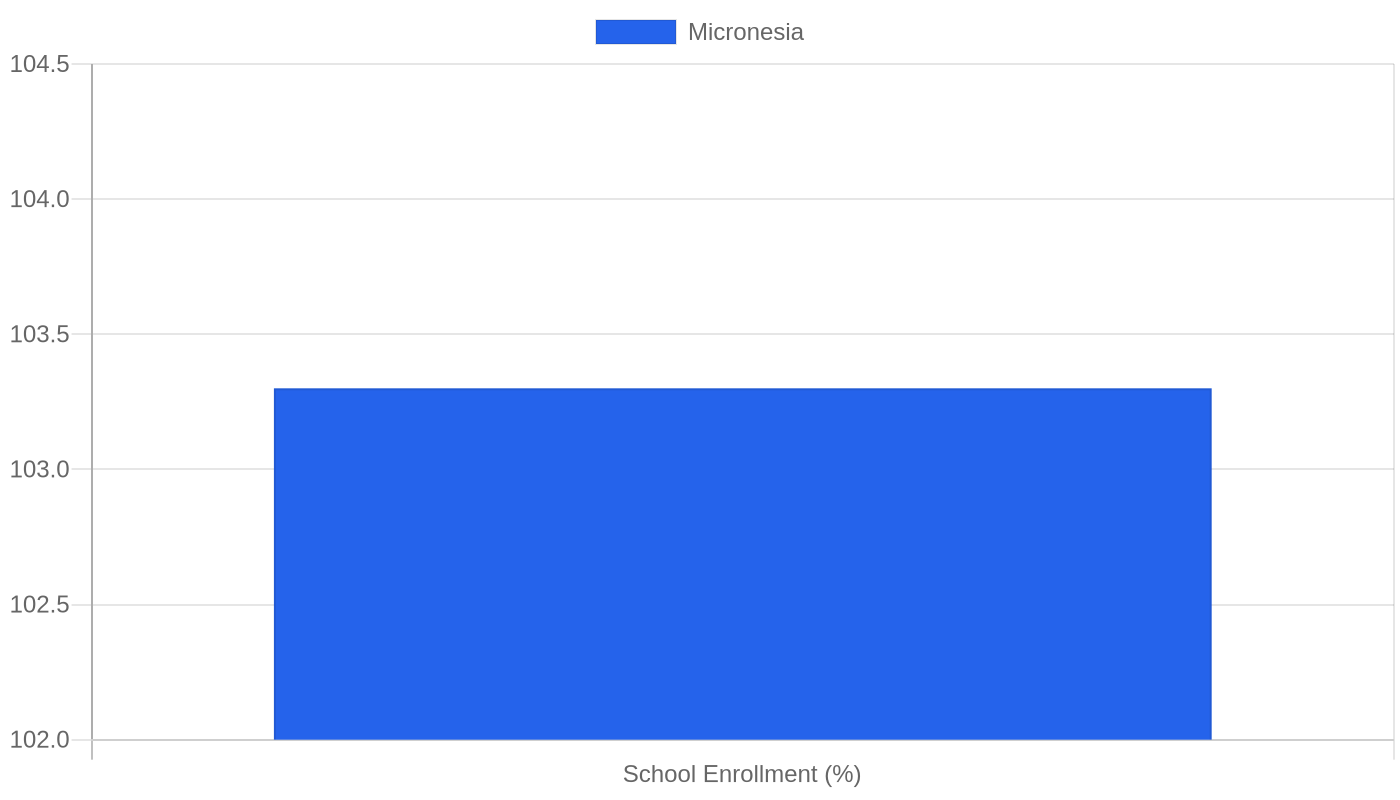
Economic Pulse Net | Sources: World Bank World Development Indicators, Government Sources | 2026
Key Takeaways
– The Federated States of Micronesia (FSM) operates as a unique economic entity in the Pacific, with its economic indicators remaining largely unquantified in global databases, presenting both challenges and opportunities for investors.
– As a nation spanning 607 islands across the western Pacific, Micronesia’s economic story is defined by its geography, its people, and its strategic position rather than traditional metrics.
– The country’s economic framework is built on a foundation of subsistence agriculture, fishing, and a growing services sector, though comprehensive data remains limited.
– For international observers and potential investors, understanding Micronesia’s economic landscape requires looking beyond conventional indicators to appreciate its distinctive development model.
– The nation’s future economic trajectory hinges on sustainable resource management, infrastructure development, and its ability to leverage its unique Pacific Island identity.
The Economic Canvas — Beyond Traditional Metrics
The Federated States of Micronesia presents an intriguing paradox to economic analysts: a nation whose GDP figures, inflation rates, and employment statistics remain unquantified in the World Bank’s latest database, yet one that functions with remarkable resilience in the vast expanse of the western Pacific.
This absence of data should not be mistaken for economic insignificance—rather, it reflects the challenges of measuring economic activity in a nation where traditional subsistence practices coexist with modern market mechanisms. The World Bank’s inability to provide standard indicators like GDP growth or GNI per capita speaks to the unique nature of Micronesia’s economic structure, where formal sector employment represents only a fraction of daily economic activity.
The nation’s economic foundation rests upon three pillars: the ocean’s bounty, the land’s generosity, and the strength of community networks. Fishing remains the country’s most significant natural resource, with tuna stocks in FSM’s exclusive economic zone representing one of the Pacific’s most valuable assets. The country has negotiated fisheries access agreements that provide substantial revenue, though exact figures remain undisclosed in available data.
Agriculture, primarily at the subsistence level, provides food security for the majority of the population, with crops like breadfruit, taro, and bananas forming the backbone of local food systems. The services sector, including government administration and tourism-related activities, constitutes the formal economy’s core, though precise employment figures remain unquantified.
Understanding Micronesia’s economic reality requires acknowledging that the absence of data itself tells a story—one of a nation that has deliberately or organically maintained economic structures outside the global mainstream. The country’s development model emphasizes sustainability and community welfare over aggregate growth metrics, a perspective increasingly relevant as the world grapples with questions of sustainable development.
While economists might view the lack of GDP data as a governance gap, Micronesia’s approach to economic measurement reflects its broader philosophy of development—one that prioritizes social cohesion and environmental stewardship alongside material progress.
The Cost of Living Puzzle — Navigating Island Economics
Life in Micronesia presents a cost-of-living landscape that defies easy comparison with regional neighbors or global averages, precisely because the data infrastructure to measure such costs remains underdeveloped. What is clear from the country’s economic structure is that the cost of living varies dramatically between urban centers like Palikir and the outer islands, where subsistence practices significantly reduce monetary expenses.
In the capital and state capitals, imported goods—from food products to construction materials—carry substantial price premiums due to transportation costs across vast ocean distances, creating a two-tier economic reality where cash-dependent urban dwellers face significantly higher expenses than their subsistence-based rural counterparts.
The housing market in Micronesia operates primarily through traditional land tenure systems, where customary ownership and community-based allocation mechanisms prevail over formal real estate markets. This arrangement means that for most Micronesians, housing costs are not measured in rent or mortgage payments but in social obligations and community relationships.
For the small expatriate community and formal sector workers, however, housing in urban areas commands premium prices, reflecting the scarcity of modern accommodation and the costs of importing construction materials. The rental market remains thin and informal, with prices negotiated on a case-by-case basis rather than through established market mechanisms.
Daily expenses in Micronesia’s urban centers reflect the country’s import dependence, with food prices significantly higher than regional averages due to shipping costs and the limited economies of scale. The country’s reliance on imported rice, flour, and processed foods creates vulnerability to global price fluctuations, though the subsistence sector provides a buffer against food price inflation.
For visitors and expatriates, the cost of living in Micronesia can be surprisingly high, comparable to other remote Pacific island nations where import logistics dominate pricing structures. The absence of comprehensive cost-of-living data from international databases means that practical guidance for newcomers often comes from community networks rather than official statistics.
Investment and Enterprise — The Business Climate Frontier
The business environment in Micronesia reflects the nation’s unique position as a Pacific island state with significant ocean resources but limited industrial infrastructure. The country’s exclusive economic zone—one of the largest in the Pacific—positions fisheries as the primary investment opportunity, with international fishing fleets paying substantial fees for access to these productive waters.
The tuna processing and export sector presents opportunities for value-added investment, though the World Bank’s data does not currently identify specific major companies operating within the country. The tourism sector, while underdeveloped compared to other Pacific nations, offers potential for eco-tourism and cultural tourism ventures, building on the country’s pristine environments and rich cultural heritage.
The regulatory environment for business in Micronesia is characterized by its developing nature, with the government working to establish frameworks that balance foreign investment attraction with protection of local interests. The country’s federal structure, comprising four states with significant autonomy, creates a complex regulatory landscape where investors must navigate both national and state-level requirements.
Infrastructure constraints—particularly in transportation, energy, and telecommunications—represent significant barriers to business development, though they also present investment opportunities for those willing to engage with the country’s development challenges. The government has expressed interest in diversifying the economy beyond fisheries, though specific policy initiatives remain unclear from available data.
For entrepreneurs and investors considering Micronesia, the key considerations revolve around scale and patience. The domestic market is small, limiting opportunities for businesses dependent on local demand, while export-oriented ventures must contend with significant transportation costs and logistical complexities.
The country’s development partners have identified sustainable resource management and climate resilience as priority sectors, suggesting where international investment and assistance may be most welcome. The absence of major corporate names in available data reflects not just data limitations but also the reality of an economy where small and medium enterprises, often family-owned and community-based, form the backbone of formal economic activity.
Safety, Governance, and the Quality of Life Equation
Micronesia’s social fabric presents a picture of stability and community cohesion, though comprehensive crime statistics and safety indices remain unquantified in international databases. The country’s traditional governance systems, operating alongside modern political structures, contribute to social order through established mechanisms of conflict resolution and community accountability.
The political landscape is defined by the nation’s federal structure, with the national government based in Palikir coordinating policies across the four states of Yap, Chuuk, Pohnpei, and Kosrae. The country maintains democratic institutions and peaceful transitions of power, with political discourse focused on development priorities, resource management, and the challenges of delivering services across vast ocean distances.
Quality of life in Micronesia is shaped by factors that resist easy quantification—the strength of community bonds, the richness of cultural traditions, and the profound connection to ocean and land that defines Micronesian identity. The country faces significant development challenges, including infrastructure gaps, healthcare delivery constraints, and the impacts of climate change on low-lying atolls and coastal communities.
However, these challenges coexist with remarkable social resilience, where extended family networks provide support systems that in other societies might be delivered through formal institutions. The concept of well-being in Micronesia extends beyond material measures to encompass spiritual, cultural, and communal dimensions that international indices struggle to capture.
The relationship between governance and daily life in Micronesia operates through multiple layers—from traditional leaders who maintain customary authority to elected officials at state and national levels. This pluralistic governance structure, while sometimes creating coordination challenges, ensures that decision-making remains connected to community values and local knowledge.
The country’s commitment to democratic principles and its engagement with regional and international organizations demonstrate its active participation in the global community while maintaining its distinct identity. For residents and observers alike, Micronesia offers a compelling example of how Pacific Island nations navigate the tensions between tradition and modernity, between global integration and local autonomy.
Current Affairs — The Nation at a Crossroads
The Federated States of Micronesia currently finds itself at a pivotal moment, navigating the complex terrain of economic development, climate adaptation, and regional geopolitics. The nation’s ongoing negotiations over its strategic partnership arrangements have brought renewed international attention to its development needs and its vision for sustainable growth.
Within the country, discussions intensify around infrastructure modernization, with particular focus on transportation connectivity between the capital and outer islands—a challenge that has historically constrained economic integration and service delivery. The government’s commitment to expanding internet access and digital services represents a recognition that connectivity, both physical and virtual, is essential for future economic diversification.
Climate change looms large in Micronesian discourse, with rising sea levels and changing weather patterns threatening coastal infrastructure, freshwater resources, and agricultural livelihoods. The country has emerged as a vocal advocate for climate action in regional forums, translating its vulnerability into diplomatic engagement and securing commitments for adaptation support from development partners.
Concurrently, the fisheries sector continues to evolve, with ongoing discussions about maximizing returns from the country’s vast ocean resources while ensuring sustainable harvesting practices that protect tuna stocks for future generations. The balance between immediate revenue needs and long-term resource sustainability remains a central policy tension.
The country’s youth population represents both a demographic opportunity and a challenge, with limited formal employment opportunities prompting many young Micronesians to seek work abroad while others pursue entrepreneurial ventures within the islands. Remittances from Micronesians working overseas contribute meaningfully to local economies, though comprehensive data on these flows remains unavailable.
The government’s education and vocational training initiatives aim to equip young people with skills relevant to emerging sectors, though the effectiveness of these programs in stemming out-migration remains uncertain. As the nation looks toward its future, the interplay between tradition and innovation, between local needs and global pressures, will determine whether Micronesia can chart a development path that preserves its unique character while improving living standards for all its citizens.
The Bottom Line
The Federated States of Micronesia represents a compelling case study in Pacific island economics—a nation whose significance far exceeds what conventional metrics might suggest. For development economists, policy analysts, and investors with patience and cultural sensitivity, the country offers insights into alternative development models that prioritize sustainability and community well-being.
The absence of comprehensive economic data should be viewed not as a deterrent but as an invitation to engage with a nation that operates on its own terms. As climate change reshapes the Pacific and global attention increasingly turns to ocean resources, Micronesia’s strategic and economic importance will likely grow. Those who take the time to understand this unique nation—beyond its statistics or lack thereof—will find a country of remarkable resilience, cultural richness, and untapped potential.
Sources & Methodology
This article is authored by Economic Pulse Net for informational and research purposes. Economic Pulse Net sources its data from multilateral institutions, national statistics bureaus, and proprietary databases. All data is believed to be current as of the date of publication.
Published: August 07, 2026 | Category: Research — Micronesia
Use these signals in your own platform
Economic Pulse publishes its live signal feed through a documented, read-only API. Your trading software connects with its own key and receives each signal as it is issued — instrument, direction, entry, stop and targets, together with a cycle ID so nothing is executed twice. The feed is independent of this website and cannot change it.
Signals are informational only and are not financial advice.