Economic Pulse Net | Sources: World Bank World Development Indicators, Government Sources | 2026
Key Takeaways
– Kiribati operates as a parliamentary democratic republic with constitutional guarantees of free and open elections, making it one of the more politically stable nations in the Pacific Islands region.
– Despite its democratic foundations, the country faces profound economic data gaps — the World Bank reports no available figures for GDP growth, inflation, unemployment, or GDP per capita, reflecting the challenges of collecting statistics in a remote, dispersed island nation.
– The absence of major industries, top companies, or cost-of-living data suggests an economy heavily dependent on subsistence agriculture, fishing, and foreign aid, with limited formal private sector development.
– Kiribati’s vulnerability to climate change and rising sea levels remains the dominant geopolitical and economic concern, though no recent crisis data is provided in this dataset.
– Investors and policymakers should approach Kiribati with caution: the lack of economic indicators makes risk assessment difficult, but the political stability offers a foundation for potential development partnerships.
The Economic Void — What We Don’t Know Tells a Story
The World Bank’s data on Kiribati presents a striking challenge for any economic analyst: the numbers simply are not there. GDP growth, inflation, unemployment, GDP in US dollars, GDP per capita on a purchasing power parity basis, and GNI per capita are all listed as “N/A.” This absence is not a failure of data collection alone — it is a reflection of Kiribati’s economic reality.
Spread across 33 coral atolls in the central Pacific, the country’s population is small, dispersed, and largely engaged in non-market activities. Subsistence fishing and small-scale agriculture dominate daily life, with formal employment concentrated in the public sector and a handful of service industries.
Without inflation data, it is impossible to say whether the cost of living is rising or stable. Without unemployment figures, the health of the labour market remains opaque. The World Bank’s silence on these metrics underscores a deeper truth: Kiribati’s economy is not easily captured by standard statistical frameworks. The country relies heavily on revenue from fishing licenses, remittances from overseas workers, and development assistance from partners like Australia, New Zealand, and Japan.
The absence of major industries — the data lists none — means there is no manufacturing base, no significant export sector beyond fish, and no diversified economic engine.
This is not necessarily a crisis. Many Pacific island nations operate on similar terms. But for an investor or a policymaker, the lack of data is a warning sign. Without knowing the size of the economy, the rate of price changes, or the level of joblessness, any decision to engage with Kiribati carries significant uncertainty. The country’s economic story is one of resilience in the face of isolation, but also of vulnerability to external shocks — from climate change to shifts in global aid flows.
Housing and Daily Life — Living on the Edge of the Pacific
The cost of living in Kiribati is not documented in the available data, but the realities of life on remote atolls are well understood by regional observers. Most goods must be imported, driving up prices for food, fuel, and construction materials. Housing is typically basic: traditional structures made from local materials coexist with more modern concrete and corrugated iron homes, particularly in the capital, South Tarawa.
Land ownership is communal under customary systems, which means there is no formal housing market in the Western sense. Renting is rare, and buying property is often not an option for outsiders.
Daily expenses are shaped by geography. Fresh produce is limited to what can be grown in sandy, salt-affected soil — coconuts, breadfruit, and pandanus are staples. Fish is abundant and relatively cheap, but imported rice, flour, and canned goods carry a premium. Compared to regional averages in the Pacific, Kiribati likely faces a higher cost of living due to its remoteness and lack of economies of scale.
For a family in South Tarawa, where roughly half the population lives, the struggle is not about mortgage rates or rental yields — it is about access to clean water, reliable electricity, and affordable food. These are the metrics that matter more than any official index.
Investment and Business — A Landscape of Possibility and Peril
The list of top companies in Kiribati is, according to the data provided, empty. There are no multinational corporations headquartered here, no stock exchange, no venture capital ecosystem. The private sector is dominated by small-scale retail, fishing cooperatives, and a handful of tourism operators catering to divers and birdwatchers drawn to the Phoenix Islands Protected Area, one of the world’s largest marine reserves.
The business environment is constrained by high transportation costs, a small domestic market, and limited infrastructure.
Yet there are sectors worth watching. Fisheries remain the cornerstone of the formal economy, with Kiribati’s exclusive economic zone covering 3.5 million square kilometres of tuna-rich waters. Licensing fees from foreign fishing fleets generate a significant portion of government revenue. Renewable energy is another emerging opportunity — the country has abundant solar resources and a pressing need to reduce dependence on imported diesel.
Development partners have funded solar microgrids on several outer islands, creating a niche for companies specialising in off-grid energy solutions.
The political landscape, as described in the data, is a parliamentary democratic republic with constitutional guarantees of free and open elections since independence on 12 July 1979. This stability is an asset. Unlike some Pacific neighbours, Kiribati has not experienced coups or prolonged political crises. For an investor willing to navigate the logistical challenges, the rule of law and democratic governance provide a foundation.
But the lack of data on crime and safety — both indices are listed as N/A — means that security risks are not quantified. The most prudent approach is to view Kiribati as a high-risk, high-patience opportunity, best suited to development finance institutions and impact investors rather than traditional private equity.
Safety, Politics, and Quality of Life — Democracy in a Fragile State
Kiribati’s political system is a parliamentary democracy, as established by its Constitution of 12 July 1979. The document provides for free and open elections, and the country has maintained this framework without major interruption. The president, known as the Beretitenti, serves as both head of state and head of government, elected by popular vote. The unicameral House of Assembly, or Maneaba ni Maungatabu, holds legislative power.
This political stability is remarkable for a nation facing existential threats from climate change — rising sea levels, saltwater intrusion, and more frequent storms are daily realities.
Crime and safety indices are not available in the data, but anecdotal evidence from regional reports suggests that violent crime is rare in Kiribati. Petty theft and alcohol-related incidents occur, particularly in urban areas of South Tarawa, but the country is generally considered safe by Pacific standards. The quality of life is shaped by community ties, cultural traditions, and a strong sense of collective identity.
The concept of “mana” — a spiritual force that binds people to their land and sea — remains central. Happiness data is not provided, but Kiribati has historically ranked modestly on global wellbeing indices, with strong social connections offsetting material poverty.
The challenge is that political stability alone cannot protect against rising oceans. The government has pursued a “migration with dignity” policy, encouraging citizens to gain skills and education that would allow them to relocate abroad if necessary. This forward-looking approach reflects a rare honesty about the country’s long-term prospects. For now, Kiribati remains a functioning democracy, but one where the very survival of the nation is an open question.
What’s Happening Now — The Silent Crisis of Data and Climate
The most significant development in Kiribati right now is not captured in any of the provided economic indicators. It is the ongoing, slow-moving crisis of climate change. The data set offers no recent news, no live indicators, no policy shifts or election updates. What we know is that Kiribati’s government continues to advocate internationally for stronger climate action, while simultaneously preparing for the worst.
The country has purchased land in Fiji as a potential refuge for its population — a stark acknowledgment that adaptation may eventually require relocation.
Domestically, the lack of updated economic data from the World Bank suggests that statistical capacity remains a challenge. Without reliable GDP, inflation, or employment figures, the government cannot effectively plan budgets, target social spending, or attract investment. International organisations and development partners are likely working to improve data collection, but progress is slow. The absence of a national statistics bureau or recent census data in the provided information reinforces this gap.
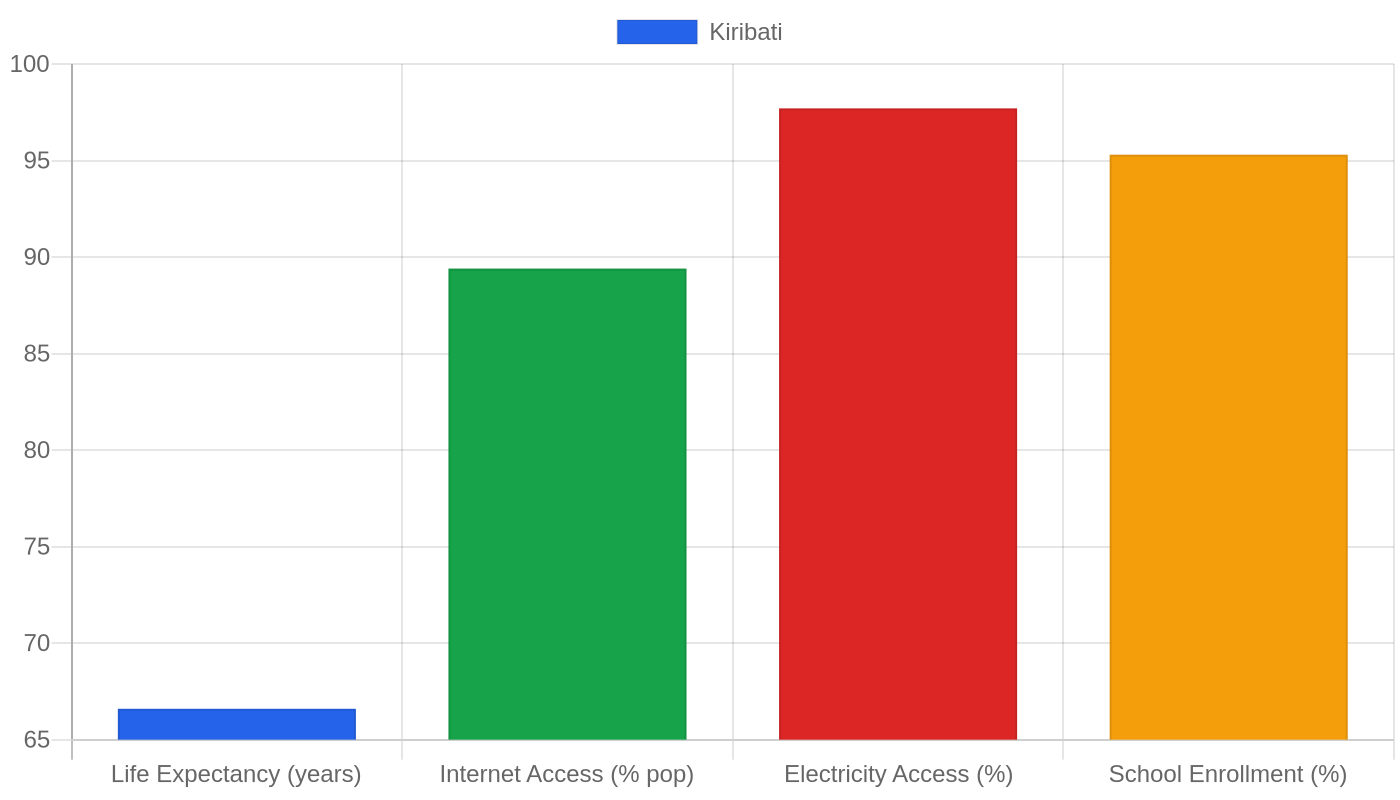
For the people of Kiribati, daily life continues. Fishing, farming, and family obligations structure time. The internet has arrived on some islands, connecting younger generations to the global economy in ways their parents could not imagine. But the fundamental reality remains: Kiribati is a country where the past is secure — the Constitution, the democracy, the traditions — but the future is uncertain.
Without better data, without economic diversification, and without a global solution to climate change, the nation’s trajectory is hard to predict.
The Bottom Line
Kiribati is a country for the patient observer, not the impatient investor. Its democratic institutions and political stability offer a rare foundation in a region often marked by volatility, but the complete absence of basic economic data makes it nearly impossible to assess risk or opportunity.
Development agencies, climate researchers, and Pacific regional policymakers should watch Kiribati closely — it is a bellwether for how small island states can navigate the twin challenges of economic isolation and environmental collapse. For everyone else, it is a reminder that not all economies fit neatly into spreadsheets, and that some of the world’s most important stories are unfolding where the data runs out.
Sources & Methodology
This article is authored by Economic Pulse Net for informational and research purposes. Economic Pulse Net sources its data from multilateral institutions, national statistics bureaus, and proprietary databases. All data is believed to be current as of the date of publication.
Published: July 23, 2026 | Category: Research — Kiribati
Use these signals in your own platform
Economic Pulse publishes its live signal feed through a documented, read-only API. Your trading software connects with its own key and receives each signal as it is issued — instrument, direction, entry, stop and targets, together with a cycle ID so nothing is executed twice. The feed is independent of this website and cannot change it.
Signals are informational only and are not financial advice.