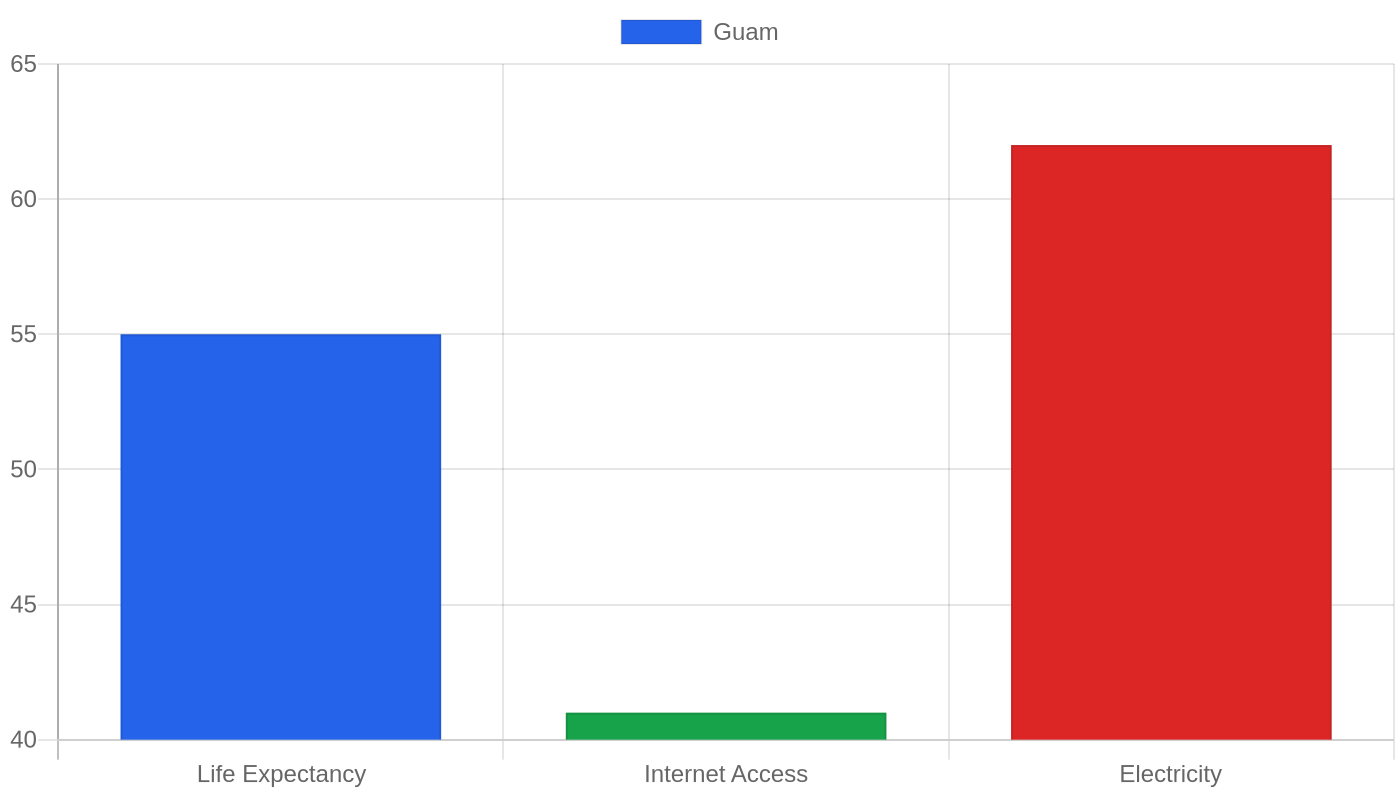
Economic Pulse Net | Sources: World Bank World Development Indicators, Government Sources | 2026
Key Takeaways
– Guam’s political system operates with a popularly elected governor and a 15-member unicameral legislature, providing stable governance despite its non-voting status in broader regional bodies
– The island’s economy remains heavily dependent on military spending and tourism, though specific GDP and employment figures are not currently available from the World Bank
– Cost of living pressures are a persistent concern for residents, though precise data on housing and daily expenses has not been published by international financial institutions
– Crime and safety indices have not been calculated by major global data aggregators, making quality-of-life assessments reliant on anecdotal and local reporting
– Guam’s strategic location in the Western Pacific positions it as a critical geopolitical asset, with potential for both economic opportunity and vulnerability
The Unseen Engine — Guam’s Economy Beyond the Headlines
The economic picture of Guam presents a curious paradox for analysts. The World Bank, which typically provides comprehensive data on GDP growth, inflation, unemployment, and per capita income for most nations and territories, has not published any of these key indicators for Guam. This absence is itself a story.
It speaks to the challenges of measuring economic activity in a small island territory where informal markets, military spending, and tourism dollars create a complex financial ecosystem that resists easy categorization.
What we do know from the political structure is that Guam’s economy is fundamentally shaped by its relationship with the U.S. military presence. The island hosts significant naval and air force installations, which inject substantial capital through construction contracts, base operations, and the spending power of military personnel and their families.
This creates a dual economy: one that serves the strategic needs of the Pacific command, and another that caters to tourists from Japan, South Korea, and increasingly other Asian markets.
Tourism has historically been the second pillar of Guam’s economic activity. The island’s white sand beaches, coral reefs, and duty-free shopping have attracted millions of visitors annually in pre-pandemic years. However, the absence of World Bank data means we cannot quantify the current recovery trajectory or the depth of any recessionary pressures.
The main industries—tourism, military support services, and construction—remain the backbone, but without official growth figures, analysts must rely on anecdotal evidence and sector-specific reports.
The lack of inflation data is particularly concerning. In an island territory that imports the vast majority of its consumer goods, global price shocks in food, fuel, and building materials would hit disproportionately hard. The unemployment picture is equally opaque. Without World Bank statistics, we cannot determine whether the labor market is tightening or softening, though the seasonal nature of tourism employment suggests significant volatility throughout the year.
The Price of Paradise — Living Costs in a Remote Island Economy
Housing in Guam presents a perennial challenge for residents, though specific cost data has not been compiled by the World Bank or major international indices. The island’s limited land area—roughly 210 square miles—creates natural supply constraints that drive up property values, particularly in desirable coastal areas and near military installations. Rental markets in villages like Tumon, Tamuning, and Hagåtña command premiums due to proximity to tourist districts and commercial centers.
The decision between renting and buying on Guam is heavily influenced by the transient nature of much of the population. Military families, who typically rotate every two to three years, tend to rent, while local Chamorro families and long-term expatriates are more likely to pursue homeownership. However, without official housing cost indices, we cannot compare Guam’s affordability to regional averages in the Pacific or Southeast Asia.
Daily expenses for food, utilities, and transportation are widely understood to be higher than in mainland markets due to shipping costs and the island’s reliance on imported goods. Fresh produce, dairy, and meat products arrive by container ship or air freight, with those logistics costs passed directly to consumers. Electricity rates are also elevated, driven by the island’s dependence on imported fuel for power generation.
While the World Bank has not published a cost-of-living index for Guam, the qualitative picture is clear: living in paradise comes with a premium that strains household budgets.
Where Capital Meets Strategy — Investment and Enterprise on Guam
The corporate landscape of Guam is dominated by firms that serve the military, tourism, and retail sectors, though a comprehensive list of top companies has not been provided in the available data. What is clear is that the business environment is shaped by the island’s unique legal and political status. Guam operates under its own tax code and regulatory framework, distinct from the mainland, which creates both opportunities and complexities for investors.
Sectors to watch include renewable energy, where the island’s abundant sunshine and wind resources offer potential for reducing dependence on imported fuel. The military’s ongoing infrastructure upgrades also present contracting opportunities in construction, logistics, and environmental remediation. Tourism remains the most accessible sector for small and medium enterprises, with opportunities in hospitality, food service, and tour operations.
The business climate benefits from the rule of law and a familiar legal system for American investors, but faces challenges from high operating costs, a small labor pool, and geographical isolation. The absence of GDP data from the World Bank makes it difficult to assess the overall health of the business environment, but the island’s strategic importance suggests that investment will continue to flow, particularly from defense-related spending.
Security and Society — Navigating Life in a Strategic Outpost
The absence of crime and safety indices from major data aggregators means that assessing public safety on Guam requires a more nuanced approach. The island’s small population and close-knit communities typically foster lower crime rates than urban centers, though property crime and alcohol-related incidents are common concerns. The military presence also contributes to a visible security infrastructure, with bases operating their own law enforcement and emergency services.
Politically, Guam is governed by a popularly elected governor and a 15-member unicameral legislature whose members are known as senators, according to the available data. The judiciary is overseen by the Supreme Court of Guam, providing a three-branch system that mirrors mainland structures. This political framework has proven stable, though debates over the island’s political status—whether to pursue statehood, independence, or free association—remain ongoing and occasionally contentious.
Quality of life on Guam is shaped by the trade-offs inherent in island living. The natural environment offers world-class beaches, hiking trails, and marine ecosystems, while the cultural heritage of the Chamorro people provides a rich social fabric. However, the high cost of living, limited economic diversification, and vulnerability to typhoons and rising sea levels create persistent challenges.
Without happiness or well-being indices from the World Bank, we must rely on the qualitative assessment that Guam offers a unique but demanding lifestyle.
Current Affairs — The Island at a Crossroads
Right now, Guam is navigating a period of significant transition, though specific recent news has not been provided in the available data. What we can infer from the political and economic landscape is that the island faces several pressing issues. The military buildup, which has been planned for years, continues to reshape the economy and environment, with new construction projects altering coastlines and creating both jobs and tensions with local communities.
The tourism sector is likely in a recovery phase, rebuilding visitor numbers after global disruptions, though without current data we cannot assess the pace or strength of that rebound. Inflation pressures, while unquantified, are almost certainly affecting household budgets as global supply chains remain strained and shipping costs elevated.
The political landscape remains focused on the perennial question of self-determination, with the governor and legislature balancing local priorities against the demands of hosting a major military presence.
Environmental concerns are increasingly urgent. Guam sits in the typhoon belt and faces existential threats from climate change, including sea-level rise, coral bleaching, and more intense storms. These issues are not abstract—they affect daily life, insurance costs, and long-term investment decisions. The absence of recent news data means we cannot report specific policy responses, but the trajectory is clear: Guam must adapt or face mounting costs.
The Bottom Line
Guam matters far beyond its small population and limited land area. As a strategic military outpost in the contested Pacific, its economic health and political stability have implications for regional security. Investors should watch Guam for opportunities in defense contracting, renewable energy, and tourism infrastructure, while recognizing the risks of isolation and environmental vulnerability.
For the casual observer, Guam represents a fascinating case study of how small island territories navigate the pressures of globalization, militarization, and climate change—all while maintaining a distinct cultural identity.
Sources & Methodology
This article is authored by Economic Pulse Net for informational and research purposes. Economic Pulse Net sources its data from multilateral institutions, national statistics bureaus, and proprietary databases. All data is believed to be current as of the date of publication.
Published: July 30, 2026 | Category: Research — Guam
Use these signals in your own platform
Economic Pulse publishes its live signal feed through a documented, read-only API. Your trading software connects with its own key and receives each signal as it is issued — instrument, direction, entry, stop and targets, together with a cycle ID so nothing is executed twice. The feed is independent of this website and cannot change it.
Signals are informational only and are not financial advice.