Economic Pulse Net | Sources: World Bank World Development Indicators, Government Sources | 2026
Key Takeaways
– Brunei’s economy remains overwhelmingly dominated by oil and gas, with state-linked giants like Brunei Shell Petroleum and Brunei LNG forming the backbone of national wealth.
– The political system is absolute monarchy under the Malay Islamic Monarchy (MIB) framework, with no elections and all parliament members appointed by the Sultan.
– Financial services are emerging as a secondary pillar, with Baiduri Bank and Bank Islam Brunei Darussalam leading a modest but steady diversification push.
– Crime and safety data is unavailable from the World Bank, but Brunei is widely regarded as one of Southeast Asia’s most orderly and low-crime societies.
– The country faces a structural challenge: how to sustain high living standards when hydrocarbon revenues eventually decline, with fertilizer and methanol production representing early industrial diversification efforts.
The Hydrocarbon Kingdom — Growth Without Transparency
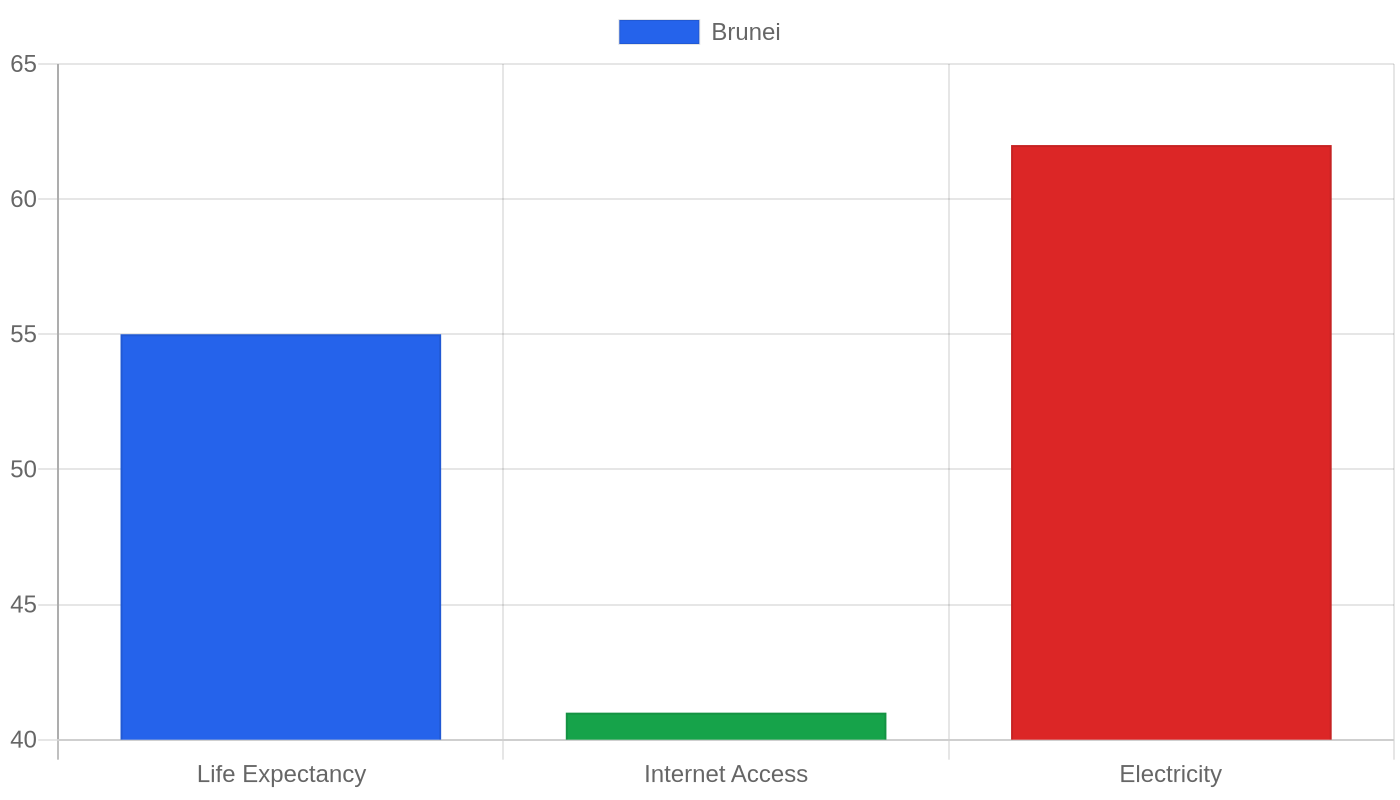
Brunei’s economic story is written in the language of oil and gas, yet the World Bank provides no current data on GDP growth, inflation, unemployment, or GDP per capita. This absence is itself telling: the Sultanate has long operated with a level of statistical opacity that frustrates analysts and investors alike. What is clear from the corporate landscape is that hydrocarbons dominate absolutely.
Brunei Shell Petroleum, Brunei LNG, and Brunei Energy Services and Trading form the triad that drives national revenue, while Brunei Methanol Company and Brunei Fertilizer Industries represent downstream diversification into petrochemicals and industrial production.
The lack of hard numbers from the World Bank forces observers to read the economy through its corporate structure. When the dominant players are all either wholly state-owned or joint ventures with the government, the distinction between public finance and corporate balance sheets blurs. Brunei Investment Agency, the sovereign wealth fund, sits at the center of this system, managing the proceeds from decades of oil wealth.
The absence of inflation or unemployment data suggests either a deliberate policy of non-disclosure or an economy where such metrics are deemed less critical because the state cushions its citizens from market forces through subsidies and public sector employment. Either way, the message is clear: Brunei’s economic health is measured in barrels, not Bureau of Statistics bulletins.
The Price of Stability — Living in a Subsidised Bubble
Cost of living data is also absent from the provided materials, but the shape of Brunei’s consumer economy can be inferred from its corporate players. Hua Ho Department Store, the lone consumer services company on the top-ten list, indicates a retail sector that serves a population accustomed to imports and modest consumption choices.
Brunei’s currency is pegged to the Singapore dollar, which provides price stability but also means that inflation in Singapore directly affects Brunei’s import costs. Housing in Brunei is heavily subsidised for citizens through government schemes, and the absence of a large rental market suggests that homeownership is the norm rather than the exception.
Energy costs are among the lowest in the region because the state controls production, meaning petrol, electricity, and cooking gas are cheap. This creates a peculiar dynamic: daily expenses for essentials like food and clothing may be moderate, but the true cost of living is masked by subsidies that make Brunei feel artificially affordable. For expatriate workers, who form a significant portion of the skilled workforce, housing and schooling costs are higher because they do not qualify for the same benefits.
The result is a two-tier economy where citizens live in a subsidised bubble and foreigners pay market rates, a structure that works as long as oil revenues remain sufficient to fund the gap.
Banking on Diversification — Where the Money Moves
The list of Brunei’s top companies reveals a quiet but significant shift. Four of the ten are financial institutions: Baiduri Bank, Bank Islam Brunei Darussalam, Brunei Darussalam Central Bank, and Brunei Investment Agency. This concentration suggests that the Sultanate is attempting to build a financial services hub as a hedge against hydrocarbon volatility.
Baiduri Bank is the largest commercial bank, offering retail and corporate banking, while Bank Islam Brunei Darussalam provides sharia-compliant products. The presence of the central bank and the investment agency on the list underscores how tightly financial regulation and sovereign wealth management are woven into the corporate fabric.
For investors, the message is that Brunei is open for business — but only on its own terms. The legal system blends English common law with sharia, which creates complexity for foreign firms unfamiliar with Islamic finance principles. The absence of elections and the concentration of power in the monarchy mean that regulatory decisions can be swift but unpredictable.
Sectors to watch include petrochemicals, where Brunei Fertilizer Industries and Brunei Methanol Company are expanding, and Islamic finance, where Brunei positions itself as a competitor to Malaysia. However, the small domestic market and reliance on foreign labor for technical roles limit the scale of any diversification effort.
The Sultan’s Peace — Politics, Safety, and the Social Contract
Brunei’s political landscape is defined by the Malay Islamic Monarchy, or MIB, which fuses Malay cultural identity, Islamic law, and absolute royal authority. The constitution enshrines this system, and while a parliament exists, its members are appointed by the Sultan, not elected. The last election mentioned in the data is left unspecified, which is itself a statement: elections are so rare and inconsequential that the date is not worth recording.
Sharia law supersedes English common law in some cases, a fact that has drawn international criticism but is domestically supported by the conservative Malay majority.
Crime and safety indices are unavailable from the World Bank, but Brunei’s reputation as one of Asia’s safest countries is well established. Violent crime is rare, petty theft is low, and the combination of small population, strong family structures, and strict Islamic codes creates a social environment where disorder is minimal. Quality of life is high for citizens who benefit from free healthcare, subsidised housing, and no income tax.
The trade-off is clear: personal freedoms are constrained by religious and monarchical authority, but material security is virtually guaranteed. This social contract has kept Brunei stable for decades, even as neighboring countries have experienced political turbulence.
The Clock Is Ticking — Brunei’s Post-Oil Reality
The most pressing current affair in Brunei is the question that hangs over the entire economy: what happens when the oil runs out? The data provided shows that Brunei Fertilizer Industries and Brunei Methanol Company are operational, indicating that the government is already investing in downstream industries that can process hydrocarbons into higher-value products.
The World Bank’s silence on recent economic indicators may reflect a period of transition where old data is no longer relevant and new metrics have not yet been established. The Sultan has spoken publicly in recent years about the need for economic diversification, but the pace of change remains slow.
Brunei Investment Agency continues to manage the country’s overseas assets, providing a buffer against revenue shocks. The financial sector’s prominence on the corporate list suggests that the government sees banking and Islamic finance as a growth area. However, the lack of elections and the absolute nature of the monarchy mean that economic policy is made by decree, not debate.
This can enable swift decision-making, but it also means that there is no public accountability if diversification efforts falter. For now, Brunei remains a wealthy petro-state with a long runway, but the data gaps in the World Bank report are a warning sign: the country is not yet ready to tell the world what comes next.
The Bottom Line
Brunei is a country for patient, risk-tolerant investors who understand that the monarchy’s stability is both an asset and a constraint. The hydrocarbon wealth provides a cushion that few other nations can match, but the lack of transparency and the absence of democratic accountability mean that outsiders must operate with incomplete information.
For analysts tracking Southeast Asia’s energy transition, Brunei is a case study in how an absolute monarchy prepares — or fails to prepare — for a post-oil future. The Sultanate is worth watching, but only from a distance, until the data catches up with the reality on the ground.
Sources & Methodology
This article is authored by Economic Pulse Net for informational and research purposes. Economic Pulse Net sources its data from multilateral institutions, national statistics bureaus, and proprietary databases. All data is believed to be current as of the date of publication.
Published: July 30, 2026 | Category: Research — Brunei
Use these signals in your own platform
Economic Pulse publishes its live signal feed through a documented, read-only API. Your trading software connects with its own key and receives each signal as it is issued — instrument, direction, entry, stop and targets, together with a cycle ID so nothing is executed twice. The feed is independent of this website and cannot change it.
Signals are informational only and are not financial advice.