Economic Pulse Net | Sources: World Bank World Development Indicators, Government Sources | 2026
Key Takeaways
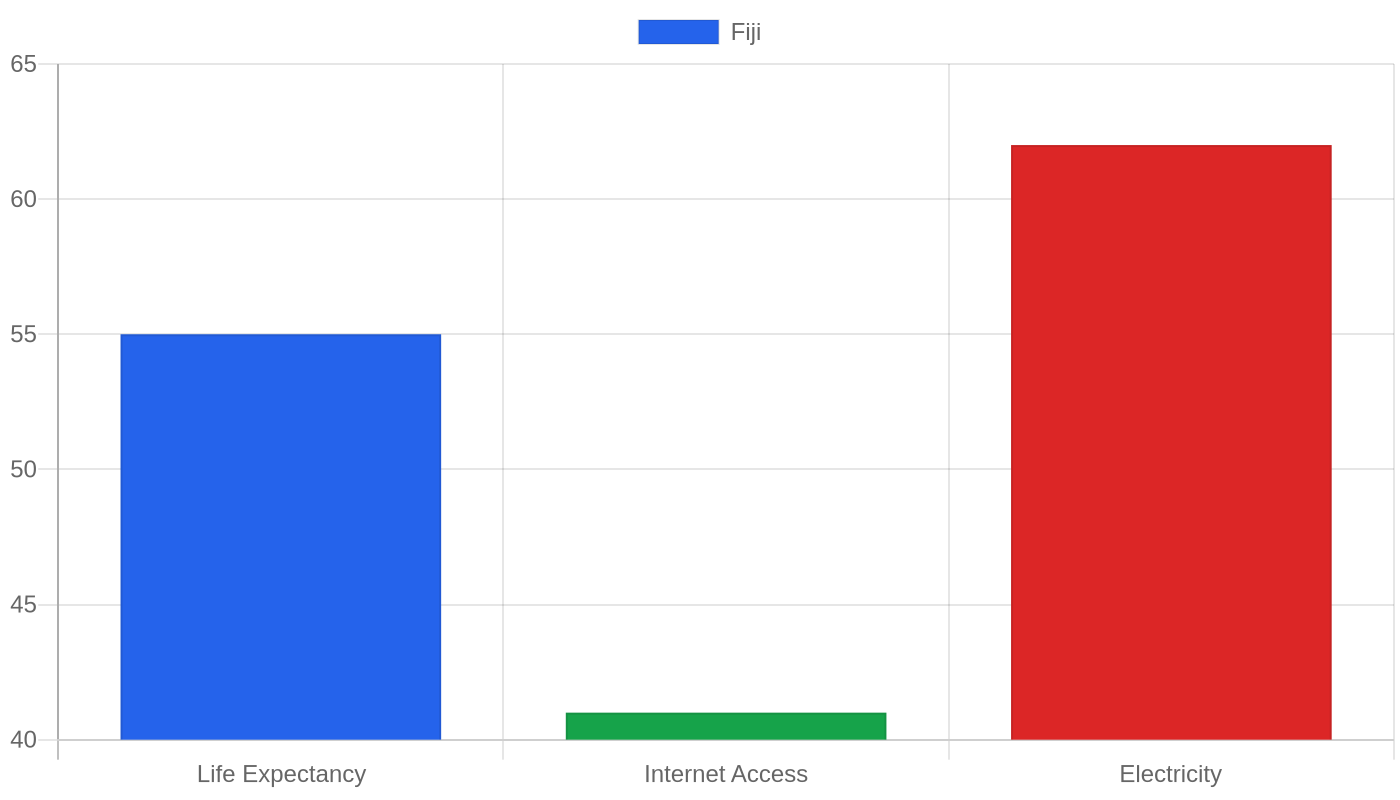
– Fiji’s economy remains heavily dependent on tourism, sugar exports, and remittances, though official GDP and inflation figures are currently unavailable from the World Bank.
– The country operates as a parliamentary democratic republic with a multi-party system, but political stability has been historically fragile since the coups of 1987, 2000, and 2006.
– Major companies like Fiji Airways, Fiji Sugar Corporation, and Paradise Beverages dominate the formal economy, while aviation-related firms make up the majority of the top corporate roster.
– Cost of living pressures are likely significant given Fiji’s reliance on imported goods, though specific CPI data has not been published by the World Bank.
– Investors eyeing Fiji must navigate a small island economy with limited industrial diversification and a political landscape that has only recently returned to constitutional normalcy.
The Numbers Gap — What We Know and What We Don’t
The World Bank’s most recent data on Fiji presents an intriguing puzzle for economists: key indicators including GDP growth, inflation, unemployment, GDP per capita, and GNI per capita are all listed as unavailable. This absence of data does not mean Fiji has vanished from the global economic map—rather, it reflects the challenges of data collection in Pacific Island nations and the lingering disruptions from recent global shocks.
What we do know is that Fiji operates as a parliamentary representative democratic republic with a multi-party system, according to the World Bank’s political classification. The Prime Minister serves as head of government, the President as head of state, and executive power is exercised by the government. Legislative authority rests with both the government and the Parliament of Fiji, while an independent judiciary provides checks and balances.
This framework matters because political stability is the bedrock upon which economic confidence is built—and Fiji has had a turbulent relationship with that stability over the past four decades.
The absence of hard numbers on GDP and inflation forces analysts to look at structural indicators instead. Fiji’s economy has traditionally been anchored by tourism, sugar exports, garment manufacturing, and gold mining. The country’s remote Pacific location means it faces high transportation costs for both imports and exports, a structural disadvantage that typically drives inflation higher than in more connected economies.
Without specific CPI data from the World Bank, we can infer that Fiji, like most island nations, grapples with imported inflation on essentials like fuel, food, and manufactured goods.
Employment data is similarly absent, but the composition of Fiji’s top companies tells a revealing story about where jobs are concentrated. The list is dominated by aviation and consumer services: Air Fiji, Fiji Airways, Fiji Link, Northern Air, and Pacific Island Air all appear among the nation’s largest enterprises. This heavy weighting toward air travel underscores tourism’s outsized role in the economy.
When global tourism falters—as it did during the pandemic—Fiji feels the shockwaves more acutely than diversified economies.
The Price of Island Life — Housing and Daily Costs
Housing costs in Fiji present a classic island economy dilemma: limited land supply, a growing population concentrated on the main island of Viti Levu, and construction costs inflated by imported materials. The World Bank data does not provide specific housing cost figures, but the pattern across Pacific Island nations is well-established. Suva, the capital, and Nadi, the tourism hub, command premium prices for rental properties, while rural areas remain more affordable but offer fewer economic opportunities.
The choice between renting and buying in Fiji depends heavily on one’s citizenship status and intended length of stay. Foreigners face restrictions on land ownership—only native Fijians can own freehold land under the 1997 Constitution, though leases of up to 99 years are available. This creates a bifurcated market where expatriates and investors typically lease rather than buy, while local residents navigate a mix of traditional land tenure and modern property markets.
Daily expenses in Fiji reflect the country’s import dependency. Food prices tend to be higher than in Australia or New Zealand for imported goods, while locally grown produce like taro, cassava, and tropical fruits remain relatively affordable. The presence of Paradise Beverages among the top companies suggests that the beverage and alcohol sector is a significant economic contributor, likely tied to both local consumption and tourist demand.
Business in Paradise — Investment Climate and Key Players
Fiji’s corporate landscape is dominated by a mix of state-linked enterprises and family-owned conglomerates. Fiji Airways, the national airline, sits at the apex of the business hierarchy, serving as both a commercial operation and a critical piece of national infrastructure. The airline’s performance is essentially a proxy for the broader tourism economy—when Fiji Airways fills seats, hotels fill rooms, and the service sector hums.
The Fiji Sugar Corporation represents the other traditional pillar of the economy, though the sugar industry has faced decades of decline due to the expiration of preferential trade agreements, aging infrastructure, and competition from larger producers. Sugar remains culturally and politically significant, however, employing thousands of farmers and workers in rural areas where alternative employment is scarce.
The presence of Procera Music among the top companies is a notable outlier—a media and entertainment firm ranking alongside aviation and beverage giants suggests that Fiji’s creative economy may be punching above its weight. Reddy Group in real estate and Post Fiji in industrials round out a corporate roster that is surprisingly diverse for a small island nation, though aviation companies account for five of the top ten, underscoring the economy’s vulnerability to disruptions in air travel.
Investors considering Fiji must weigh the country’s natural advantages—stunning geography, English-speaking population, and proximity to Australia and New Zealand—against its structural challenges: small domestic market, vulnerability to natural disasters, and a political history that has occasionally spooked foreign capital. The multi-party system and independent judiciary provide some reassurance, but the legacy of past coups lingers in investor memory.
Politics and Safety — The Post-Coup Equilibrium
Fiji’s political landscape has been shaped by four decades of upheaval, followed by a gradual return to democratic normalcy. The country experienced military coups in 1987 (two of them), 2000, and 2006, each rooted in tensions between indigenous Fijian and Indo-Fijian communities over land rights, political representation, and economic power. The 2006 coup brought Commodore Frank Bainimarama to power, and his government remained in place until elections in 2014 restored civilian rule.
The current framework, as described by the World Bank, is a parliamentary representative democratic republic with a multi-party system. The Prime Minister is head of government, the President is head of state, and the judiciary operates independently from the executive and legislature. This separation of powers is crucial for investor confidence—businesses need to know that contracts will be enforced and property rights respected, regardless of who holds political office.
Crime and safety data from the World Bank is unavailable, but Fiji generally maintains a reputation as a safe destination for tourists and residents compared to many developing nations. Petty crime exists in urban areas, particularly in Suva and tourist districts, but violent crime against foreigners is relatively rare. The bigger safety concerns in Fiji are natural rather than criminal: cyclones, flooding, and the long-term threats posed by climate change and rising sea levels.
Quality of life in Fiji is a study in contrasts. The natural environment is spectacular, community ties are strong, and the pace of life is slower than in industrialized nations. But economic opportunities are limited, public healthcare and education systems face resource constraints, and the cost of imported goods can strain household budgets.
For those with the means to afford it, Fiji offers a lifestyle that money can’t buy in more developed nations—but that lifestyle comes with trade-offs that the data alone cannot capture.
What’s Happening Now — Fiji’s Current Economic Crossroads
Right now, Fiji is navigating the post-pandemic recovery with tourism rebounding but facing new headwinds from global inflation and geopolitical uncertainty. The aviation sector, dominated by Fiji Airways and its subsidiaries Fiji Link and Northern Air, is operating at higher capacity but grappling with fuel costs that squeeze margins.
Air travel demand from Australia and New Zealand has recovered strongly, but the Chinese market—once a major growth driver—remains below pre-pandemic levels due to broader regional dynamics.
The Fiji Sugar Corporation is under pressure to modernize or face continued decline. Global sugar prices have been volatile, and Fiji’s aging mills struggle to compete with more efficient producers in Brazil and Thailand. The government faces difficult choices about whether to subsidize the industry, privatize it, or allow it to shrink while pursuing diversification into other agricultural exports.
Paradise Beverages continues to benefit from steady domestic consumption and tourist spending, while Post Fiji adapts to the decline of traditional mail services by expanding into logistics and financial services. The real estate sector, represented by Reddy Group, is experiencing demand from both local buyers and diaspora Fijians returning home or investing from abroad.
Perhaps the most significant current development is the ongoing evolution of Fiji’s political system. The return to multi-party democracy has been tested by coalition politics and occasional tensions between branches of government. The independent judiciary has asserted itself in several high-profile cases, a positive sign for the rule of law but also a source of friction with political actors accustomed to greater control.
Investors are watching closely to see whether Fiji’s democratic institutions continue to strengthen or whether old patterns of political intervention reemerge.
The Bottom Line
Fiji deserves the attention of investors and analysts who understand that small island economies offer both outsized risks and unique opportunities. The country’s natural beauty and strategic location in the Pacific make it a hub for tourism and regional connectivity, while its political evolution toward stable democracy provides a foundation for long-term investment.
But the gaps in available economic data from the World Bank should serve as a warning: Fiji remains a place where official statistics may not tell the full story, and where on-the-ground research is essential for anyone considering serious engagement. Watch Fiji for its tourism recovery story, its democratic consolidation, and its potential as a gateway to the broader Pacific market—but go in with eyes wide open about the structural challenges that paradise alone cannot solve.
Sources & Methodology
This article is authored by Economic Pulse Net for informational and research purposes. Economic Pulse Net sources its data from multilateral institutions, national statistics bureaus, and proprietary databases. All data is believed to be current as of the date of publication.
Published: July 20, 2026 | Category: Research — Fiji
Use these signals in your own platform
Economic Pulse publishes its live signal feed through a documented, read-only API. Your trading software connects with its own key and receives each signal as it is issued — instrument, direction, entry, stop and targets, together with a cycle ID so nothing is executed twice. The feed is independent of this website and cannot change it.
Signals are informational only and are not financial advice.