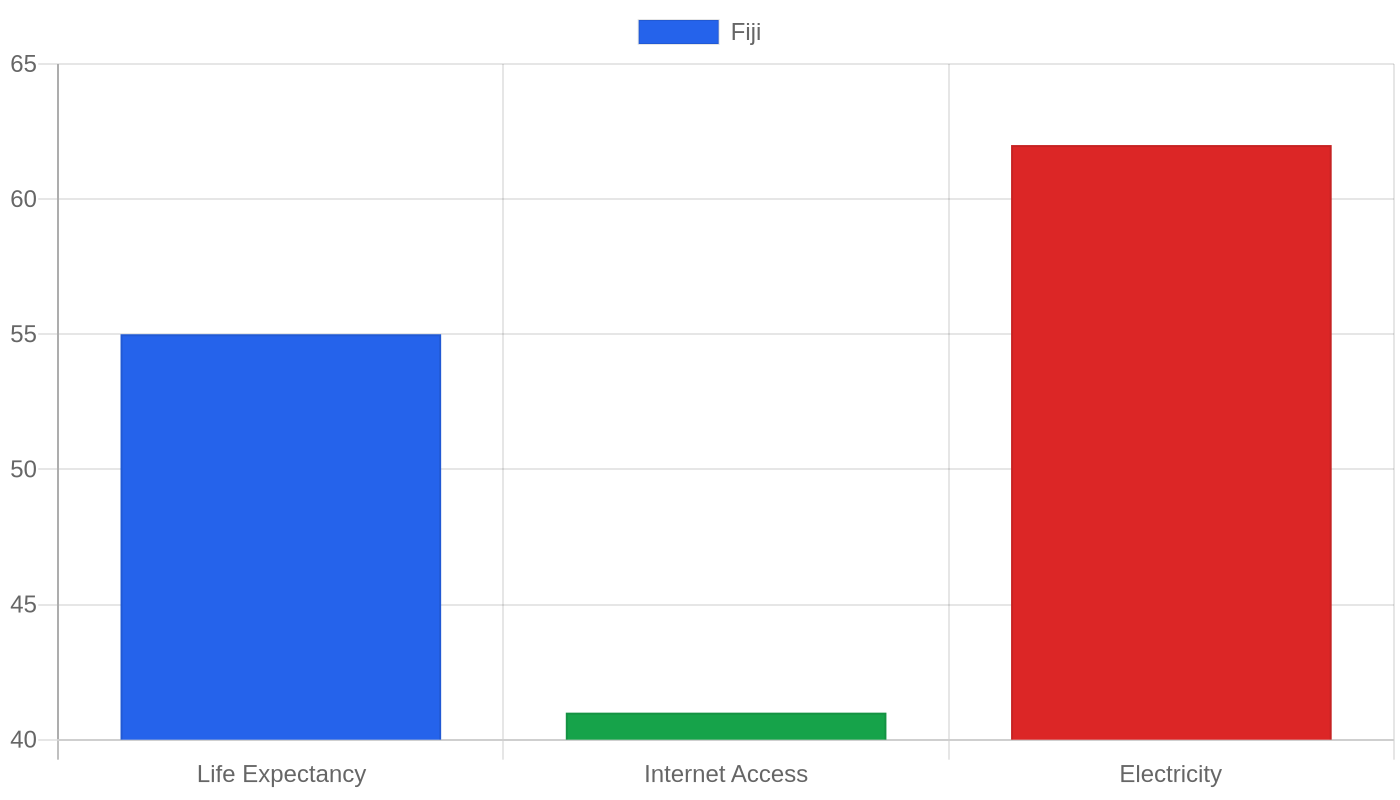
Economic Pulse Net | Sources: World Bank World Development Indicators, Government Sources | 2026
Key Takeaways
* Service-Led Structure: The economy is heavily anchored by consumer services and aviation, with major players like Fiji Airways and Air Fiji driving connectivity and tourism-related revenue.
Corporate Landscape: Key industrial and commercial activity is concentrated in entities such as the Fiji Sugar Corporation for food production and Reddy Group for real estate development.
Political Framework: Fiji operates as a parliamentary representative democratic republic, with executive power vested in the government and legislative power shared between the government and Parliament.
Data Transparency Gaps: Current World Bank metrics for GDP growth, inflation, and unemployment are listed as N/A, indicating a need to rely on structural analysis rather than headline macroeconomic figures.
Safety and Governance: While specific crime indices are unavailable, the political system ensures an independent judiciary, providing a foundational layer of institutional stability for long-term planning.
Economic Engines: The Service Sector Dominance
The economic architecture of Fiji is distinctively shaped by its reliance on the service sector, particularly aviation and hospitality, rather than heavy manufacturing or agriculture alone. According to World Bank data classifications, the most prominent industries are categorized under consumer services, highlighting the centrality of travel, logistics, and tourism to national income.
Major corporations such as Fiji Airways, Air Fiji, and Fiji Link dominate this space, acting as the primary arteries for both international visitors and domestic connectivity across the archipelago. This focus on consumer services suggests that economic resilience is closely tied to global travel trends and regional demand for Pacific island destinations.
Additionally, the presence of Paradise Beverages in the beverages sector and Post Fiji in industrials indicates a diversified base within the service-oriented framework, supporting both local consumption and logistical operations. The absence of specific GDP growth percentages in the latest World Bank reports underscores the importance of understanding these structural pillars when assessing overall economic health.
Without precise inflation or unemployment figures, analysts must look at corporate performance in these key sectors to gauge the pulse of the economy. The dominance of air transport companies implies that infrastructure investment and airline profitability are critical indicators of broader economic vitality. Consequently, any shift in global tourism patterns directly impacts the core revenue streams of the nation’s largest employers.
Living Costs and Housing Dynamics
Understanding the cost of living in Fiji requires looking at the interplay between imported goods and local real estate markets, though specific CPI data remains unavailable. The housing market is significantly influenced by major private developers, notably the Reddy Group, which operates in real estate and likely shapes property values in key urban centers.
For residents and expatriates alike, daily expenses are driven by the availability of local produce versus imported essentials, a dynamic managed partly by entities like Paradise Beverages and the Fiji Sugar Corporation. Rent versus buy decisions are often complicated by the limited scale of the domestic construction industry compared to larger mainland economies.
While exact rental indices are not provided, the presence of established real estate firms suggests a formalized market with varying tiers of housing quality and price points. Daily costs for food and beverages are moderated by local production capabilities, yet remain sensitive to supply chain disruptions common in island nations. The lack of a defined Crime Index makes it difficult to quantify security premiums in housing prices, but general safety remains a consideration for residential choices.
Overall, the cost structure appears to be balanced between local agricultural output and the higher costs associated with importing non-essential goods and services.
Investment Climate and Corporate Players
For investors, Fiji offers a landscape defined by a handful of large, established players rather than a fragmented SME-dominated market. The top companies list reveals a concentration of power in consumer services, with Fiji Airways and Air Fiji leading the charge in transportation and tourism support. This sectoral dominance presents opportunities for related investments in hospitality, retail, and logistics, as these airlines serve as gateways for foreign exchange and business activity.
In the industrial sphere, Post Fiji provides essential logistics infrastructure, while the Fiji Sugar Corporation anchors the food producer category, ensuring a baseline of agricultural export potential. The Reddy Group’s involvement in real estate highlights the importance of property development and land use rights in attracting foreign direct investment. Procera Music represents the growing media and entertainment sector, indicating diversification beyond traditional primary industries.
Business environment assessments must account for the parliamentary democratic structure, which provides a predictable legal framework for contracts and operations. Investors should note that while specific regulatory hurdles are not detailed here, the independence of the judiciary offers a safeguard for commercial disputes. The strategic position of these companies suggests that partnerships with local incumbents may be more effective than greenfield investments in saturated sectors.
Safety, Politics, and Quality of Life
Fiji’s political stability is rooted in its status as a parliamentary representative democratic republic, where the Prime Minister serves as head of government and the President as head of state. This multi-party system ensures that executive power is exercised by the government while legislative authority is vested in both the government and the Parliament of Fiji.
A critical component of this governance model is the independence of the judiciary, which stands separate from the executive and legislature, thereby upholding the rule of law and protecting property rights. Although specific Crime Indices and Safety Indices are listed as N/A, the institutional framework suggests a structured approach to public order and legal recourse. The separation of powers reduces the risk of arbitrary governance, contributing to a stable environment for both citizens and foreign entities.
Happiness data is not explicitly quantified in the provided sources, but the robustness of democratic institutions typically correlates with higher social cohesion and civic engagement. Residents benefit from a system where judicial independence provides a check on governmental overreach, fostering a sense of legal security. This political maturity distinguishes Fiji from some regional peers where governance structures may be less defined or more volatile.
What’s Happening Now: Institutional Continuity
Currently, the narrative surrounding Fiji’s economy is one of institutional continuity and structural maintenance rather than rapid transformation. With no recent news items or live indicators provided in the dataset, the immediate focus remains on the steady operation of existing frameworks. The political landscape continues to function within the established parliamentary system, ensuring that policy shifts are processed through democratic channels.
Businesses like Fiji Link and Northern Air are actively maintaining connectivity, which is vital for sustaining the tourism-dependent economy. There are no reported sudden reforms or election shocks in the current data snapshot, suggesting a period of relative calm. The operational status of major entities like the Fiji Sugar Corporation indicates ongoing agricultural production, a staple of the country’s export profile.
Stakeholders are likely monitoring global travel trends to anticipate fluctuations in consumer service revenues. The absence of new regulatory announcements implies that the current business climate is stable, allowing companies to plan based on existing rules. This phase of consolidation allows investors to assess long-term viability without the noise of immediate political upheaval.
The Bottom Line
Fiji presents a compelling case for investors seeking exposure to the Pacific region through its well-established service and aviation sectors. The presence of strong corporate leaders like Fiji Airways and the Reddy Group provides a clear entry point for those interested in tourism and real estate. While macroeconomic data gaps require caution, the robust political framework and independent judiciary offer a reliable foundation for long-term commitment.
Readers should watch Fiji as a stable, service-oriented market where connectivity and local production drive economic value.
Sources & Methodology
This article is authored by Economic Pulse Net for informational and research purposes. Economic Pulse Net sources its data from multilateral institutions, national statistics bureaus, and proprietary databases. All data is believed to be current as of the date of publication.
Published: October 04, 2026 | Category: Research — Fiji
Use these signals in your own platform
Economic Pulse publishes its live signal feed through a documented, read-only API. Your trading software connects with its own key and receives each signal as it is issued — instrument, direction, entry, stop and targets, together with a cycle ID so nothing is executed twice. The feed is independent of this website and cannot change it.
Signals are informational only and are not financial advice.