Economic Pulse Net | Sources: World Bank World Development Indicators, Government Sources | 2026
Key Takeaways
* Political Framework: Fiji operates as a parliamentary representative democratic republic, with power shared between the Prime Minister, the President, an independent judiciary, and a multi-party system.
Service-Led Economy: The corporate landscape is dominated by consumer services, particularly aviation, alongside key players in food production, beverages, and real estate.
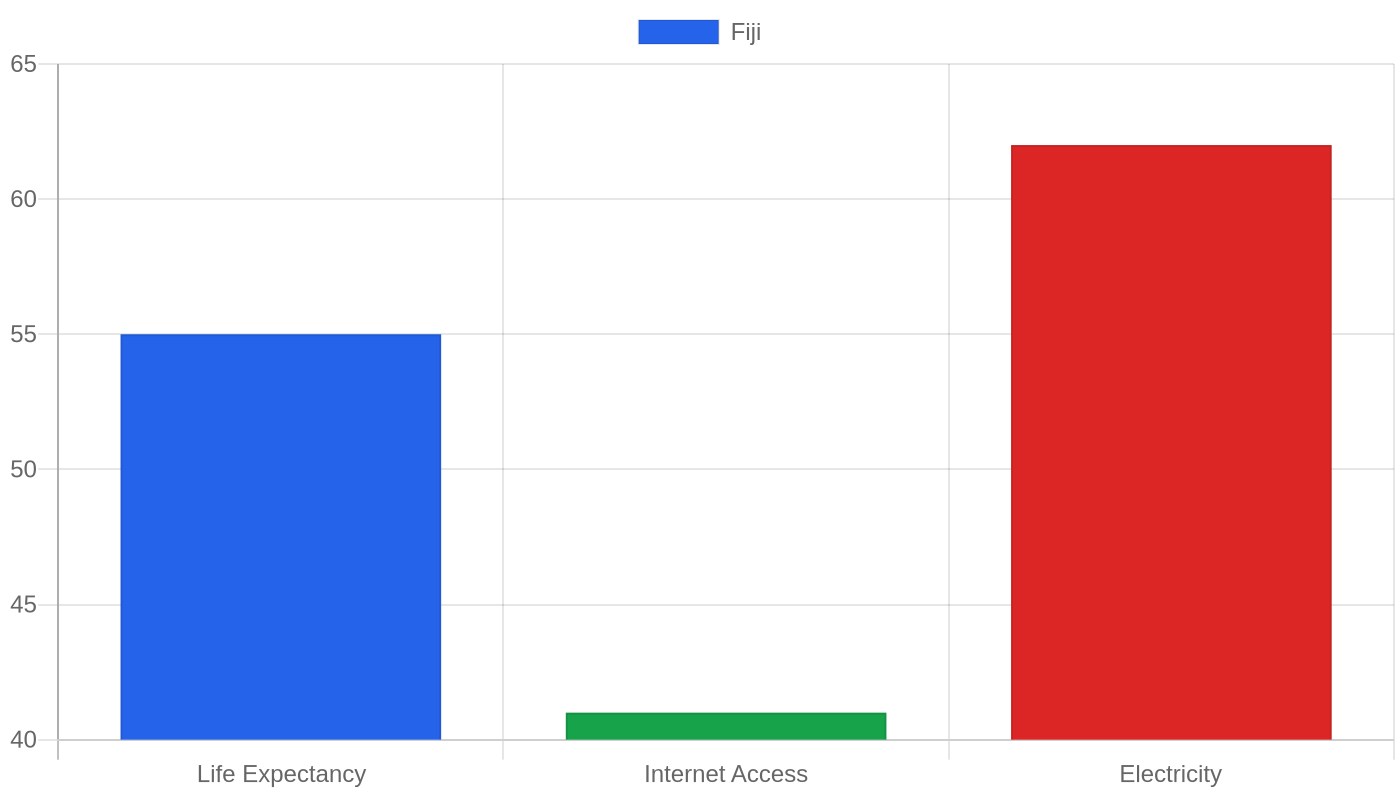
Data Gaps in Macro Metrics: Official World Bank data for GDP growth, inflation, unemployment, and per capita income figures are currently listed as unavailable, requiring a qualitative assessment of the business environment.
Safety and Governance: Specific crime and safety indices are not provided, but the political structure suggests established institutional checks and balances.
Key Corporate Players: Major economic activity is driven by entities such as Fiji Airways, the Fiji Sugar Corporation, and Paradise Beverages, highlighting a reliance on tourism-adjacent services and local manufacturing.
Economic Structure: A Service-Dominant Landscape
While specific quantitative metrics from the World Bank regarding GDP growth, inflation rates, and unemployment levels are currently marked as unavailable, the structural composition of Fiji’s economy reveals a distinct pattern centered on services and light industry. The absence of precise numerical data does not obscure the fact that the nation’s economic engine is heavily reliant on the consumer services sector, particularly air transport and hospitality support.
This is evident in the prominence of major airlines such as Fiji Airways, Air Fiji, and Northern Air, which serve as critical connectors for both tourism and trade. Beyond aviation, the presence of the Fiji Sugar Corporation underscores the enduring importance of agricultural processing, specifically sugar production, within the national output. Meanwhile, companies like Paradise Beverages indicate a robust domestic manufacturing base that caters to local consumption needs.
In the absence of hard GDP figures, one must look at these industrial pillars to understand where value is being created; the economy appears less driven by heavy manufacturing or raw resource extraction and more by facilitating movement, consumption, and basic processing. This service-oriented model makes the economy highly sensitive to external shocks in global travel and regional demand, rather than commodity price fluctuations alone.
Understanding this structure is vital for investors, as it suggests that growth trajectories will likely follow trends in international connectivity and domestic purchasing power rather than industrial expansion.
Cost of Living: The Price of Island Life
Assessing the cost of living in Fiji requires navigating a landscape where detailed consumer price index (CPI) data and specific housing cost metrics are not explicitly quantified in the current dataset. However, the presence of diverse corporate entities offers clues about the market dynamics.
The existence of significant real estate developers like the Reddy Group implies an active property market, suggesting that housing costs are a notable component of the economic ecosystem, though specific rent-to-buy ratios remain undefined. Daily expenses are influenced by the availability of local producers such as Paradise Beverages and Post Fiji, which provide essential goods and logistics services, potentially stabilizing prices for basic necessities compared to imported alternatives.
Without concrete inflation numbers, it is difficult to compare Fiji’s cost of living directly against regional averages or historical baselines with precision. Nevertheless, the reliance on imported goods for many non-local items typically creates a cost structure that differs significantly from mainland economies, often commanding a premium for convenience and variety.
For residents and expatriates alike, the financial burden is likely shaped more by the availability of local substitutes and the efficiency of logistics providers like Post Fiji than by broad macroeconomic inflation trends. Consequently, budgeting in Fiji involves managing the gap between locally produced staples and the higher costs associated with international connectivity and specialized services.
Investment & Business Climate: Aviation and Agri-Business Focus
The investment landscape in Fiji is characterized by a concentration of power in a few key sectors, primarily consumer services and food production. Investors looking at the country must recognize that the top companies listed—ranging from Fiji Airways and Fiji Link to the Fiji Sugar Corporation—represent the backbone of commercial activity.
These firms operate within a framework where executive power is exercised by the government, yet legislative power is vested in both the government and the Parliament, creating a complex but structured regulatory environment. The dominance of aviation companies like Pacific Island Air and Northern Air highlights the strategic importance of connectivity; any investment climate analysis must account for the ease of moving people and goods across the archipelago.
Furthermore, the presence of media entities like Procera Music and beverage giants like Paradise Beverages indicates a mature domestic market for consumer goods, offering opportunities in marketing and distribution networks. Real estate development by groups like the Reddy Group points to ongoing urbanization and infrastructure needs, providing avenues for capital deployment in construction and property management.
While specific GDP per capita figures are unavailable, the diversity of these top companies suggests a diversified enough economy to support various types of business ventures, from logistics to media production. Potential investors should focus on how these established players interact with government policy, as the parliamentary system ensures that legislative changes can quickly impact operational frameworks.
Safety, Politics & Quality of Life: Institutional Stability
Fiji’s political environment is defined by its status as a parliamentary representative democratic republic, which provides a clear framework for governance and accountability. The separation of powers is a critical feature: the Prime Minister serves as the head of government, while the President acts as the Head of State, ensuring a distinction between ceremonial duties and executive decision-making.
Crucially, the judiciary is independent of both the executive and the legislature, a safeguard that enhances the rule of law and protects property rights, which is fundamental for long-term quality of life and business confidence. Although specific crime and safety indices are not provided in the current data, the existence of a multi-party system and independent judicial review suggests a stable political atmosphere conducive to social order.
This institutional setup allows for regular political competition and representation, reducing the likelihood of abrupt authoritarian shifts that often plague smaller island nations. For residents, this political stability translates into predictable legal environments and consistent public administration. While happiness data is not explicitly cited, the structured nature of the government implies that civic engagement and legal recourse are accessible mechanisms for addressing grievances.
Ultimately, the political landscape offers a degree of security and predictability that underpins daily life, even if granular safety statistics remain opaque.
What’s Happening Now: Policy and Corporate Dynamics
In the current period, the focal point for observers is the interplay between government policy and the operational realities of major corporations. With executive power resting in the hands of the government, recent policy shifts likely impact the regulatory environment for key industries such as aviation and sugar production.
The independence of the judiciary continues to play a vital role in resolving disputes and maintaining fair market practices, ensuring that businesses like Fiji Airways and the Fiji Sugar Corporation operate within a consistent legal framework. Legislative activities within the Parliament of Fiji are shaping the multi-party dynamic, influencing everything from tax policies to infrastructure investments that benefit companies like the Reddy Group.
As consumer services remain the dominant sector, any governmental incentives for tourism or transport will have immediate ripple effects through the economy. The lack of new macroeconomic data releases means that attention is drawn to corporate performance and political developments as primary indicators of economic health.
Stakeholders are watching how the government balances fiscal responsibilities with the needs of key employers, recognizing that stability in these large enterprises is synonymous with national economic resilience. Recent news flows suggest a focus on maintaining this balance, with an eye toward sustainable growth in the face of limited statistical visibility.
The Bottom Line
Fiji presents a unique case study for investors and analysts, where strong institutional frameworks and a clear corporate hierarchy exist alongside gaps in standard macroeconomic reporting. Those interested in the Asia-Pacific region should watch Fiji not for explosive GDP growth figures, but for its stability, service-sector depth, and political maturity.
The country offers a safe harbor for businesses focused on aviation, agriculture, and consumer goods, provided they navigate the nuances of its parliamentary democracy. For now, the verdict is one of cautious optimism, anchored by reliable institutions rather than volatile data points.
Sources & Methodology
This article is authored by Economic Pulse Net for informational and research purposes. Economic Pulse Net sources its data from multilateral institutions, national statistics bureaus, and proprietary databases. All data is believed to be current as of the date of publication.
Published: October 11, 2026 | Category: Research — Fiji
Use these signals in your own platform
Economic Pulse publishes its live signal feed through a documented, read-only API. Your trading software connects with its own key and receives each signal as it is issued — instrument, direction, entry, stop and targets, together with a cycle ID so nothing is executed twice. The feed is independent of this website and cannot change it.
Signals are informational only and are not financial advice.