Economic Pulse Net | Sources: World Bank World Development Indicators, Government Sources | 2026
Key Takeaways
* Steady but Slow Growth: Australia’s economy is expanding at a modest pace, with GDP growth projected at just over 1.35% for 2025, indicating stability rather than rapid acceleration.
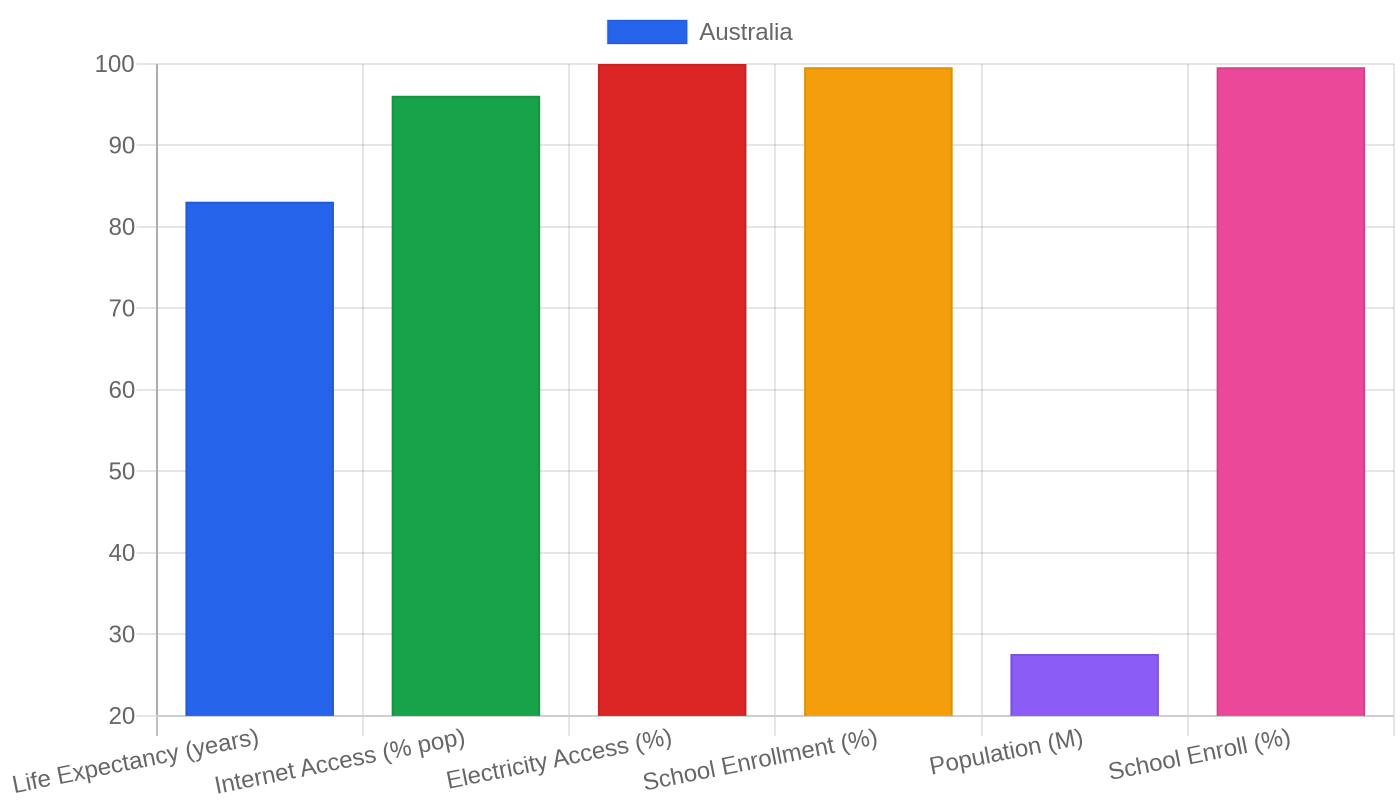
High Living Standards: With a GDP per capita (PPP) exceeding $71,900 and a GNI per capita of $64,120, the nation maintains one of the highest standards of living globally, supported by a large population of over 27.6 million.
Tight Labor Market: Unemployment remains historically low at 4.09%, suggesting a robust labor market despite broader economic headwinds.
Political-Economic Tension: Recent business analysis highlights significant friction between the government and the private sector, particularly regarding budget crises and tax legislation reforms.
Data Transparency Gaps: While macroeconomic indicators are strong, specific data on crime indices, safety scores, detailed cost of living metrics, and top corporate entities are currently unavailable in the provided dataset.
Economic Pulse: Navigating Modest Expansion
Australia’s economic landscape in 2025 is defined by cautious steadiness rather than explosive growth. According to World Bank data, the country’s GDP growth is projected at 1.35039785076631% for 2025. This figure, while positive, signals a slowdown from previous highs, reflecting the complex interplay of global supply chain adjustments and domestic monetary policy constraints.
Inflation, measured by the CPI, stands at 2.87403791660173%, which is relatively close to target ranges for many central banks, suggesting that price pressures are moderating but not yet fully tamed. This inflationary environment exists alongside a remarkably tight labor market, where the unemployment rate holds steady at 4.09%. Such a low unemployment rate indicates that businesses are still competing for workers, which can sustain wage growth but also keeps upward pressure on service costs.
The aggregate size of the economy is substantial, with a total GDP in USD reaching 1798518933689.21. When adjusted for purchasing power parity, the GDP per capita rises to 71934.4033931263, underscoring the high value generated per individual worker. Furthermore, the Gross National Income (GNI) per capita is recorded at 64120.0, providing a clear picture of the average income available to residents after accounting for international transfers.
These figures collectively paint a picture of a mature, high-income economy that is prioritizing stability and social welfare over aggressive expansion, serving nearly 27.61 million people across its vast geographic footprint.
Cost of Living and Housing Dynamics
While precise numerical data for housing rents or daily consumer expenses is not currently available in the provided dataset, the macroeconomic indicators offer strong inferential insights into the Australian cost of structure. The high GNI per capita of $64,120 suggests that households have significant nominal income, which often correlates with higher baseline costs for goods and services compared to emerging markets.
Similarly, the GDP per capita (PPP) of approximately $71,934 implies that the local currency retains substantial purchasing power domestically, though this may be offset by elevated prices in major urban centers like Sydney and Melbourne. Typically, economies with such high income levels experience premium pricing for housing, healthcare, and education, creating a dual reality where wealth accumulation is possible but daily operational costs remain steep.
Without specific rental yield data or consumer basket indices, it is difficult to quantify the exact burden on middle-income earners, but the combination of low unemployment (4.09%) and moderate inflation (2.87%) suggests that wages are keeping pace with prices, preventing a severe erosion of living standards. Investors and expatriates should anticipate a high-cost environment that rewards high-skilled labor and capital investment, even as general price stability helps maintain household budgets.
Investment & Business Climate
The business environment in Australia is characterized by a stable institutional framework and a focus on high-value sectors, although specific details on top companies are not listed in the current data. The political structure, described as a constitutional monarchy and parliamentary democracy with a federal system, provides a predictable legal and regulatory environment that is attractive to long-term foreign direct investment.
Power is divided between federal and state governments, allowing for regional economic initiatives while maintaining national consistency in trade and monetary policy. This stability is underpinned by a liberal democratic system that has remained largely unchanged since Federation in 1901, offering investors a sense of continuity and rule of law.
However, the recent narrative surrounding the business climate has become more contentious, with industry leaders pointing to self-inflicted wounds by the government in managing fiscal policy. The absence of data on specific “Top Companies” does not diminish the importance of understanding that Australia’s economy is heavily influenced by its resources sector, financial services, and increasingly, technology and renewable energy industries.
Businesses operating here must navigate a sophisticated regulatory landscape and a highly educated workforce, leveraging the country’s position as a gateway to the Asia-Pacific region.
Safety, Politics & Quality of Life
Australia’s political landscape is anchored in a deep-seated tradition of democratic governance, which contributes significantly to its overall quality of life and social stability. As a federation with a fused executive and strong party system derived from British traditions, the country offers a balanced approach to governance that checks and balances power effectively.
This political maturity translates into a safe and orderly society, although specific Crime Index and Safety Index scores are marked as N/A in the provided data, meaning we cannot cite precise statistical rankings for public safety. Nevertheless, the historical consistency of its constitutional framework since 1901 suggests a low risk of political volatility or civil unrest, which is a critical factor for both residents and international observers.
The high GDP per capita and GNI per capita further enhance quality of life metrics, implying access to superior healthcare, infrastructure, and public services. For individuals considering relocation or long-term residence, the combination of political stability, high income levels, and established democratic norms makes Australia a premier destination, even if granular safety statistics are currently unavailable for deeper analysis.
What’s Happening Now: Policy Battles and Budget Scrutiny
The most pressing developments in Australia right now revolve around the tension between government policy and business expectations, as highlighted by recent coverage from ABC News and the Australian Financial Review (AFR). A dominant theme in the latest business news is the accusation that the government has brought a budget crisis upon itself, signaling a period of fiscal scrutiny and potential austerity measures.
This political friction is directly impacting the legislative agenda, particularly with the introduction of updated trust tax legislation by the Labor Party. Analysis from the AFR points out “three wins (and three traps)” in this new legislation, indicating a complex maneuvering effort to balance revenue generation with economic incentives.
These developments suggest that businesses are currently operating in an environment of heightened regulatory uncertainty, where tax structures are being actively revised to address fiscal deficits. The ongoing coverage from sources like ABC.net.au/news/business and Markets sections of the AFR underscores that the immediate future will be defined by how these tax reforms affect corporate behavior and investment decisions.
Stakeholders are closely watching to see if these legislative changes will stimulate compliance and revenue or stifle growth through increased complexity and cost.
The Bottom Line
Australia presents a compelling case for investors and analysts seeking exposure to a stable, high-income economy with strong institutional foundations. While growth rates are modest at 1.35%, the underlying strength of the labor market and high per-capita incomes provide a resilient buffer against external shocks. However, the current political climate, marked by budget disputes and complex tax reforms, introduces short-term uncertainty that requires careful navigation.
Those who can withstand regulatory shifts and leverage the country’s stable democratic framework will find Australia to be a secure and lucrative market for long-term engagement.
Sources & Methodology
This article is authored by Economic Pulse Net for informational and research purposes. Economic Pulse Net sources its data from multilateral institutions, national statistics bureaus, and proprietary databases. All data is believed to be current as of the date of publication.
Published: October 15, 2026 | Category: Research — Australia
Use these signals in your own platform
Economic Pulse publishes its live signal feed through a documented, read-only API. Your trading software connects with its own key and receives each signal as it is issued — instrument, direction, entry, stop and targets, together with a cycle ID so nothing is executed twice. The feed is independent of this website and cannot change it.
Signals are informational only and are not financial advice.