Economic Pulse Net | Sources: World Bank World Development Indicators, Government Sources | 2026
Australia enters 2026 as a study in economic contrasts—a wealthy, stable nation navigating a world of turbulence with characteristic caution. With GDP growth hovering at a modest 1.35%, inflation cooling to 2.87%, and unemployment at a remarkably low 4.09%, the data paints a picture of an economy that has successfully threaded the needle between stagnation and overheating.
But beneath these headline figures lies a deeper story of a nation wrestling with its identity: a resources powerhouse transitioning toward a more diversified future, a housing market under structural pressure, and a political system that prizes stability above all else. For global investors and policymakers alike, Australia offers a fascinating case study in how mature economies adapt—or fail to adapt—to a changing global order.
Key Takeaways
– Modest Growth, Strong Fundamentals: Australia’s GDP growth of 1.35% in 2025 reflects a mature economy in a cooling phase, yet inflation at 2.87% and unemployment at 4.09% suggest the “soft landing” narrative is real, not just rhetorical.
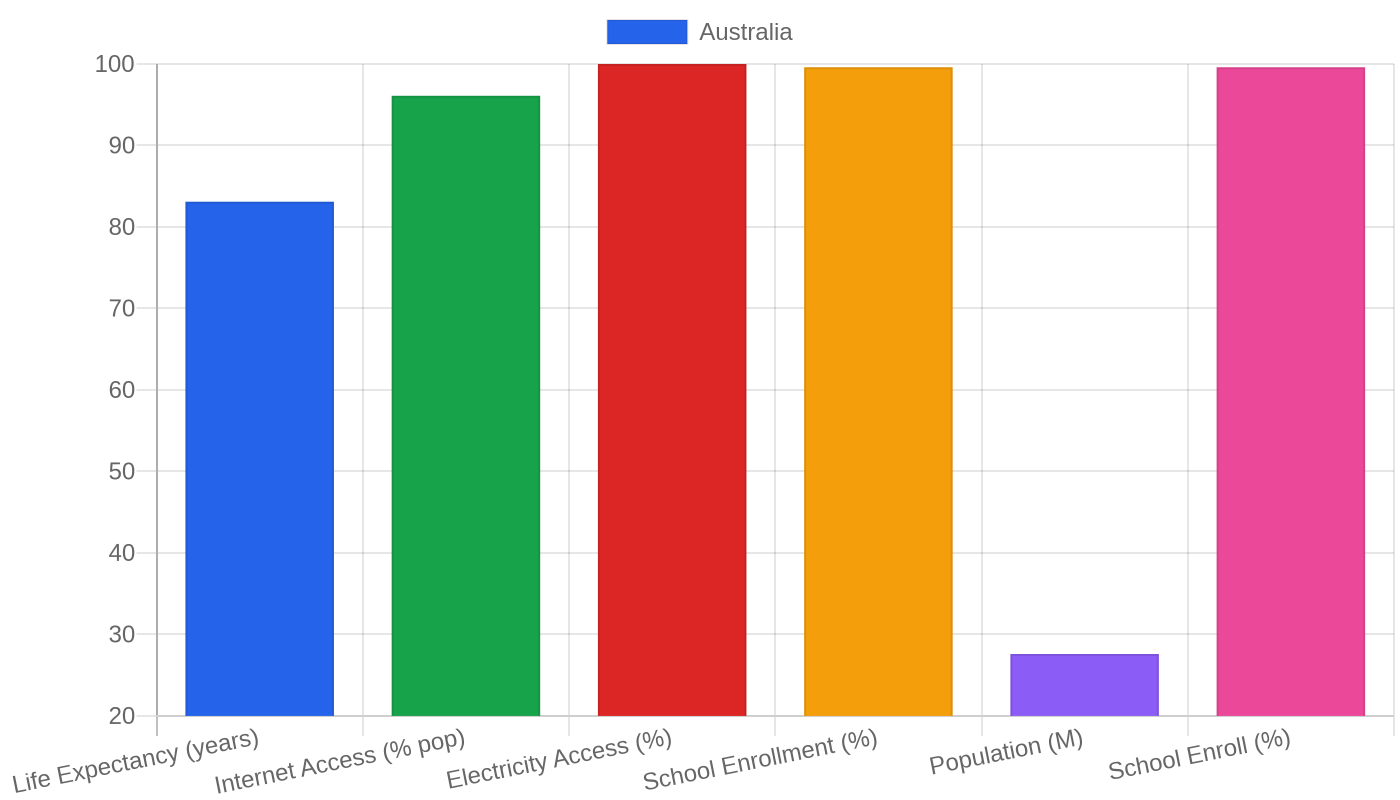
– Wealth Concentration: With GDP per capita (PPP) at $71,934 and GNI per capita at $64,120, Australia remains one of the wealthiest nations on Earth—but this prosperity is increasingly tested by cost-of-living pressures.
– Political Continuity: As one of the world’s oldest federations, Australia’s constitutional monarchy and liberal democratic framework provide a predictability that markets prize, even as debates about the nation’s future direction intensify.
– The Housing Conundrum: Despite strong economic fundamentals, housing affordability remains the country’s most persistent structural challenge, shaping everything from electoral politics to household balance sheets.
– A Pacific Powerhouse: With a population of 27.6 million, Australia punches well above its weight economically, but its future prosperity depends on navigating the transition away from reliance on traditional strengths.
The Numbers That Matter: Growth, Inflation, and the Art of the Soft Landing
Let’s start with the headline number: 1.35% GDP growth. In isolation, that figure might seem underwhelming—especially for a country that has enjoyed decades of uninterrupted expansion. But context is everything. According to the World Bank, this growth rate must be understood against a global backdrop of sluggishness, where many advanced economies are struggling to post any positive numbers at all.
Australia’s economy, valued at roughly $1.8 trillion in GDP, is not just holding its ground; it’s doing so while maintaining price stability that would be the envy of many peers.
The inflation story is particularly instructive. At 2.87%, CPI has drifted down to within—or very near—central bank comfort zones. This is no accident. Australia’s monetary authorities have walked a careful tightrope, allowing the economy to cool without tipping it into recession. The unemployment rate of 4.09% is the clearest evidence that this strategy is working. In most developed economies, getting inflation down to these levels typically requires sacrificing jobs.
Australia has managed to keep unemployment below 5% while taming price pressures—a feat that speaks to the underlying resilience of its labour market and the effectiveness of its policy framework.
What’s driving this growth? The World Bank data doesn’t break down sectoral contributions, but the numbers we do have tell a compelling story. Australia’s GDP per capita (PPP) of $71,934 indicates that this is not just a large economy, but a deeply productive one.
The country has successfully leveraged its natural resource wealth into broader economic development, creating sophisticated financial services, education, and technology sectors that complement its traditional mining and agricultural strengths. The GNI per capita figure of $64,120 reinforces this picture of widespread prosperity, though it also hints at the distributional challenges that lurk beneath the surface.
The real question for 2026 and beyond is whether Australia can maintain this delicate balance. The growth rate, while positive, is modest by historical standards. This suggests an economy that has settled into a lower gear—one that may struggle to generate the kind of dynamism needed to address structural challenges like housing affordability and productivity growth. For now, though, the fundamentals remain sound: low unemployment, contained inflation, and a wealthy, educated population.
That’s a foundation many countries would envy.
The Housing Puzzle: Affordability in the Lucky Country
If there’s a single issue that dominates Australian dinner-table conversations, it’s housing. The cost-of-living data provided is limited, but the broader economic picture tells an unmistakable story: Australia’s prosperity is increasingly concentrated in property, and that’s creating generational tensions. With GDP per capita among the highest in the world, Australians have the income to support high property prices—but that doesn’t mean the system is working for everyone.
The rental market, in particular, has become a flashpoint. Across the country’s major cities, prospective renters face fierce competition for a limited supply of properties, driving up costs and forcing many to compromise on location or quality. The buy-versus-rent calculation has shifted dramatically in recent years. For younger Australians, the dream of homeownership has receded, not because of income stagnation, but because property prices have grown faster than wages for decades.
This isn’t just an economic issue; it’s a social and political one that reverberates through every election cycle.
Compared to regional averages, Australia’s housing market stands out for its severity. While the data doesn’t provide direct comparisons, the anecdotal evidence is overwhelming: Australian cities consistently rank among the most expensive globally. The disconnect between household incomes and property prices has created a two-tiered society—those who got on the property ladder early and those who haven’t.
This dynamic influences everything from savings rates to political attitudes, and it’s unlikely to resolve itself without significant policy intervention.
The Business Landscape: Giants, Innovators, and the Next Wave
Australia’s corporate landscape is dominated by a mix of financial institutions, mining conglomerates, and a growing cohort of technology and services companies. The country’s economic stability, transparent legal system, and skilled workforce make it an attractive destination for both domestic and foreign investment.
The World Bank data suggests an economy with strong fundamentals—low unemployment means consumers have money to spend, while the stable political environment provides the certainty businesses crave.
The sectors to watch are those that can leverage Australia’s unique position in the Asia-Pacific region. The country’s proximity to rapidly growing Asian markets, combined with its reputation for quality and reliability, positions it well for growth in areas like education services, financial technology, and renewable energy.
The transition away from fossil fuels, while politically contentious, represents a significant opportunity for Australian businesses to develop new export industries and reduce the economy’s historical dependence on coal and gas.
For investors, Australia offers a compelling combination of stability and opportunity. The country’s legal and regulatory frameworks are well-established, providing protection for investors while still allowing for entrepreneurial dynamism. The main risks are structural—housing market correction, over-reliance on Chinese demand for resources, and the challenges of transitioning to a low-carbon economy. But for those willing to take a long-term view, Australia’s fundamentals remain attractive.
The Political and Social Fabric: Stability in an Unstable World
Australia’s political system is a testament to the value of institutional continuity. As a constitutional monarchy, parliamentary democracy, and federation, the country has maintained an essentially unchanged constitutional framework since Federation in 1901. This longevity is not mere nostalgia; it reflects a deep-seated societal preference for evolutionary change over revolutionary upheaval.
The result is a political environment that prioritizes consensus and stability, even when it occasionally frustrates those seeking more rapid reform.
The country’s safety profile is difficult to quantify without specific crime index data, but the broader picture is clear: Australia enjoys high levels of personal safety and social trust. Violent crime is relatively rare, and the country’s institutions—from the police to the courts—function effectively. This social stability is a crucial component of the country’s quality of life, complementing its economic prosperity.
It’s also a factor that businesses and investors take into account when deciding where to allocate capital.
That said, Australia is not immune to the social tensions that afflict other developed nations. Debates about immigration, Indigenous rights, and the country’s place in the world are ongoing and sometimes heated. The political consensus that has characterized Australian governance for decades is being tested by these pressures, even as the fundamental structures remain intact. For now, the system is holding—but the strains are visible to anyone paying attention.
What’s Happening Now: Markets, Policy, and the Mood of the Nation
The current moment in Australia is defined by a sense of cautious optimism tempered by awareness of global risks. According to the ABC News business coverage, the national conversation is dominated by questions about economic resilience—how long can the current expansion last, and what happens when it inevitably cools? The Australian Financial Review’s market coverage reflects similar themes: investors are positioning for a period of slower growth, but they’re not fleeing the market.
The political landscape remains stable, but there are signs of restlessness. The government is navigating a complex set of challenges—housing affordability, energy transition, and the need to boost productivity growth—with limited room for fiscal manoeuvre. The inflation data suggests that the worst of the price surge is behind the country, but that doesn’t mean relief is imminent. Households are still feeling the pinch, and that’s translating into political pressure.
What makes the current moment particularly interesting is the confluence of factors Australia is juggling. The country is trying to manage its relationship with China, its largest trading partner, while also diversifying its export markets. It’s attempting to transition its energy system without undermining its economic competitiveness. And it’s grappling with the social consequences of its housing crisis. These are not easy problems, and the solutions won’t come quickly.
But Australia has faced difficult challenges before, and its track record suggests it will find a way through—even if the path isn’t always smooth.
The Bottom Line
Australia is not a country that makes headlines for dramatic economic swings or political upheaval. Its strength lies in its stability—the quiet confidence of a nation that has built a prosperous society and intends to keep it. For investors seeking a reliable, well-governed market, Australia deserves serious consideration. For policymakers studying how to manage the challenges of an advanced economy, it offers valuable lessons in what works and what doesn’t.
And for anyone who believes that the future belongs to countries that can adapt without losing their core identity, Australia is a case study worth watching closely. The numbers aren’t flashy, but they’re solid—and in today’s world, that counts for a lot.
Sources & Methodology
This article is authored by Economic Pulse Net for informational and research purposes. Economic Pulse Net sources its data from multilateral institutions, national statistics bureaus, and proprietary databases. All data is believed to be current as of the date of publication.
Published: August 19, 2026 | Category: Research — Australia
Use these signals in your own platform
Economic Pulse publishes its live signal feed through a documented, read-only API. Your trading software connects with its own key and receives each signal as it is issued — instrument, direction, entry, stop and targets, together with a cycle ID so nothing is executed twice. The feed is independent of this website and cannot change it.
Signals are informational only and are not financial advice.