Economic Pulse Net | Sources: World Bank World Development Indicators, Government Sources | 2026
Key Takeaways
* Political Status: American Samoa remains an unincorporated U.S. territory with a unique governance structure tracing back to the Ratification Act of 1929, where civil, judicial, and military powers were vested in the President of the United States.
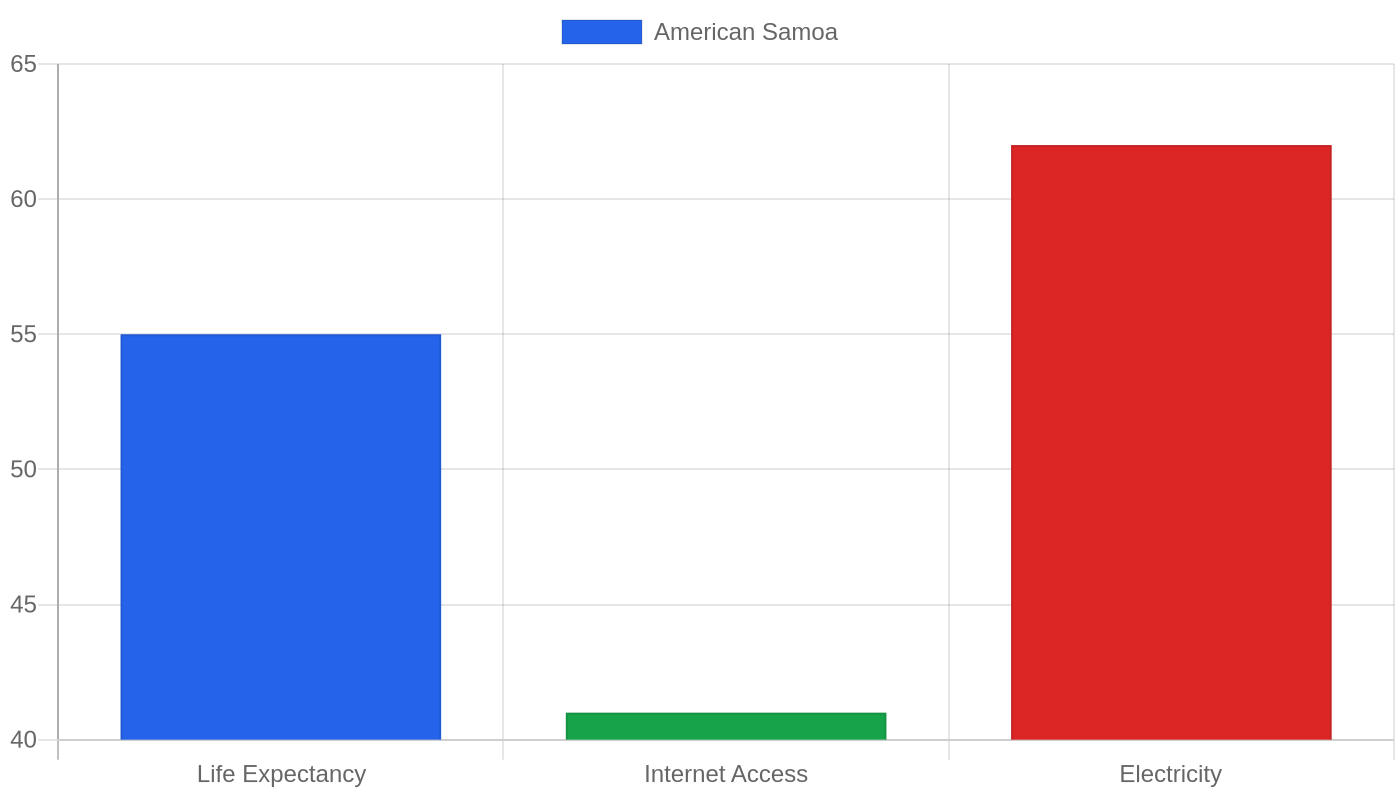
Data Gaps: Comprehensive economic indicators such as GDP growth, inflation rates, unemployment figures, and population statistics are currently listed as not available (N/A) by major data providers like the World Bank.
Historical Governance Shifts: Authority was delegated from the President to the Secretary of the Interior via Executive Order 10264 in 1951, leading to the establishment of local administrative roles such as the Secretary of Samoan Affairs.
Indigenous Leadership Milestones: The political landscape features significant milestones in indigenous representation, notably the swearing-in of Paramount Chief Tuli Leʻiato as the first Secretary of Samoan Affairs in 1963.
Investment Caution: Due to the absence of recent cost-of-living indices, top company listings, and crime safety metrics, potential investors and residents must rely on historical structural frameworks rather than current real-time market data.
Structural Foundations of Governance
The economic and social fabric of American Samoa is deeply intertwined with its complex political history. Unlike other territories, it holds the status of an unincorporated territory under U.S. law, a classification that dictates its relationship with federal authorities. The foundational shift occurred with the Ratification Act of 1929, which explicitly vested all civil, judicial, and military powers in the President of the United States.
This centralization of power was later streamlined in 1951 when President Harry Truman issued Executive Order 10264, delegating this authority to the Secretary of the Interior. This delegation marked a pivotal moment in administrative history, allowing for more localized management of territorial affairs while maintaining federal oversight.
The evolution of local governance continued with the installation of the first Secretary of Samoan Affairs on June 21, 1963. Sworn in by Governor H. Rex Lee, Paramount Chief Tuli Leʻiato of Fagaʻituwa represented a significant step toward integrating traditional chiefly leadership into the modern administrative framework. Further developments occurred on June 2, 1967, when Interior Secretary Stewart Udal played a role in subsequent administrative adjustments.
These historical precedents establish a unique blend of federal authority and indigenous tradition that continues to shape the territory’s operational environment today. Understanding this lineage is crucial for anyone assessing the regulatory or policy risks associated with long-term engagement in the region.
Economic Indicators and Industrial Landscape
When examining the macroeconomic health of American Samoa, one encounters a significant void in current statistical reporting. According to the latest data from the World Bank, critical metrics including GDP growth, inflation CPI, unemployment rates, total GDP in USD, GDP per capita based on purchasing power parity (PPP), and Gross National Income (GNI) per capita are all listed as not available. Furthermore, the current population figure is also absent from these primary datasets.
This lack of quantifiable data presents a substantial challenge for analysts attempting to model economic trajectories or compare the territory against regional peers. Without concrete numbers, it is impossible to determine whether the economy is expanding, contracting, or stagnating in real terms.
The main industries driving the local economy are similarly undefined in the provided dataset, leaving the specific sectors contributing to livelihoods unclear. Similarly, the top companies operating within the territory are not listed, obscuring the corporate landscape and potential employers. In the absence of hard data, observers must look to the structural dependencies implied by the territory’s status.
The economy likely relies heavily on external transfers, subsistence activities, and niche service sectors, but without specific industry classifications, these remain speculative. Investors and researchers are thus forced to navigate a landscape defined by what is missing rather than what is present, requiring a cautious approach to any financial forecasting or market entry strategies.
Cost of Living and Daily Expenses
Assessing the affordability of life in American Samoa requires navigating a complete absence of consumer price data. The cost of living index is not provided, nor are there details regarding housing costs, rental markets, or the balance between renting versus buying property. Consequently, it is impossible to calculate daily expenses for food, utilities, transportation, or healthcare.
Without these figures, comparing the cost of living to regional averages or global benchmarks becomes a theoretical exercise rather than a practical analysis. Residents and expatriates cannot gauge their purchasing power relative to income levels because both variables lack definitive measurement in the current records.
This data vacuum extends to safety and security metrics as well. The Crime Index and Safety Index are both reported as not available, meaning there is no quantitative measure of personal security or community stability. For individuals considering relocation or business expansion, the inability to assess the risk profile of the environment adds a layer of uncertainty.
Typically, cost of living analyses would include insights into housing affordability and utility prices, but here, those details are entirely omitted. As a result, the narrative around quality of life must be constructed around qualitative factors and historical context rather than current financial realities. Prospective residents must rely on anecdotal evidence or older reports, as the immediate financial picture remains obscured by the lack of updated statistical inputs.
Investment Climate and Business Environment
The business environment in American Samoa is characterized by a lack of contemporary corporate and industrial data. With no information on top companies, it is difficult to identify key market players, dominant sectors, or potential partners for joint ventures. The main industries section provides no insight into which sectors are most robust or emerging, leaving the investment landscape shrouded in ambiguity.
For foreign entities looking to enter the market, the absence of clear industrial leaders makes due diligence significantly more challenging. There is no visibility into supply chains, local manufacturing capabilities, or service-oriented strengths that typically guide investment decisions.
Furthermore, the political stability derived from the territory’s unique legal status offers a predictable framework, yet the economic outcomes of this stability are unknown. The historical precedence of strong federal ties suggests a certain level of infrastructural support, but without GDP or employment data, the tangible benefits of this relationship are unquantified. Businesses must proceed with caution, recognizing that the standard metrics used to evaluate market size and growth potential are unavailable.
The investment climate appears stable in terms of governance continuity but volatile in terms of economic transparency. Stakeholders should monitor future data releases from the World Bank and local government bodies to fill these critical informational gaps before committing significant resources.
Current Affairs and Future Outlook
The most pressing aspect of the current situation in American Samoa is the ongoing need for updated economic intelligence. While the historical political milestones provide a clear timeline of governance evolution, they do not reflect the immediate economic pulse of the territory. Recent news and live indicators do not offer new reforms, election results, or policy shifts that would alter the current static data landscape.
Instead, the focus remains on understanding the legacy structures established in the mid-20th century. The lack of fresh data suggests that either reporting mechanisms are delayed or the territory does not prioritize high-frequency economic publishing.
For observers, the “current” narrative is one of waiting and monitoring. The absence of new crime indices or safety updates means that security perceptions have not been recently recalibrated. Similarly, the lack of inflation or unemployment data implies that these issues are not being tracked with the same rigor as larger economies. This silence from statistical agencies creates a blind spot for international stakeholders.
To gain clarity, interested parties must await the next release of World Bank data or seek direct communication with local administrative offices. Until then, the story of American Samoa is one of historical resilience and structural uniqueness, rather than dynamic economic change.
The Bottom Line
American Samoa presents a fascinating case study in governance and history, but a challenging one for data-driven economic analysis. The territory’s unique status as an unincorporated U.S. territory with deep roots in indigenous leadership provides a stable political backdrop, yet the lack of current GDP, inflation, and industry data limits its appeal for short-term investment.
Readers and investors should watch this country primarily for insights into how small, insular territories manage their relationship with larger federal powers. However, until comprehensive economic metrics become available, the territory remains an opaque market best approached with extreme caution and reliance on qualitative historical knowledge rather than quantitative forecasts.
Sources & Methodology
This article is authored by Economic Pulse Net for informational and research purposes. Economic Pulse Net sources its data from multilateral institutions, national statistics bureaus, and proprietary databases. All data is believed to be current as of the date of publication.
Published: October 02, 2026 | Category: Research — American Samoa
Use these signals in your own platform
Economic Pulse publishes its live signal feed through a documented, read-only API. Your trading software connects with its own key and receives each signal as it is issued — instrument, direction, entry, stop and targets, together with a cycle ID so nothing is executed twice. The feed is independent of this website and cannot change it.
Signals are informational only and are not financial advice.