Economic Pulse Net | Sources: World Bank World Development Indicators, Government Sources | 2026
Key Takeaways
* Constitutional Evolution: Tuvalu enacted a new Constitution in September 2023, which came into force on October 1, establishing itself as the supreme law of the land with robust protections for fundamental rights.
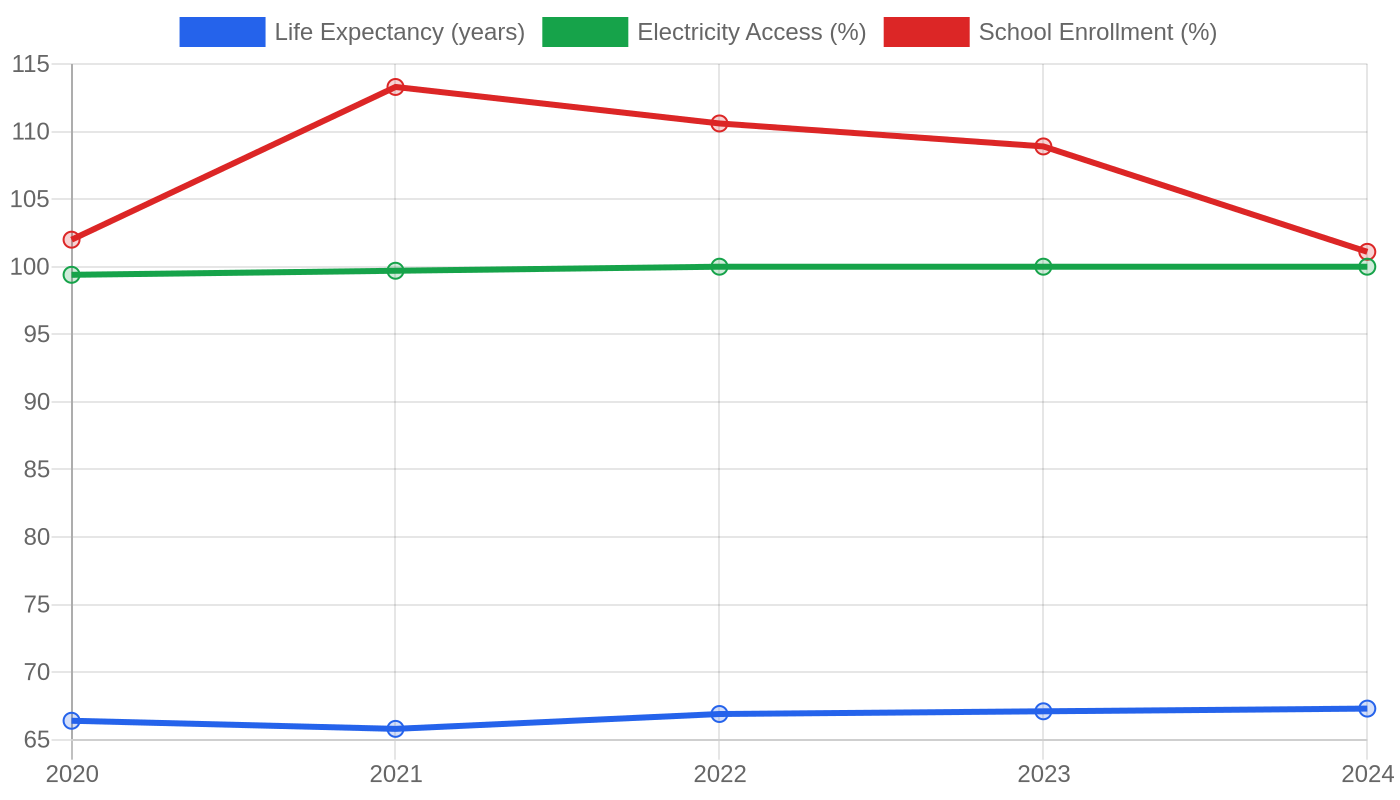
Data Transparency Gap: Official macroeconomic indicators such as GDP growth, inflation rates, and unemployment figures are currently listed as N/A by the World Bank, highlighting a significant gap in standardized economic reporting for the nation.
Legal Framework Focus: The political landscape is defined by a recent legislative shift toward codifying the Bill of Rights and protecting fundamental freedoms, rather than immediate industrial expansion metrics.
Limited Commercial Visibility: Specific data regarding major top companies, detailed cost-of-living indices, and crime safety scores are not available in current datasets, suggesting an economy that operates largely outside traditional global commercial tracking.
The Legal Foundation of Governance
The most significant development in Tuvalu’s recent history is not measured in currency or cargo tonnage, but in parchment and parliamentary procedure. On 5 September 2023, the nation’s parliament passed the Constitution of Tuvalu Act 2023, marking a pivotal moment in the country’s legal evolution. This legislation did not merely tweak existing statutes; it fundamentally restructured the hierarchy of law within the archipelago.
According to the text of the Act, the Constitution is explicitly declared to be “the supreme law of Tuvalu,” a designation that carries profound implications for all subsequent judicial and administrative actions. Furthermore, the Act mandates that “all other laws shall be interpreted and applied subject to this Constitution,” ensuring that no statutory provision can override the foundational principles laid out in the document.
These changes officially came into effect on 1 October 2023, shifting the operational reality of governance from the previous legal framework to this newly empowered structure. The inclusion of the Principles of the Bill of Rights and the Protection of the Fundamental Rights and Freedoms signals a deliberate move to anchor the nation’s identity in human rights and civic liberties.
For observers of Pacific governance, this represents a consolidation of internal sovereignty and a clarification of the rule of law, even as broader economic metrics remain obscured.
The Invisible Economy
When attempting to assess the health of Tuvalu’s economy through standard lenses, one encounters a wall of silence. The World Bank’s latest data lists GDP growth, inflation CPI, unemployment rates, total GDP in USD, GDP per capita (PPP), GNI per capita, and population all as “N/A.” This absence of data is not necessarily indicative of economic stagnation, but rather reflects the challenges of measuring a micro-economy that may rely heavily on subsistence activities, informal trade, and external aid flows that do not always fit neatly into standard Gross Domestic Product calculations.
Without concrete figures on inflation or unemployment, traditional economic analysis becomes speculative. However, the lack of reported GDP growth does not imply a lack of activity; it suggests that the primary economic engines—likely centered around fishing licenses, remittances, and tourism—are either too small to register on global scales or are managed through bilateral agreements that bypass standard national accounting methods.
For investors and analysts, this data void requires a shift in perspective: success in Tuvalu cannot be measured by quarterly earnings reports or consumer price indexes, but rather by resilience against climate change and the stability of international partnerships. The “invisible” nature of these transactions underscores the unique character of the nation’s economic reality, where survival and sustainability often take precedence over measurable market expansion.
Business Environment and Daily Life
In the absence of data on top companies, housing costs, or general crime indices, the business and social landscape of Tuvalu must be understood through its structural limitations and community focus. With no listed Crime Index or Safety Index, it is difficult to apply comparative risk models used for larger economies, though small island states often benefit from tight-knit community structures that naturally regulate social behavior.
The lack of specific information on daily expenses or rent versus buy scenarios indicates that the local market may operate on barter systems, family-supported living arrangements, or subsidized housing models that are not captured by commercial real estate databases. Similarly, the non-reporting of major corporate entities suggests that the private sector is likely composed of small enterprises, cooperatives, or state-owned utilities rather than large multinational corporations.
This environment prioritizes communal well-being over individual wealth accumulation, creating a business climate where relationships and reputation outweigh formal credit histories or capital investment scales. For those navigating this space, understanding the social fabric is more critical than analyzing balance sheets, as economic participation is deeply intertwined with social cohesion and mutual support networks.
Current Affairs and Political Momentum
The freshest and most tangible developments in Tuvalu right now are centered on the implementation of the new constitutional order. Following the passage of the Constitution of Tuvalu Act 2023, the immediate focus of the government has shifted to the practical application of these new legal standards. The effective date of 1 October 2023 marks the beginning of a new era where the protection of fundamental rights and freedoms is legally enforceable at the highest level.
This political momentum is crucial for maintaining national unity and providing a clear framework for dispute resolution in a nation facing existential threats from climate change. While there are no recent reports of election cycles or sudden policy shifts in the economic sphere, the consolidation of the legal system provides a stable backdrop for future negotiations with international partners.
The emphasis on the supremacy of the Constitution ensures that any future economic or environmental policies will be vetted against human rights standards, adding a layer of accountability to governance. As Tuvalu continues to advocate for global climate action, this strengthened internal legal framework serves as a testament to its democratic resilience and commitment to self-determination.
The Bottom Line
Tuvalu presents a case study in governance over growth, where legal stability and human rights protections are the primary metrics of progress. Investors and policymakers should watch this country not for high-yield opportunities, but as a bellwether for climate diplomacy and small-state sovereignty. The lack of conventional economic data means that engagement must be based on partnership and humanitarian considerations rather than pure financial return.
Ultimately, Tuvalu’s story is one of preserving identity and rights in the face of overwhelming external pressures.
Sources & Methodology
This article is authored by Economic Pulse Net for informational and research purposes. Economic Pulse Net sources its data from multilateral institutions, national statistics bureaus, and proprietary databases. All data is believed to be current as of the date of publication.
Published: October 08, 2026 | Category: Research — Tuvalu
Use these signals in your own platform
Economic Pulse publishes its live signal feed through a documented, read-only API. Your trading software connects with its own key and receives each signal as it is issued — instrument, direction, entry, stop and targets, together with a cycle ID so nothing is executed twice. The feed is independent of this website and cannot change it.
Signals are informational only and are not financial advice.