Economic Pulse Net | Sources: World Bank World Development Indicators, Government Sources | 2026
Key Takeaways
– Mexico’s economy grew by a razor-thin 0.56% in 2025, according to the World Bank, signaling a near-stall that raises questions about the country’s long-term growth model.
– Inflation remains sticky at 3.81%, above the central bank’s comfort zone, squeezing household purchasing power despite a remarkably low **2.67% unemployment rate**.
– The country boasts a $1.83 trillion economy and a GDP per capita (PPP) of **$25,868**, but a GNI per capita of just **$13,730** reveals deep income inequality and a massive informal sector.
– Mexico’s corporate landscape is dominated by América Móvil in telecoms and **ALFA** in conglomerates, but the list of top companies is heavy on aviation and basic materials—sectors vulnerable to global shocks.
– The political system remains stable under a federal presidential republic framework, but the combination of sluggish growth and persistent inflation creates a delicate balancing act for policymakers.
The Growth Conundrum — When Near-Zero Is the New Normal
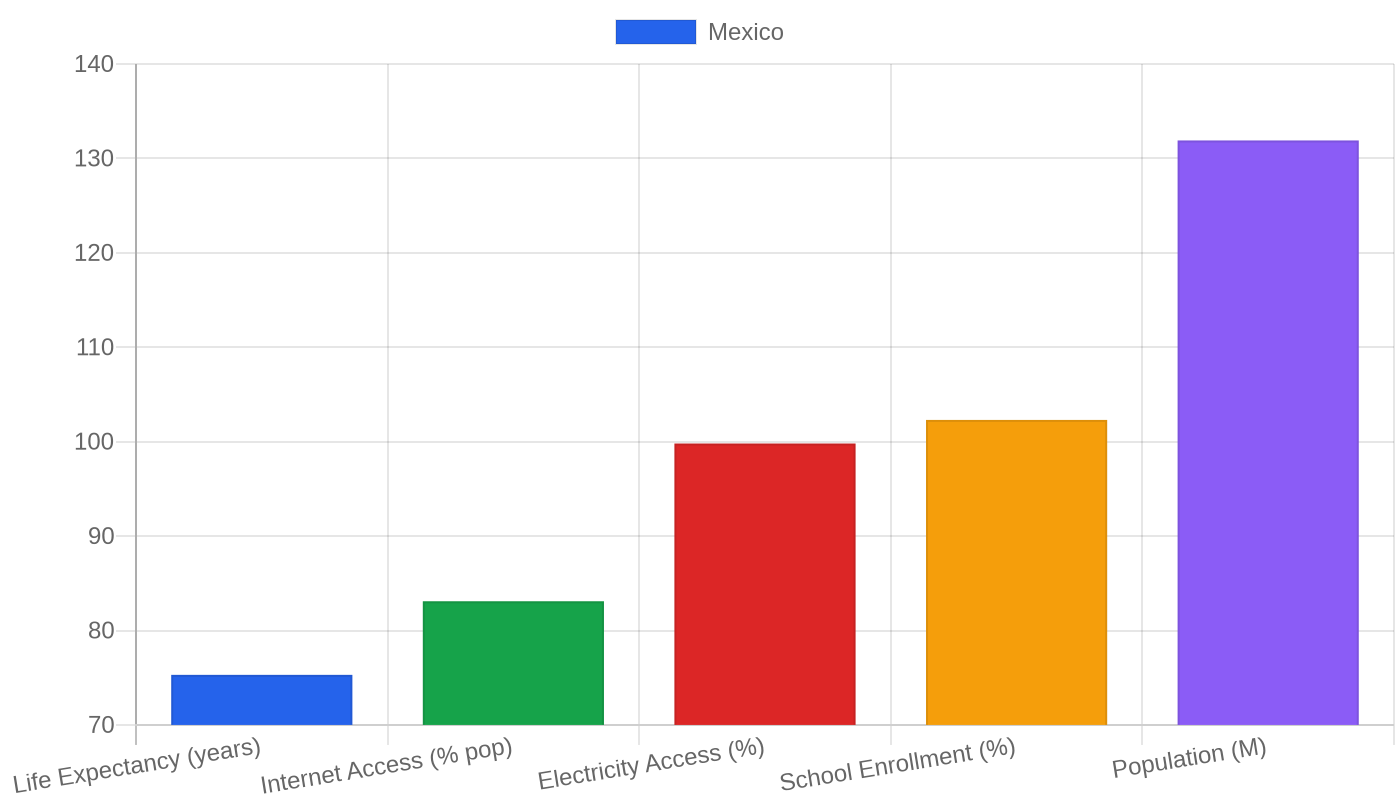
Mexico’s economy is sending mixed signals that would perplex even seasoned analysts. The World Bank reports GDP growth of just 0.56% for 2025—a number so low it borders on stagnation. For a nation of nearly **132 million people**, this pace is insufficient to generate the jobs and opportunities needed for a young, growing population.
The headline figure masks a deeper structural problem: Mexico has been grappling with productivity stagnation for years, and this latest data point suggests the trend is far from over.
Inflation, meanwhile, stands at 3.81%, according to the same source. That is above the Bank of Mexico’s target range, meaning the central bank cannot afford to cut interest rates aggressively to stimulate growth. The central bank finds itself in a policy trap: loosen monetary policy to boost the economy, and inflation could accelerate; keep rates high, and growth remains anemic. This is the classic “stagflation lite” scenario that keeps economists awake at night.
The unemployment rate of 2.67% is, on the surface, a stunning achievement. Most developed economies would envy such a low figure. But here lies the paradox: Mexico’s labor market is notoriously informal. The World Bank data does not capture the millions of Mexicans working in unregistered businesses, street vending, domestic work, and day labor. A low unemployment rate in this context often means people are taking whatever work they can find—not that they have found stable, well-paying jobs.
The GDP per capita of **$25,868** (PPP-adjusted) suggests a middle-income country, but the GNI per capita of just **$13,730** tells a different story: a significant portion of economic output flows to capital owners and foreign investors, not to the average Mexican worker.
The $1.83 trillion economy is heavily reliant on manufacturing, oil, and remittances. The World Bank data does not break down sectoral contributions, but the list of top companies offers clues. **ALFA**, a conglomerate with interests in petrochemicals and food packaging, and **Alpek**, an oil and gas firm, underscore the economy’s exposure to global commodity prices. **América Móvil**, the telecommunications giant, reflects a services sector that has grown but remains concentrated.
The bottom line: Mexico is not growing fast enough to reduce poverty meaningfully, and inflation is eating into whatever gains workers manage to secure.
The Hidden Cost of Living — When Statistics Don’t Match Reality
The World Bank data does not provide specific cost-of-living figures for Mexico, but the macroeconomic numbers paint a clear picture of household strain. With inflation at 3.81%, the purchasing power of the Mexican peso is eroding steadily. For a family earning the median income, this means higher prices for tortillas, transportation, rent, and utilities—items that consume a disproportionate share of household budgets in developing economies.
Housing costs in Mexico’s major cities have become a flashpoint. While the data does not provide exact figures, the combination of low GDP growth and persistent inflation suggests that rent is rising faster than wages. In Mexico City, Guadalajara, and Monterrey, middle-class families are increasingly priced out of desirable neighborhoods. The low unemployment rate might mask the reality that many workers hold multiple jobs just to cover basic expenses.
The gap between GDP per capita and GNI per capita—a difference of more than $12,000—indicates that the benefits of economic activity are not trickling down evenly.
Daily expenses for staples like food and fuel are particularly sensitive to inflation. Mexico imports a significant portion of its grain and energy, meaning global price shocks transmit directly to local markets. The 3.81% CPI figure is an average; for low-income households that spend a larger share of income on food and transport, the effective inflation rate is likely higher.
The cost of living in Mexico is not uniformly high—rural areas remain cheaper—but urbanization trends mean more people are competing for housing and services in expensive metro areas.
Investment and Business Climate — Giants, Gaps, and Glimmers
Mexico’s corporate landscape is dominated by a handful of heavyweight players. América Móvil, controlled by billionaire Carlos Slim, is the undisputed leader in telecommunications, serving hundreds of millions of customers across Latin America. **ALFA** and **Alpek** represent the industrial backbone, with interests in petrochemicals, food, and packaging.
The aviation sector is unusually prominent: **Aeroméxico**, **Aeroméxico Connect**, **Aeromexpress**, and **AeroUnion** all rank among the top companies, reflecting Mexico’s role as a travel hub and its dependence on tourism.
The World Bank data does not provide a detailed breakdown of business climate indicators, but the concentration of top companies in consumer services, industrials, and basic materials suggests an economy that is still heavily reliant on traditional sectors. There is no major technology company in the top ten—no Mexican equivalent of a Silicon Valley giant.
This is a vulnerability: the global economy is shifting toward digital services and green energy, and Mexico risks being left behind if it cannot foster innovation in these areas.
For investors, the 0.56% growth rate is a red flag. A near-stagnant economy offers limited opportunities for revenue growth, especially in domestic-oriented sectors. However, Mexico’s manufacturing base, particularly in automotive and electronics, remains attractive for export-oriented investment. The country’s network of trade agreements and its proximity to major markets are structural advantages that no amount of domestic stagnation can erase.
The challenge for businesses is navigating a regulatory environment that, while stable under the federal presidential system, can be bureaucratic and unpredictable at the state and municipal levels.
Safety, Politics, and Quality of Life — Stability Amid Uncertainty
The World Bank data does not provide a crime index or safety index for Mexico, and it would be irresponsible to invent figures. What can be said is that Mexico’s political system is clearly defined: the United Mexican States operates as a **federation with a representative, democratic, and republican government based on a presidential system under the 1917 Constitution**.
The three levels of government—federal, state, and municipal—provide a framework for checks and balances, though implementation varies widely across the country.
Quality of life in Mexico is a study in contrasts. The GDP per capita of $25,868 (PPP) places the country in the upper-middle-income bracket globally, but the **GNI per capita of $13,730** reveals that much of this wealth is concentrated. A family living in a wealthy neighborhood of Mexico City enjoys access to world-class healthcare, education, and entertainment. A family in a rural village in Chiapas or Oaxaca may lack reliable electricity, clean water, and paved roads.
The political system provides stability at the national level, but local governance can be inconsistent, affecting everything from public safety to infrastructure maintenance.
The absence of crime data in the provided information means this article cannot make specific claims about safety. However, the broader economic context suggests that persistent poverty and inequality are underlying stressors that affect social cohesion. A country growing at 0.56% is not generating enough opportunities to lift all boats, and that reality has consequences for public trust, migration patterns, and political stability.
Current Affairs — The 2025 Squeeze
This is the moment when Mexico’s economic contradictions are most acute. The 0.56% growth rate for 2025, as reported by the World Bank, is not a blip—it is the result of structural headwinds that have been building for years. The **3.81% inflation rate** means the central bank cannot ease monetary policy without risking a price spiral. The **2.67% unemployment rate** looks enviable, but only if you ignore the millions of Mexicans working informally, without benefits, job security, or legal protections.
The ALFA and **Alpek** conglomerates are navigating a global environment of volatile oil prices and shifting supply chains. **América Móvil** faces regulatory pressures and competition in its core markets. The aviation sector, represented by **Aeroméxico** and its affiliates, is still recovering from the pandemic’s devastation of global travel. None of these dynamics are unique to Mexico, but they compound the domestic challenge of low growth.
Politically, the federal system provides continuity, but the slow growth rate creates pressure for policy changes. The government faces a difficult choice: pursue structural reforms to boost productivity—which could be politically painful—or maintain the status quo and hope that external factors, like nearshoring or higher oil prices, provide a tailwind. The data suggests that hope is not a strategy. With growth barely above zero, Mexico needs a new economic narrative, and it needs one fast.
The Bottom Line
Mexico in 2025 is a country of stark contradictions: low unemployment but high informality, political stability but economic stagnation, a large economy but deep inequality. The World Bank data shows a nation that is not in crisis but is not thriving either. Investors should watch Mexico for its manufacturing and export potential, but they should be cautious about domestic demand. Policymakers need to confront the reality that **0.56% growth** is not enough to improve living standards for **132 million people**.
Mexico is not failing, but it is not succeeding—and in the global economy, standing still is the same as falling behind.
Sources & Methodology
This article is authored by Economic Pulse Net for informational and research purposes. Economic Pulse Net sources its data from multilateral institutions, national statistics bureaus, and proprietary databases. All data is believed to be current as of the date of publication.
Published: July 20, 2026 | Category: Research — Mexico
Use these signals in your own platform
Economic Pulse publishes its live signal feed through a documented, read-only API. Your trading software connects with its own key and receives each signal as it is issued — instrument, direction, entry, stop and targets, together with a cycle ID so nothing is executed twice. The feed is independent of this website and cannot change it.
Signals are informational only and are not financial advice.