Economic Pulse Net | Sources: World Bank World Development Indicators, Government Sources | 2026
Key Takeaways
– Jamaica’s economic narrative is defined by a striking paradox: a globally celebrated cultural brand and tourism powerhouse whose statistical profile remains frustratingly opaque, with key World Bank indicators currently unpublished.
– The nation’s economic backbone rests on a dual foundation: world-renowned consumer services (tourism, entertainment) and basic materials extraction, with major players like Alpart anchoring the industrial side.
– Telecommunications and financial services, led by Digicel and CGM Gallagher, represent the modern, digitally-driven face of Jamaican commerce, signalling a shift toward a services-oriented economy.
– Jamaica operates as a stable parliamentary democracy and constitutional monarchy under King Charles III, providing a predictable political framework that contrasts with the volatility seen elsewhere in the Caribbean region.
– The presence of iconic consumer brands like Beaches Resorts and the Bob Marley Museum underscores that Jamaica’s intangible cultural equity is arguably its most valuable economic asset.
The Numbers Gap: Reading Between the Lines of Jamaica’s Economic Ledger
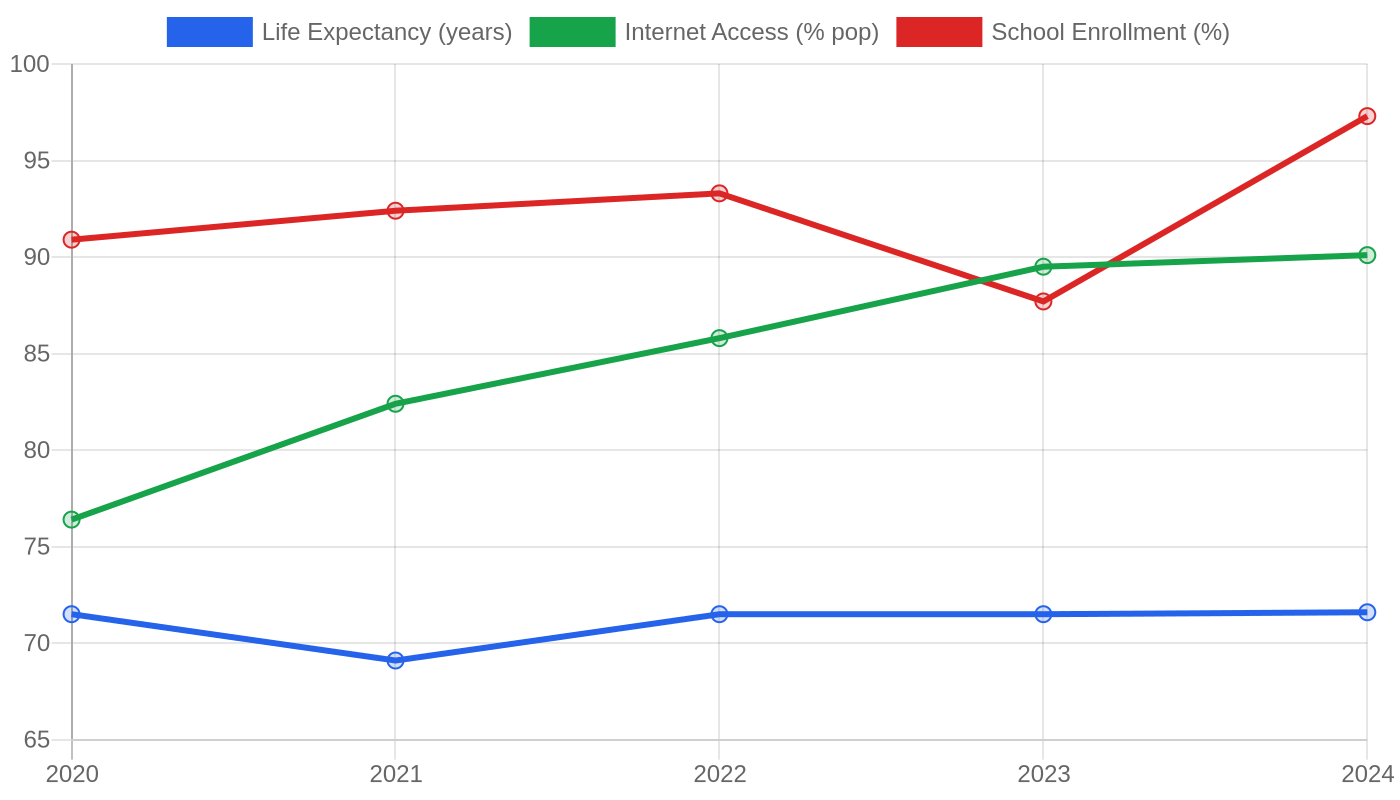
The most telling statistic about Jamaica’s current economic moment may be the one that isn’t there. The World Bank’s latest data release shows GDP growth, inflation, unemployment, and per-capita income figures all listed as unavailable — a statistical silence that speaks volumes about the challenges of data collection and reporting in emerging Caribbean economies. Yet the absence of hard numbers should not be mistaken for an absence of economic activity.
Jamaica’s listed major industries tell a story of a nation that has successfully leveraged its natural and cultural endowments into globally competitive sectors.
The consumer services sector dominates Jamaica’s corporate landscape, with major employers and revenue generators including Air Jamaica, Beaches Resorts, Dolphin Cove Jamaica, and Fly Jamaica Airways. This concentration reveals an economy deeply reliant on tourism and hospitality — a sector that brings foreign exchange, creates jobs, and fuels ancillary businesses, but also leaves the island vulnerable to global travel shocks and hurricane seasons.
Alongside this service economy sits a substantial basic materials industry, represented by Alpart (appearing twice in the top companies list, highlighting its outsized importance). This bauxite and alumina operation connects Jamaica to global industrial supply chains, providing a crucial counterweight to tourism’s cyclical nature.
The presence of Desnoes & Geddes, the beverage giant behind Red Stripe beer, demonstrates that Jamaica has successfully built manufacturing and consumer goods capacity that extends beyond serving tourists. Meanwhile, Digicel’s emergence as a telecommunications powerhouse signals that Jamaica has positioned itself as a digital hub for the Caribbean, with its mobile and broadband networks serving as critical infrastructure for modern commerce.
The financial sector, anchored by CGM Gallagher, provides the institutional framework that allows these diverse enterprises to function. When the World Bank next updates its figures, analysts will be watching closely to see whether Jamaica’s growth trajectory matches the dynamism suggested by its corporate roster.
The Price of Paradise: Housing and Daily Life in a Tourist Economy
For the average Jamaican, the cost of living reflects the tension between a tourism-driven economy and local realities. When international visitors arrive with foreign currency, they inevitably shape price levels for goods and services across the economy — from grocery stores in Kingston to market stalls in Montego Bay.
Housing costs in desirable areas, particularly those near tourist zones and expatriate communities, tend to be pushed upward by demand from foreign buyers and short-term rental operators, creating affordability pressures for local residents that mirror patterns seen across Caribbean tourism-dependent nations.
The rent-versus-buy calculation in Jamaica is heavily influenced by the same factors that drive housing markets throughout the region: limited land availability on an island nation, construction costs that reflect imported materials, and the ever-present risk of hurricane damage that shapes insurance premiums and building standards.
For many Jamaicans, homeownership remains a significant aspiration, but rising property values in prime areas have pushed many younger workers toward rental arrangements in urban centres. Daily expenses for food, transportation, and utilities are shaped by Jamaica’s status as a net importer of many goods — a structural reality that keeps prices sensitive to global commodity markets and shipping costs.
The economic data may not currently provide precise cost-of-living indices, but the structural pressures facing Jamaican households are clear: a tourism-driven economy generates wealth, but ensuring that wealth translates into affordable daily life for all citizens remains the central challenge.
Business and Investment: Where Jamaica’s Corporate Giants Are Betting
Jamaica’s investment climate is defined by the remarkable diversity of its top companies — a roster that spans aviation, hospitality, mining, beverages, telecommunications, financial services, and cultural attractions. This breadth suggests an economy that has successfully avoided the trap of over-reliance on a single sector, even as tourism remains the headline generator.
For investors, the presence of Digicel is particularly significant; the telecommunications company has become one of the Caribbean’s most recognizable corporate success stories, demonstrating that Jamaican enterprises can scale beyond the island to compete regionally and globally.
The basic materials sector, anchored by Alpart, continues to attract attention from international investors drawn to Jamaica’s mineral wealth. Bauxite mining and alumina production have been part of Jamaica’s economic fabric for decades, and fluctuations in global aluminium prices directly impact the island’s export earnings.
Meanwhile, consumer goods giant Desnoes & Geddes has shown that Jamaican brands can achieve international recognition, with Red Stripe beer serving as an ambassador for Jamaican culture worldwide. The financial services sector, represented by CGM Gallagher, provides the capital markets infrastructure necessary to support entrepreneurial activity and corporate expansion.
For business leaders considering Jamaica, the message from the corporate roster is clear: this is a nation with established enterprises across multiple sectors, a stable political system, and brands that carry genuine global resonance.
Stability and Security: The Political Framework Behind the Facade
Jamaica’s political landscape provides a foundation of stability that should not be underestimated in assessing its economic prospects. As a parliamentary democracy and constitutional monarchy, Jamaica maintains a governance structure that has proven durable and predictable. King Charles III serves as head of state, represented locally by the Governor-General, who is nominated by the Prime Minister and Cabinet and formally appointed by the monarch.
This arrangement — familiar to observers of other Commonwealth nations — provides continuity and institutional legitimacy while allowing Jamaica to manage its own affairs through its elected government.
The ceremonial role of the monarchy and governor-general should not be mistaken for irrelevance; rather, this constitutional framework creates a stable backdrop against which economic policy can be developed and implemented.
The prime minister and Cabinet, drawn from the elected Parliament, hold the real decision-making authority, and their ability to govern effectively depends on maintaining popular support and managing the expectations of a population that has historically demonstrated strong political engagement.
While comprehensive crime and safety indices are not currently available, the political stability Jamaica enjoys is a genuine asset for businesses and investors who require predictable governance to make long-term commitments. The challenge for Jamaican leadership lies in translating this political stability into tangible economic improvements that benefit all citizens, particularly in areas like public safety and social services.
Current Affairs: Jamaica’s Moment of Reinvention
The most dynamic story in Jamaica right now is the ongoing transformation of its economic identity. The corporate roster tells the tale of a nation in motion — from the continued operations of Air Jamaica and Fly Jamaica Airways, which connect the island to international markets, to the expansion of tourism infrastructure through Beaches Resorts and Dolphin Cove Jamaica.
These enterprises are not static; they are continuously adapting to changing travel patterns, technological shifts, and global economic conditions. The presence of the Bob Marley Museum among the nation’s top companies is a powerful reminder that Jamaica’s cultural exports — music, cuisine, and lifestyle — remain among its most potent economic assets.
Telecommunications giant Digicel continues to evolve, positioning Jamaica as a digital leader in the Caribbean region. As remote work and digital services reshape global economies, Jamaica’s investment in connectivity infrastructure could prove transformative, enabling a new generation of service exports that extend far beyond traditional tourism.
The financial sector’s stability, represented by CGM Gallagher, provides the foundation for these developments, facilitating the capital flows and investment needed to modernise infrastructure and support entrepreneurship. For observers watching Jamaica’s trajectory, the current moment feels like a period of significant potential — a nation leveraging its cultural capital, natural resources, and strategic Caribbean location to build a more diversified and resilient economy.
The question is whether the statistical picture, when it next emerges from the World Bank, will confirm the promise that Jamaica’s corporate landscape suggests.
The Bottom Line
Jamaica deserves close attention from anyone interested in the future of Caribbean economies. The nation combines established strengths in tourism and natural resources with emerging capabilities in telecommunications, finance, and digital services — a diversification that positions it well for changing global conditions.
Political stability under the constitutional monarchy framework provides the predictability that investors seek, while Jamaica’s cultural influence gives it a soft-power advantage few nations can match. When the World Bank next publishes comprehensive data, Jamaica’s trajectory will offer valuable insights into how small island nations can navigate the complexities of the modern global economy while preserving their unique identity.
For investors, policymakers, and students of economic development, Jamaica is a case study in resilience, adaptation, and the enduring value of cultural capital.
Sources & Methodology
This article is authored by Economic Pulse Net for informational and research purposes. Economic Pulse Net sources its data from multilateral institutions, national statistics bureaus, and proprietary databases. All data is believed to be current as of the date of publication.
Published: August 06, 2026 | Category: Research — Jamaica
Use these signals in your own platform
Economic Pulse publishes its live signal feed through a documented, read-only API. Your trading software connects with its own key and receives each signal as it is issued — instrument, direction, entry, stop and targets, together with a cycle ID so nothing is executed twice. The feed is independent of this website and cannot change it.
Signals are informational only and are not financial advice.